
Mind map
Uncontrollable factors
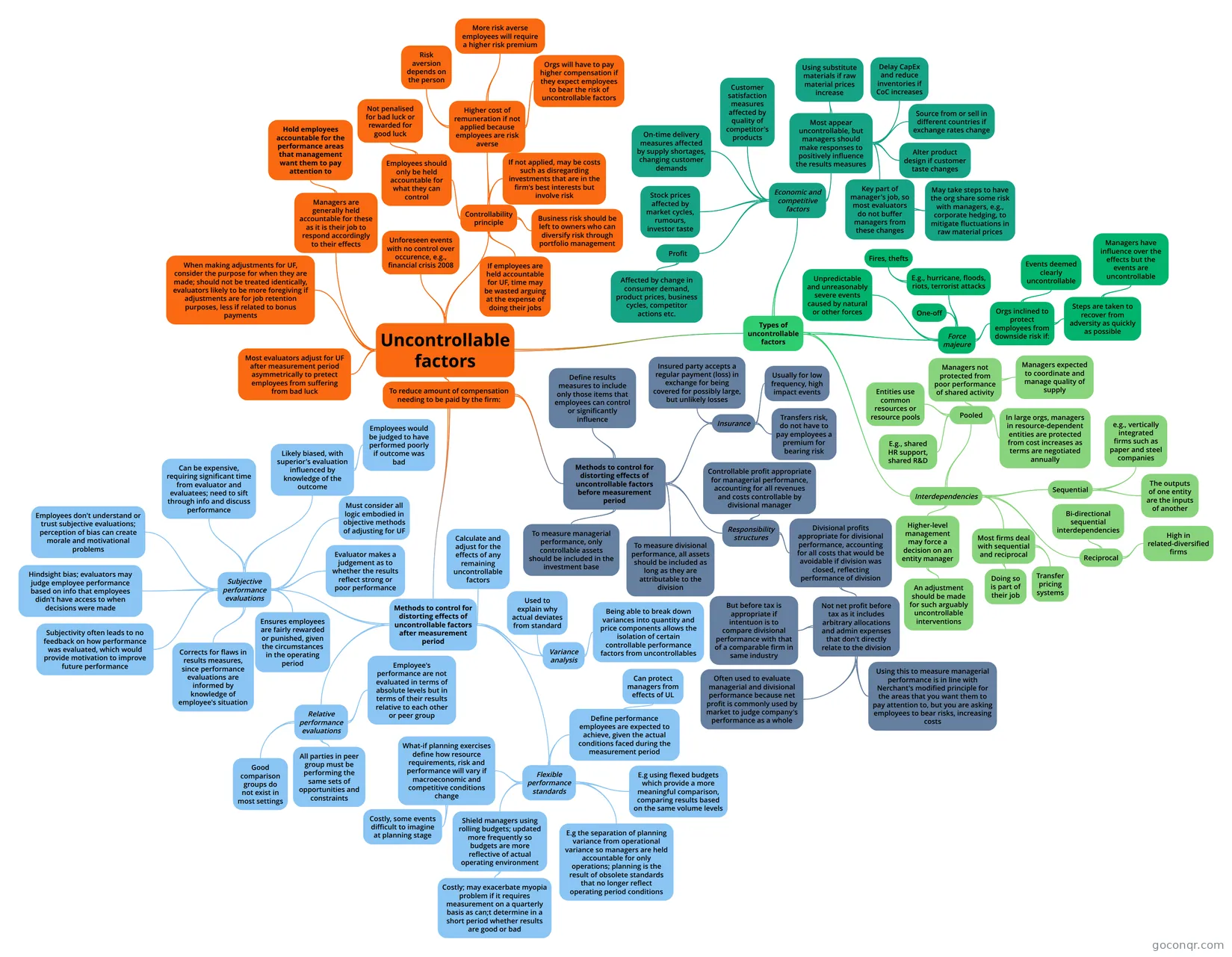
Mind map: Uncontrollable factors
Map content
Uncontrollable factors
Unforeseen events with no control over occurence, e.g., financial crisis 2008
Controllability principle
- Employees should only be held accountable for what they can control
- Not penalised for bad luck or rewarded for good luck
- Higher cost of remuneration if not applied because employees are risk averse
- More risk averse employees will require a higher risk premium
- Orgs will have to pay higher compensation if they expect employees to bear the risk of uncontrollable factors
- Risk aversion depends on the person
- If not applied, may be costs such as disregarding investments that are in the firm's best interests but involve risk
- If employees are held accountable for UF, time may be wasted arguing at the expense of doing their jobs
- Business risk should be left to owners who can diversify risk through portfolio management
- Employees should only be held accountable for what they can control
Types of uncontrollable factors
- Economic and competitive factors
- Profit
- Affected by change in consumer demand, product prices, business cycles, competitor actions etc.
- Stock prices affected by market cycles, rumours, investor taste
- On-time delivery measures affected by supply shortages, changing customer demands
- Customer satisfaction measures affected by quality of competitor's products
- Most appear uncontrollable, but managers should make responses to positively influence the results measures
- Using substitute materials if raw material prices increase
- Delay CapEx and reduce inventories if CoC increases
- Source from or sell in different countries if exchange rates change
- Alter product design if customer taste changes
- Key part of manager's job, so most evaluators do not buffer managers from these changes
- May take steps to have the org share some risk with managers, e.g., corporate hedging, to mitigate fluctuations in raw material prices
- Profit
- Force majeure
- Unpredictable and unreasonably severe events caused by natural or other forces
- One-off
- E.g., hurricane, floods, riots, terrorist attacks
- Fires, thefts
- Orgs inclined to protect employees from downside risk if:
- Events deemed clearly uncontrollable
- Steps are taken to recover from adversity as quickly as possible
- Managers have influence over the effects but the events are uncontrollable
- Interdependencies
- Pooled
- Entities use common resources or resource pools
- E.g., shared HR support, shared R&D
- In large orgs, managers in resource-dependent entities are protected from cost increases as terms are negotiated annually
- Managers not protected from poor performance of shared activity
- Managers expected to coordinate and manage quality of supply
- Sequential
- The outputs of one entity are the inputs of another
- e.g., vertically integrated firms such as paper and steel companies
- Reciprocal
- Bi-directional sequential interdependencies
- High in related-diversified firms
- Most firms deal with sequential and reciprocal
- Transfer pricing systems
- Doing so is part of their job
- Higher-level management may force a decision on an entity manager
- An adjustment should be made for such arguably uncontrollable interventions
- Pooled
- Economic and competitive factors
Managers are generally held accountable for these as it is their job to respond accordingly to their effects
- Hold employees accountable for the performance areas that management want them to pay attention to
To reduce amount of compensation needing to be paid by the firm:
- Methods to control for distorting effects of uncontrollable factors before measurement period
- Define results measures to include only those items that employees can control or significantly influence
- Insurance
- Insured party accepts a regular payment (loss) in exchange for being covered for possibly large, but unlikely losses
- Usually for low frequency, high impact events
- Transfers risk, do not have to pay employees a premium for bearing risk
- Responsibility structures
- Controllable profit appropriate for managerial performance, accounting for all revenues and costs controllable by divisional manager
- Divisional profits appropriate for divisional performance, accounting for all costs that would be avoidable if division was closed, reflecting performance of division
- Not net profit before tax as it includes arbitrary allocations and admin expenses that don't directly relate to the division
- But before tax is appropriate if intentuon is to compare divisional performance with that of a comparable firm in same industry
- Often used to evaluate managerial and divisional performance because net profit is commonly used by market to judge company's performance as a whole
- Using this to measure managerial performance is in line with Nerchant's modified principle for the areas that you want them to pay attention to, but you are asking employees to bear risks, increasing costs
- Not net profit before tax as it includes arbitrary allocations and admin expenses that don't directly relate to the division
- To measure managerial performance, only controllable assets should be included in the investment base
- To measure divisional performance, all assets should be included as long as they are attributable to the division
- Methods to control for distorting effects of uncontrollable factors after measurement period
- Calculate and adjust for the effects of any remaining uncontrollable factors
- Variance analysis
- Used to explain why actual deviates from standard
- Being able to break down variances into quantity and price components allows the isolation of certain controllable performance factors from uncontrollables
- Flexible performance standards
- Define performance employees are expected to achieve, given the actual conditions faced during the measurement period
- Can protect managers from effects of UL
- E.g using flexed budgets which provide a more meaningful comparison, comparing results based on the same volume levels
- E.g the separation of planning variance from operational variance so managers are held accountable for only operations; planning is the result of obsolete standards that no longer reflect operating period conditions
- Shield managers using rolling budgets; updated more frequently so budgets are more reflective of actual operating environment
- Costly; may exacerbate myopia problem if it requires measurement on a quarterly basis as can;t determine in a short period whether results are good or bad
- What-if planning exercises define how resource requirements, risk and performance will vary if macroeconomic and competitive conditions change
- Costly, some events difficult to imagine at planning stage
- Define performance employees are expected to achieve, given the actual conditions faced during the measurement period
- Relative performance evaluations
- Employee's performance are not evaluated in terms of absolute levels but in terms of their results relative to each other or peer group
- All parties in peer group must be performing the same sets of opportunities and constraints
- Good comparison groups do not exist in most settings
- Subjective performance evaluations
- Must consider all logic embodied in objective methods of adjusting for UF
- Evaluator makes a judgement as to whether the results reflect strong or poor performance
- Corrects for flaws in results measures, since performance evaluations are informed by knowledge of employee's situation
- Ensures employees are fairly rewarded or punished, given the circumstances in the operating period
- Likely biased, with superior's evaluation influenced by knowledge of the outcome
- Employees would be judged to have performed poorly if outcome was bad
- Subjectivity often leads to no feedback on how performance was evaluated, which would provide motivation to improve future performance
- Hindsight bias; evaluators may judge employee performance based on info that employees didn't have access to when decisions were made
- Employees don't understand or trust subjective evaluations; perception of bias can create morale and motivational problems
- Can be expensive, requiring significant time from evaluator and evaluatees; need to sift through info and discuss performance
- Methods to control for distorting effects of uncontrollable factors before measurement period
When making adjustments for UF, consider the purpose for when they are made; should not be treated identically, evaluators likely to be more foregiving if adjustments are for job retention purposes, less if related to bonus payments
Most evaluators adjust for UF after measurement period asymmetrically to pretect employees from suffering from bad luck
Information
- Description
- Mind Map on Uncontrollable factors, created by Abbie Goffin on 08/01/2023.
- Created by
- Abbie Goffin
- Views
- 0
- Rating
More on Business Performance Measures