
Mind map
T.1.- Realism and constructivism
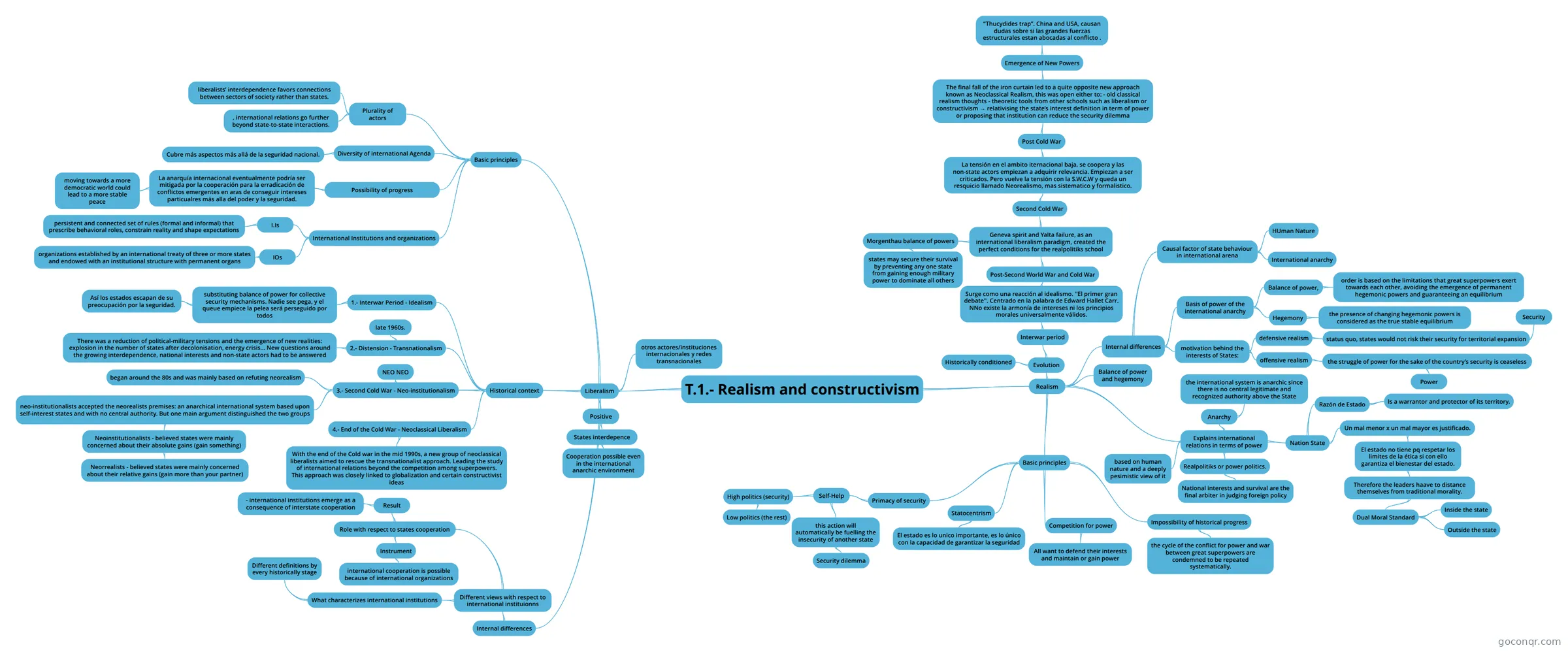
Mind map: Realism and constructivism
Map content
T.1.- Realism and constructivism
Realism
- Explains international relations in terms of power
- Realpolitiks or power politics.
- National interests and survival are the final arbiter in judging foreign policy
- Anarchy
- the international system is anarchic since there is no central legitimate and recognized authority above the State
- Nation State
- Razón de Estado
- Is a warrantor and protector of its territory.
- Un mal menor x un mal mayor es justificado.
- El estado no tiene pq respetar los limites de la ética si con ello garantiza el bienestar del estado.
- Therefore the leaders haave to distance themselves from traditional morality.
- Dual Moral Standard
- Inside the state
- Outside the state
- Dual Moral Standard
- Therefore the leaders haave to distance themselves from traditional morality.
- El estado no tiene pq respetar los limites de la ética si con ello garantiza el bienestar del estado.
- Razón de Estado
- based on human nature and a deeply pesimistic view of it
- Realpolitiks or power politics.
- Basic principles
- Primacy of security
- Self-Help
- this action will automatically be fuelling the insecurity of another state
- Security dilemma
- High politics (security)
- Low politics (the rest)
- this action will automatically be fuelling the insecurity of another state
- Self-Help
- Statocentrism
- El estado es lo unico importante, es lo único con la capacidad de garantizar la seguridad
- Competition for power
- All want to defend their interests and maintain or gain power
- Impossibility of historical progress
- the cycle of the conflict for power and war between great superpowers are condemned to be repeated systematically.
- Primacy of security
- Evolution
- Historically conditioned
- Interwar period
- Surge como una reacción al idealismo. ''El primer gran debate''. Centrado en la palabra de Edward Hallet Carr. NNo existe la armonía de intereses ni los principios morales universalmente válidos.
- Post-Second World War and Cold War
- Geneva spirit and Yalta failure, as an international liberalism paradigm, created the perfect conditions for the realpolitiks school
- Morgenthau balance of powers
- states may secure their survival by preventing any one state from gaining enough military power to dominate all others
- Second Cold War
- La tensión en el ambito iternacional baja, se coopera y las non-state actors empiezan a adquirir relevancia. Empiezan a ser criticados. Pero vuelve la tensión con la S.W.C.W y queda un resquicio llamado Neorealismo, mas sistematico y formalistico.
- Post Cold War
- The final fall of the iron curtain led to a quite opposite new approach known as Neoclassical Realism, this was open either to: - old classical realism thoughts - theoretic tools from other schools such as liberalism or constructivism → relativising the state’s interest definition in term of power or proposing that institution can reduce the security dilemma
- Emergence of New Powers
- “Thucydides trap”. China and USA, causan dudas sobre si las grandes fuerzas estructurales estan abocadas al conflicto .
- Emergence of New Powers
- The final fall of the iron curtain led to a quite opposite new approach known as Neoclassical Realism, this was open either to: - old classical realism thoughts - theoretic tools from other schools such as liberalism or constructivism → relativising the state’s interest definition in term of power or proposing that institution can reduce the security dilemma
- Post Cold War
- La tensión en el ambito iternacional baja, se coopera y las non-state actors empiezan a adquirir relevancia. Empiezan a ser criticados. Pero vuelve la tensión con la S.W.C.W y queda un resquicio llamado Neorealismo, mas sistematico y formalistico.
- Morgenthau balance of powers
- Geneva spirit and Yalta failure, as an international liberalism paradigm, created the perfect conditions for the realpolitiks school
- Post-Second World War and Cold War
- Surge como una reacción al idealismo. ''El primer gran debate''. Centrado en la palabra de Edward Hallet Carr. NNo existe la armonía de intereses ni los principios morales universalmente válidos.
- Internal differences
- Causal factor of state behaviour in international arena
- HUman Nature
- International anarchy
- Basis of power of the international anarchy
- Balance of power,
- order is based on the limitations that great superpowers exert towards each other, avoiding the emergence of permanent hegemonic powers and guaranteeing an equilibrium
- Hegemony
- the presence of changing hegemonic powers is considered as the true stable equilibrium
- Balance of power,
- motivation behind the interests of States:
- defensive realism
- status quo, states would not risk their security for territorial expansion
- Security
- status quo, states would not risk their security for territorial expansion
- offensive realism
- the struggle of power for the sake of the country’s security is ceaseless
- Power
- the struggle of power for the sake of the country’s security is ceaseless
- defensive realism
- Causal factor of state behaviour in international arena
- Balance of power and hegemony
- Explains international relations in terms of power
Liberalism
- Positive
- States interdepence
- Cooperation possible even in the international anarchic environment
- States interdepence
- Basic principles
- Plurality of actors
- liberalists’ interdependence favors connections between sectors of society rather than states.
- , international relations go further beyond state-to-state interactions.
- Diversity of international Agenda
- Cubre más aspectos más allá de la seguridad nacional.
- Possibility of progress
- La anarquía internacional eventualmente podría ser mitigada por la cooperación para la erradicación de conflictos emergentes en aras de conseguir intereses particualres más alla del poder y la seguridad.
- moving towards a more democratic world could lead to a more stable peace
- La anarquía internacional eventualmente podría ser mitigada por la cooperación para la erradicación de conflictos emergentes en aras de conseguir intereses particualres más alla del poder y la seguridad.
- International Institutions and organizations
- I.Is
- persistent and connected set of rules (formal and informal) that prescribe behavioral roles, constrain reality and shape expectations
- IOs
- organizations established by an international treaty of three or more states and endowed with an institutional structure with permanent organs
- I.Is
- Plurality of actors
- Historical context
- 1.- Interwar Period - Idealism
- substituting balance of power for collective security mechanisms. Nadie see pega, y el queue empiece la pelea será perseguido por todos
- Así los estados escapan de su preocupación por la seguridad.
- substituting balance of power for collective security mechanisms. Nadie see pega, y el queue empiece la pelea será perseguido por todos
- 2.- Distension - Transnationalism
- late 1960s.
- There was a reduction of political-military tensions and the emergence of new realities: explosion in the number of states after decolonisation, energy crisis… New questions around the growing interdependence, national interests and non-state actors had to be answered
- 3.- Second Cold War - Neo-institutionalism
- began around the 80s and was mainly based on refuting neorealism
- NEO NEO
- neo-institutionalists accepted the neorealists premises: an anarchical international system based upon self-interest states and with no central authority. But one main argument distinguished the two groups
- Neoinstitutionalists - believed states were mainly concerned about their absolute gains (gain something)
- Neorrealists - believed states were mainly concerned about their relative gains (gain more than your partner)
- Neoinstitutionalists - believed states were mainly concerned about their absolute gains (gain something)
- 4.- End of the Cold War - Neoclassical Liberalism
- With the end of the Cold war in the mid 1990s, a new group of neoclassical liberalists aimed to rescue the transnationalist approach. Leading the study of international relations beyond the competition among superpowers. This approach was closely linked to globalization and certain constructivist ideas
- 1.- Interwar Period - Idealism
- Internal differences
- Different views with respect to international instituionns
- Role with respect to states cooperation
- Result
- - international institutions emerge as a consequence of interstate cooperation
- Instrument
- international cooperation is possible because of international organizations
- Result
- What characterizes international institutions
- Different definitions by every historically stage
- Role with respect to states cooperation
- Different views with respect to international instituionns
- otros actores/instituciones internacionales y redes transnacionales
- Positive
Information
- Description
- Mind Map on T.1.- Realism and constructivism, created by Luis Fernández Chacón on 11/05/2023.
- Created by
- Luis Fernández Chacón
- Views
- 0
- Rating