
Mind map
Manipulating Genomes
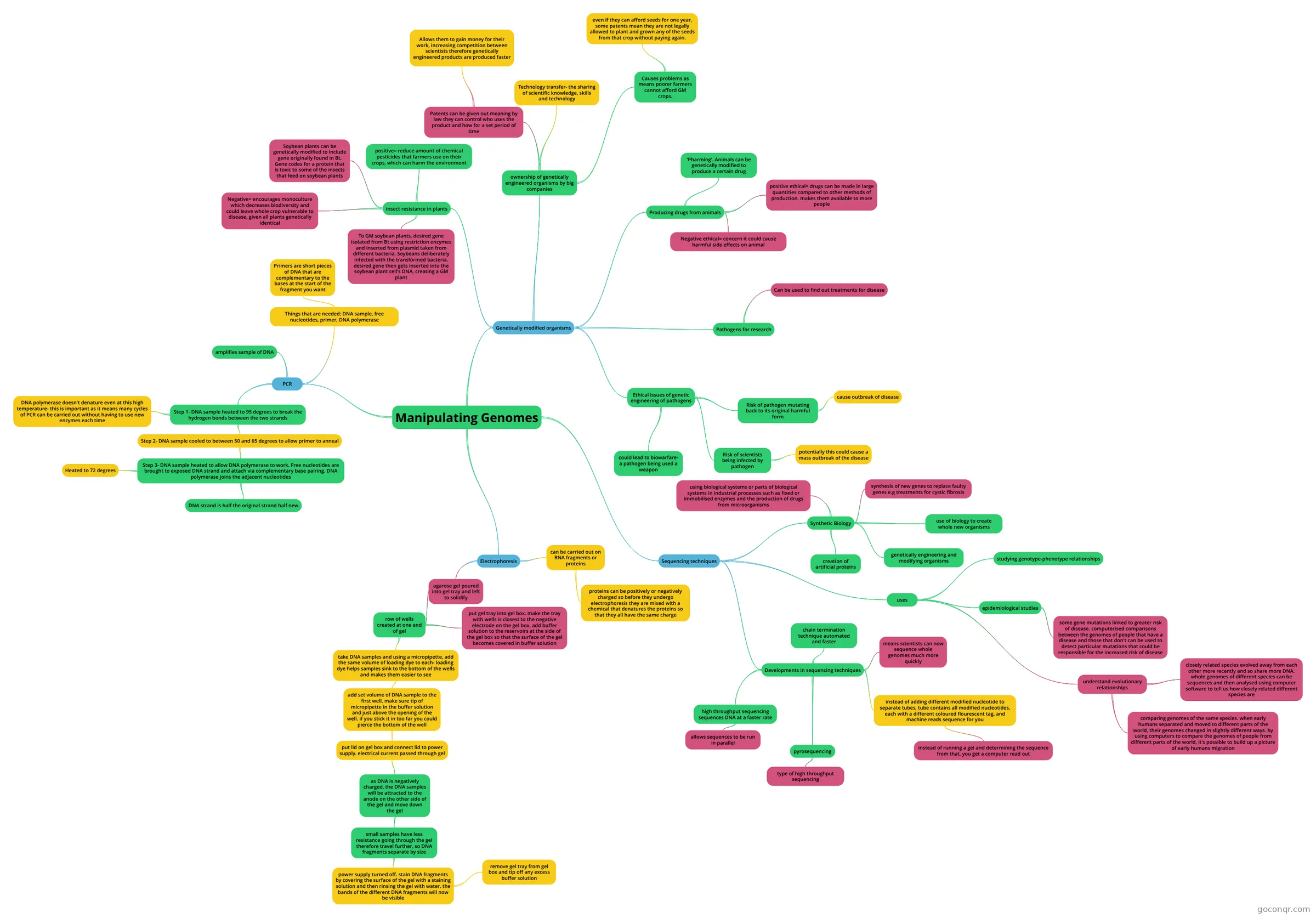
Mind map: Manipulating Genomes
Map content
Manipulating Genomes
PCR
- amplifies sample of DNA
- Step 1- DNA sample heated to 95 degrees to break the hydrogen bonds between the two strands
- Step 2- DNA sample cooled to between 50 and 65 degrees to allow primer to anneal
- Step 3- DNA sample heated to allow DNA polymerase to work. Free nucleotides are brought to exposed DNA strand and attach via complementary base pairing. DNA polymerase joins the adjacent nucleotides
- DNA strand is half the original strand half new
- Heated to 72 degrees
- Step 3- DNA sample heated to allow DNA polymerase to work. Free nucleotides are brought to exposed DNA strand and attach via complementary base pairing. DNA polymerase joins the adjacent nucleotides
- DNA polymerase doesn't denature even at this high temperature- this is important as it means many cycles of PCR can be carried out without having to use new enzymes each time
- Step 2- DNA sample cooled to between 50 and 65 degrees to allow primer to anneal
- Things that are needed: DNA sample, free nucleotides, primer, DNA polymerase
- Primers are short pieces of DNA that are complementary to the bases at the start of the fragment you want
Genetically modified organisms
- insect resistance in plants
- Soybean plants can be genetically modified to include gene originally found in Bt. Gene codes for a protein that is toxic to some of the insects that feed on soybean plants
- To GM soybean plants, desired gene isolated from Bt using restriction enzymes and inserted from plasmid taken from different bacteria. Soybeans deliberately infected with the transformed bacteria. desired gene then gets inserted into the soybean plant cell's DNA, creating a GM plant
- positive= reduce amount of chemical pesticides that farmers use on their crops, which can harm the environment
- Negative= encourages monoculture which decreases biodiversity and could leave whole crop vulnerable to disease, given all plants genetically identical
- Producing drugs from animals
- 'Pharming'. Animals can be genetically modified to produce a certain drug
- positive ethical= drugs can be made in large quantities compared to other methods of production. makes them available to more people
- Negative ethical= concern it could cause harmful side effects on animal
- Pathogens for research
- Can be used to find out treatments for disease
- Ethical issues of genetic engineering of pathogens
- could lead to biowarfare- a pathogen being used a weapon
- Risk of scientists being infected by pathogen
- potentially this could cause a mass outbreak of the disease
- Risk of pathogen mutating back to its original harmful form
- cause outbreak of disease
- ownership of genetically engineered organisms by big companies
- Patents can be given out meaning by law they can control who uses the product and how for a set period of time
- Allows them to gain money for their work, increasing competition between scientists therefore genetically engineered products are produced faster
- Causes problems as means poorer farmers cannot afford GM crops.
- even if they can afford seeds for one year, some patents mean they are not legally allowed to plant and grown any of the seeds from that crop without paying again.
- Technology transfer- the sharing of scientific knowledge, skills and technology
- Patents can be given out meaning by law they can control who uses the product and how for a set period of time
- insect resistance in plants
Electrophoresis
- can be carried out on RNA fragments or proteins
- proteins can be positively or negatively charged so before they undergo electrophoresis they are mixed with a chemical that denatures the proteins so that they all have the same charge
- agarose gel poured into gel tray and left to solidify
- row of wells created at one end of gel
- take DNA samples and using a micropipette, add the same volume of loading dye to each- loading dye helps samples sink to the bottom of the wells and makes them easier to see
- add set volume of DNA sample to the first well. make sure tip of micropipette in the buffer solution and just above the opening of the well. if you stick it in too far you could pierce the bottom of the well
- put lid on gel box and connect lid to power supply. electrical current passed through gel
- as DNA is negatively charged, the DNA samples will be attracted to the anode on the other side of the gel and move down the gel
- small samples have less resistance going through the gel therefore travel further, so DNA fragments separate by size
- power supply turned off. stain DNA fragments by covering the surface of the gel with a staining solution and then rinsing the gel with water. the bands of the different DNA fragments will now be visible
- remove gel tray from gel box and tip off any excess buffer solution
- power supply turned off. stain DNA fragments by covering the surface of the gel with a staining solution and then rinsing the gel with water. the bands of the different DNA fragments will now be visible
- small samples have less resistance going through the gel therefore travel further, so DNA fragments separate by size
- as DNA is negatively charged, the DNA samples will be attracted to the anode on the other side of the gel and move down the gel
- put lid on gel box and connect lid to power supply. electrical current passed through gel
- add set volume of DNA sample to the first well. make sure tip of micropipette in the buffer solution and just above the opening of the well. if you stick it in too far you could pierce the bottom of the well
- put gel tray into gel box. make the tray with wells is closest to the negative electrode on the gel box. add buffer solution to the reservoirs at the side of the gel box so that the surface of the gel becomes covered in buffer solution
- take DNA samples and using a micropipette, add the same volume of loading dye to each- loading dye helps samples sink to the bottom of the wells and makes them easier to see
- row of wells created at one end of gel
- can be carried out on RNA fragments or proteins
Sequencing techniques
- Synthetic Biology
- use of biology to create whole new organisms
- genetically engineering and modifying organisms
- creation of artificial proteins
- using biological systems or parts of biological systems in industrial processes such as fixed or immobilised enzymes and the production of drugs from microorganisms
- synthesis of new genes to replace faulty genes e.g treatments for cystic fibrosis
- Developments in sequencing techniques
- high throughput sequencing sequences DNA at a faster rate
- allows sequences to be run in parallel
- pyrosequencing
- type of high throughput sequencing
- instead of adding different modified nucleotide to separate tubes, tube contains all modified nucleotides, each with a different coloured flourescent tag, and machine reads sequence for you
- instead of running a gel and determining the sequence from that, you get a computer read out
- chain termination technique automated and faster
- means scientists can now sequence whole genomes much more quickly
- high throughput sequencing sequences DNA at a faster rate
- uses
- studying genotype-phenotype relationships
- epidemiological studies
- some gene mutations linked to greater risk of disease. computerised comparisons between the genomes of people that have a disease and those that don't can be used to detect particular mutations that could be responsible for the increased risk of disease
- understand evolutionary relationships
- closely related species evolved away from each other more recently and so share more DNA. whole genomes of different species can be sequences and then analysed using computer software to tell us how closely related different species are
- comparing genomes of the same species. when early humans separated and moved to different parts of the world, their genomes changed in slightly different ways. by using computers to compare the genomes of people from different parts of the world, it's possible to build up a picture of early humans migration
- Synthetic Biology
Information
- Description
- Mind Map on Manipulating Genomes, created by Maya Cruz-Mantell on 11/06/2024.
- Created by
- Maya Cruz-Mantell
- Views
- 0
- Rating