
Mind map
COORDINATION Copia
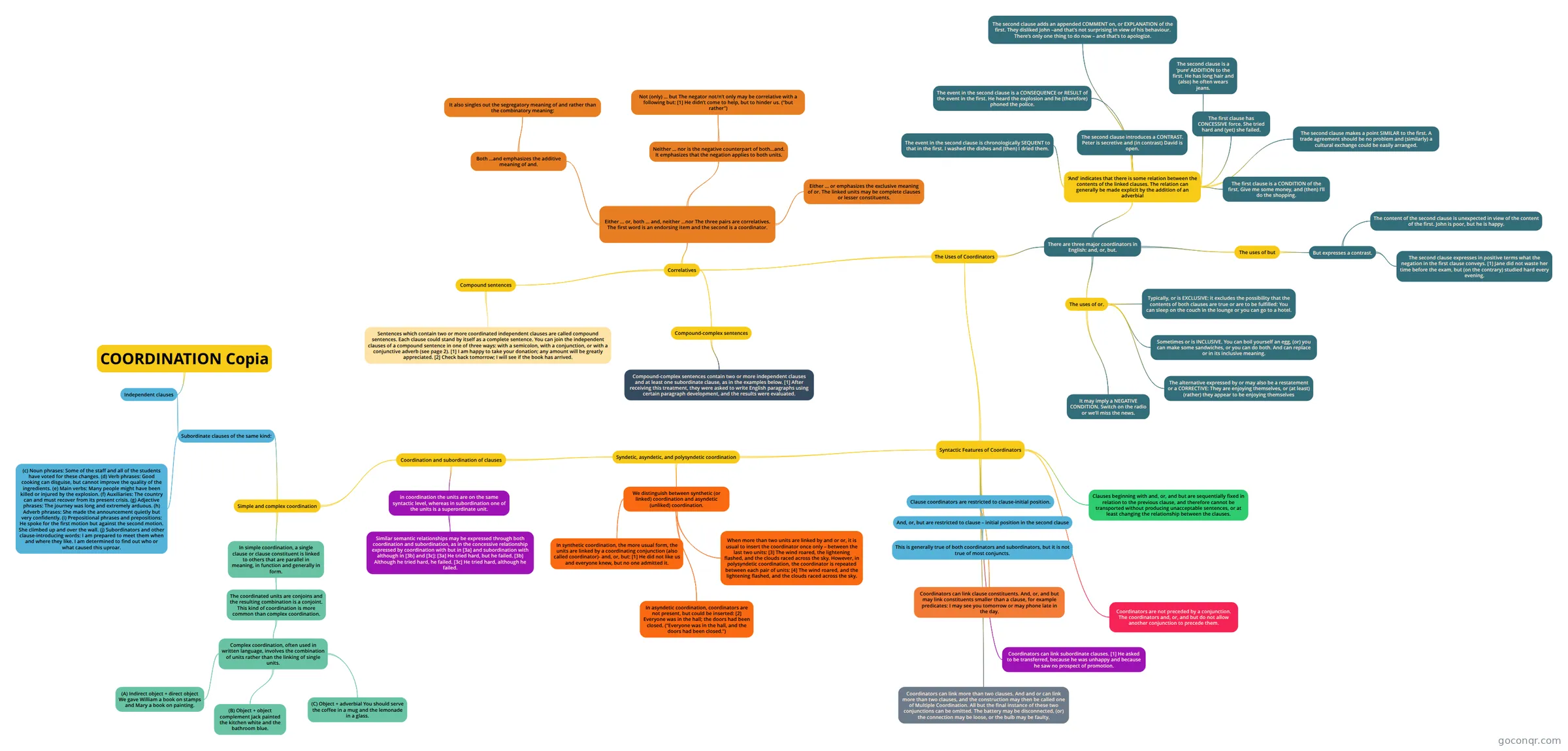
Mind map: Coordination
Map content
COORDINATION Copia
Independent clauses
- Subordinate clauses of the same kind:
- (c) Noun phrases: Some of the staff and all of the students have voted for these changes. (d) Verb phrases: Good cooking can disguise, but cannot improve the quality of the ingredients. (e) Main verbs: Many people might have been killed or injured by the explosion. (f) Auxiliaries: The country can and must recover from its present crisis. (g) Adjective phrases: The journey was long and extremely arduous. (h) Adverb phrases: She made the announcement quietly but very confidently. (i) Prepositional phrases and prepositions: He spoke for the first motion but against the second motion. She climbed up and over the wall. (j) Subordinators and other clause-introducing words: I am prepared to meet them when and where they like. I am determined to find out who or what caused this uproar.
- (c) Noun phrases: Some of the staff and all of the students have voted for these changes. (d) Verb phrases: Good cooking can disguise, but cannot improve the quality of the ingredients. (e) Main verbs: Many people might have been killed or injured by the explosion. (f) Auxiliaries: The country can and must recover from its present crisis. (g) Adjective phrases: The journey was long and extremely arduous. (h) Adverb phrases: She made the announcement quietly but very confidently. (i) Prepositional phrases and prepositions: He spoke for the first motion but against the second motion. She climbed up and over the wall. (j) Subordinators and other clause-introducing words: I am prepared to meet them when and where they like. I am determined to find out who or what caused this uproar.
- Simple and complex coordination
- In simple coordination, a single clause or clause constituent is linked to others that are parallel in meaning, in function and generally in form.
- The coordinated units are conjoins and the resulting combination is a conjoint. This kind of coordination is more common than complex coordination.
- Complex coordination, often used in written language, involves the combination of units rather than the linking of single units.
- (A) Indirect object + direct object We gave William a book on stamps and Mary a book on painting.
- (B) Object + object complement Jack painted the kitchen white and the bathroom blue.
- (C) Object + adverbial You should serve the coffee in a mug and the lemonade in a glass.
- Complex coordination, often used in written language, involves the combination of units rather than the linking of single units.
- The coordinated units are conjoins and the resulting combination is a conjoint. This kind of coordination is more common than complex coordination.
- Coordination and subordination of clauses
- in coordination the units are on the same syntactic level, whereas in subordination one of the units is a superordinate unit.
- Similar semantic relationships may be expressed through both coordination and subordination, as in the concessive relationship expressed by coordination with but in [3a] and subordination with although in [3b] and [3c]: [3a] He tried hard, but he failed. [3b] Although he tried hard, he failed. [3c] He tried hard, although he failed.
- Syndetic, asyndetic, and polysyndetic coordination
- We distinguish between synthetic (or linked) coordination and asyndetic (unliked) coordination.
- In synthetic coordination, the more usual form, the units are linked by a coordinating conjunction (also called coordinator)- and, or, but: [1] He did not like us and everyone knew, but no one admitted it.
- In asyndetic coordination, coordinators are not present, but could be inserted: [2] Everyone was in the hall; the doors had been closed. (“Everyone was in the hall, and the doors had been closed.”)
- When more than two units are linked by and or or, it is usual to insert the coordinator once only – between the last two units: [3] The wind roared, the lightening flashed, and the clouds raced across the sky. However, in polysyndetic coordination, the coordinator is repeated between each pair of units: [4] The wind roared, and the lightening flashed, and the clouds raced across the sky.
- Syntactic Features of Coordinators
- Clause coordinators are restricted to clause-initial position.
- And, or, but are restricted to clause – initial position in the second clause
- This is generally true of both coordinators and subordinators, but it is not true of most conjuncts.
- And, or, but are restricted to clause – initial position in the second clause
- Clauses beginning with and, or, and but are sequentially fixed in relation to the previous clause, and therefore cannot be transported without producing unacceptable sentences, or at least changing the relationship between the clauses.
- Coordinators are not preceded by a conjunction. The coordinators and, or, and but do not allow another conjunction to precede them.
- Coordinators can link clause constituents. And, or, and but may link constituents smaller than a clause, for example predicates: I may see you tomorrow or may phone late in the day.
- Coordinators can link subordinate clauses. [1] He asked to be transferred, because he was unhappy and because he saw no prospect of promotion.
- Coordinators can link more than two clauses. And and or can link more than two clauses, and the construction may then be called one of Multiple Coordination. All but the final instance of these two conjunctions can be omitted. The battery may be disconnected, (or) the connection may be loose, or the bulb may be faulty.
- The Uses of Coordinators
- There are three major coordinators in English: and, or, but.
- ‘And’ indicates that there is some relation between the contents of the linked clauses. The relation can generally be made explicit by the addition of an adverbial
- The event in the second clause is chronologically SEQUENT to that in the first. I washed the dishes and (then) I dried them.
- The event in the second clause is a CONSEQUENCE or RESULT of the event in the first. He heard the explosion and he (therefore) phoned the police.
- The second clause introduces a CONTRAST. Peter is secretive and (in contrast) David is open.
- The first clause has CONCESSIVE force. She tried hard and (yet) she failed.
- The first clause is a CONDITION of the first. Give me some money, and (then) I’ll do the shopping.
- The second clause makes a point SIMILAR to the first. A trade agreement should be no problem and (similarly) a cultural exchange could be easily arranged.
- The second clause is a ‘pure’ ADDITION to the first. He has long hair and (also) he often wears jeans.
- The second clause adds an appended COMMENT on, or EXPLANATION of the first. They disliked John –and that’s not surprising in view of his behaviour. There’s only one thing to do now – and that’s to apologize.
- The uses of or.
- Typically, or is EXCLUSIVE: it excludes the possibility that the contents of both clauses are true or are to be fulfilled: You can sleep on the couch in the lounge or you can go to a hotel.
- Sometimes or is INCLUSIVE. You can boil yourself an egg, (or) you can make some sandwiches, or you can do both. And can replace or in its inclusive meaning.
- The alternative expressed by or may also be a restatement or a CORRECTIVE: They are enjoying themselves, or (at least) (rather) they appear to be enjoying themselves
- It may imply a NEGATIVE CONDITION. Switch on the radio or we’ll miss the news.
- The uses of but
- But expresses a contrast.
- The content of the second clause is unexpected in view of the content of the first. John is poor, but he is happy.
- The second clause expresses in positive terms what the negation in the first clause conveys. [1] Jane did not waste her time before the exam, but (on the contrary) studied hard every evening.
- But expresses a contrast.
- ‘And’ indicates that there is some relation between the contents of the linked clauses. The relation can generally be made explicit by the addition of an adverbial
- Correlatives
- Either … or, both … and, neither …nor The three pairs are correlatives. The first word is an endorsing item and the second is a coordinator.
- Both …and emphasizes the additive meaning of and.
- It also singles out the segregatory meaning of and rather than the combinatory meaning:
- Neither … nor is the negative counterpart of both…and. It emphasizes that the negation applies to both units.
- Not (only) … but The negator not/n’t only may be correlative with a following but: [1] He didn’t come to help, but to hinder us. (“but rather”)
- Either … or emphasizes the exclusive meaning of or. The linked units may be complete clauses or lesser constituents.
- Both …and emphasizes the additive meaning of and.
- Compound sentences
- Sentences which contain two or more coordinated independent clauses are called compound sentences. Each clause could stand by itself as a complete sentence. You can join the independent clauses of a compound sentence in one of three ways: with a semicolon, with a conjunction, or with a conjunctive adverb (see page 2). [1] I am happy to take your donation; any amount will be greatly appreciated. [2] Check back tomorrow; I will see if the book has arrived.
- Compound-complex sentences
- Compound-complex sentences contain two or more independent clauses and at least one subordinate clause, as in the examples below. [1] After receiving this treatment, they were asked to write English paragraphs using certain paragraph development, and the results were evaluated.
- Either … or, both … and, neither …nor The three pairs are correlatives. The first word is an endorsing item and the second is a coordinator.
- There are three major coordinators in English: and, or, but.
- Clause coordinators are restricted to clause-initial position.
- We distinguish between synthetic (or linked) coordination and asyndetic (unliked) coordination.
- in coordination the units are on the same syntactic level, whereas in subordination one of the units is a superordinate unit.
- In simple coordination, a single clause or clause constituent is linked to others that are parallel in meaning, in function and generally in form.
- (c) Noun phrases: Some of the staff and all of the students have voted for these changes. (d) Verb phrases: Good cooking can disguise, but cannot improve the quality of the ingredients. (e) Main verbs: Many people might have been killed or injured by the explosion. (f) Auxiliaries: The country can and must recover from its present crisis. (g) Adjective phrases: The journey was long and extremely arduous. (h) Adverb phrases: She made the announcement quietly but very confidently. (i) Prepositional phrases and prepositions: He spoke for the first motion but against the second motion. She climbed up and over the wall. (j) Subordinators and other clause-introducing words: I am prepared to meet them when and where they like. I am determined to find out who or what caused this uproar.
- Subordinate clauses of the same kind:
Information
- Description
- Universitario Gramatica 2 Mind Map on COORDINATION Copia, created by Leon Gutierrez on 07/02/2026.
- Created by
- Leon Gutierrez
- Views
- 0
- History
-
- Created by Leon Gutierrez · Feb 6, 2026
- Copied by Leon Gutierrez · Feb 7, 2026
- Rating