
Mind map
Cloning and Genetic Engineering
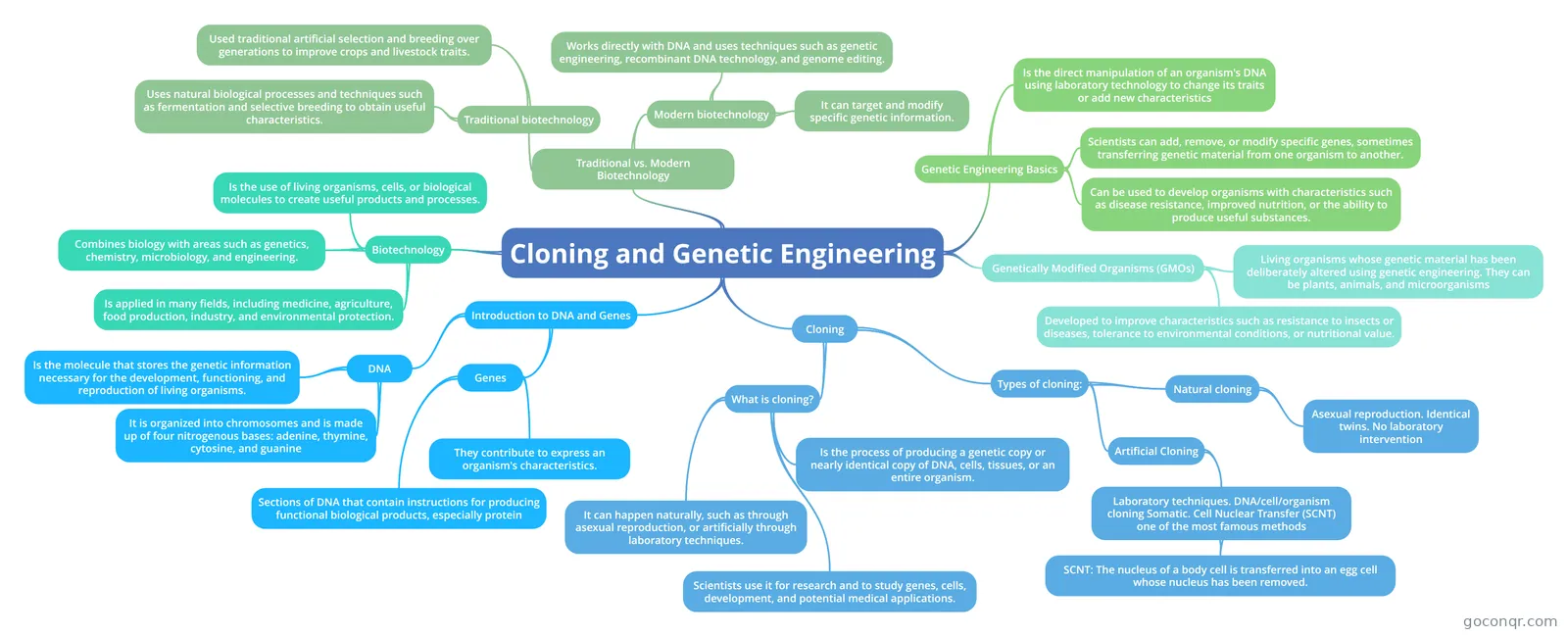
Mind map: Cloning and genetic engineering
Map content
Cloning and Genetic Engineering
Introduction to DNA and Genes
- DNA
- Is the molecule that stores the genetic information necessary for the development, functioning, and reproduction of living organisms.
- It is organized into chromosomes and is made up of four nitrogenous bases: adenine, thymine, cytosine, and guanine
- Genes
- Sections of DNA that contain instructions for producing functional biological products, especially protein
- They contribute to express an organism's characteristics.
- DNA
Biotechnology
- Is the use of living organisms, cells, or biological molecules to create useful products and processes.
- Combines biology with areas such as genetics, chemistry, microbiology, and engineering.
- Is applied in many fields, including medicine, agriculture, food production, industry, and environmental protection.
Traditional vs. Modern Biotechnology
- Traditional biotechnology
- Uses natural biological processes and techniques such as fermentation and selective breeding to obtain useful characteristics.
- Used traditional artificial selection and breeding over generations to improve crops and livestock traits.
- Modern biotechnology
- Works directly with DNA and uses techniques such as genetic engineering, recombinant DNA technology, and genome editing.
- It can target and modify specific genetic information.
- Traditional biotechnology
Genetic Engineering Basics
- Is the direct manipulation of an organism's DNA using laboratory technology to change its traits or add new characteristics
- Scientists can add, remove, or modify specific genes, sometimes transferring genetic material from one organism to another.
- Can be used to develop organisms with characteristics such as disease resistance, improved nutrition, or the ability to produce useful substances.
Genetically Modified Organisms (GMOs)
- Living organisms whose genetic material has been deliberately altered using genetic engineering. They can be plants, animals, and microorganisms
- Developed to improve characteristics such as resistance to insects or diseases, tolerance to environmental conditions, or nutritional value.
Cloning
- What is cloning?
- Is the process of producing a genetic copy or nearly identical copy of DNA, cells, tissues, or an entire organism.
- It can happen naturally, such as through asexual reproduction, or artificially through laboratory techniques.
- Scientists use it for research and to study genes, cells, development, and potential medical applications.
- Types of cloning:
- Natural cloning
- Asexual reproduction. Identical twins. No laboratory intervention
- Artificial Cloning
- Laboratory techniques. DNA/cell/organism cloning Somatic. Cell Nuclear Transfer (SCNT) one of the most famous methods
- SCNT: The nucleus of a body cell is transferred into an egg cell whose nucleus has been removed.
- Laboratory techniques. DNA/cell/organism cloning Somatic. Cell Nuclear Transfer (SCNT) one of the most famous methods
- Natural cloning
- What is cloning?
Information
- Description
- Mind Map on Cloning and Genetic Engineering, created by Mariana Torres on 18/08/2026.
- Created by
- Mariana Torres
- Views
- 0
- Rating
More on Cloning Plants and Animals