
Mind map
AC
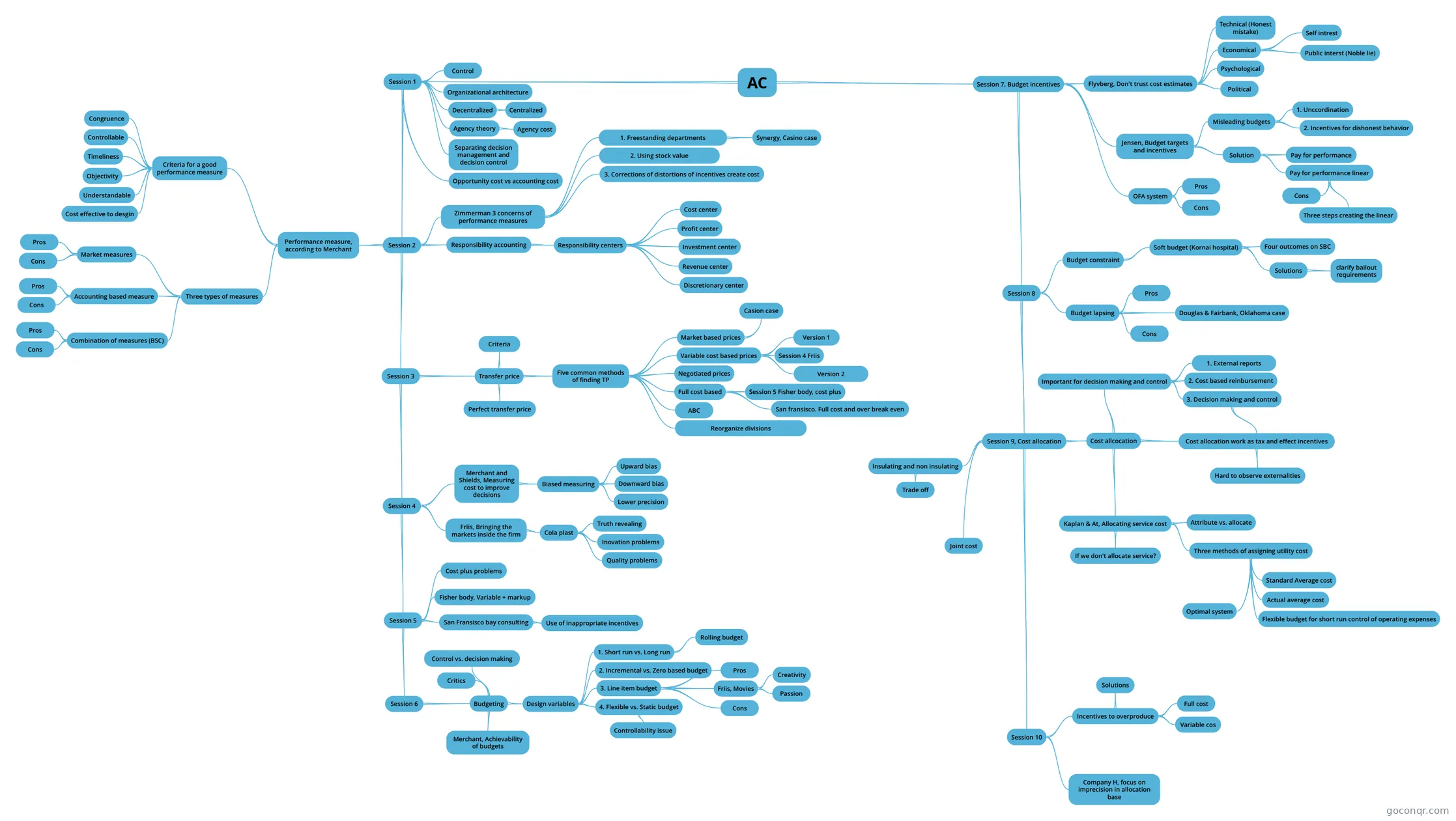
Mind map: AC
Map content
AC
Session 1
- Agency theory
- Because we allocate decision rights. A problem occurs that agents follow the own best interests which is not always the firms best interest. Because of agency theory organization need this architecture to counter act agency problem. Which does not exist in the real market. Problems with agents -Horizon problem -Free riders problem -Influence costs
- Agency cost
- The diminishing value of the firm due to agents following their own interest.
- Organizational architecture
- There is a problem with controlling behavior. And control problems are handled through the organizational architecture(O.A). We use the O.A to help us influence behavior. Because the efficient market does this so well we want to bring the market inside the firm. This does not appear by it self and needs to be created. To reduce the agency problem the architecture structure need to have a three legged system. 1) Measurement of performance 2) Reward and punish performance 3) Assign decision rights.
- Separating decision management and decision control
- Separating management from control is the best way to reduce agency problem. Management create a strategy which control (Top management) provide support and control over. This way we get the best use of local knowledge and central knowledge.
- Decentralized
- As part of three legged stool. We assign decision rights to the lower level managers. This will get better use of specific knowledge and not waste top managers time. However this is where the agency problem can arise.
- Centralized
- We centralize to reduce the agency theory. And to use top management knowledge.
- Session 2
- Performance measure, according to Merchant
- Criteria for a good performance measure
- Congruence
- Congruence points towards the coordination aspect of control. There should be a correlation between the measure and firm value. So when the manager makes the best decisions for him self it is the best decisions for the company. If a measure is not congruent it distorts incentives. Completeness: A measures is complete when it covers all the value creating tasks/ activities. There are Important trade offs Control vs. Controllability With high controlability you exclude external factors in witch you lose congruence. Bias vs. Con. If there is no opportunity of bias you have exluded all the subjective stuff.
- Controllable
- A agent should be able to control or at least influence the measure he is responsible for. Within influence there are uncontrollable factors such as taxes and bad weather. If agent is measured on uncontrollable factors he loses motivation.
- Timeliness
- Reward and action should not be to much seperated in time.
- Objectivity
- A measure should be free from manipulation since the agents being measured by this performance has incentives to mess with it. (Moral hazard, adverse selection). This goes for agent and principle. Manipulation can be reduced through proper incentive systems.
- Understandable
- Agent need to understand the measure and also know how to influence it.
- Cost effective to desgin
- It need to be cost effective. BSC is very expensive and not every company should do it.
- Congruence
- Three types of measures
- Market measures
- Market measures are based on the change in the market value of the entity and on the returns to shareholders in case dividends are also considered. Market measures are effected by what people expect to happen in the future, is that perfect?
- Pros
- They are timely, accurate, understandable
- Cons
- Market data not always available. Not objective. they can be influenced by top management. Not controlable Because based on expectation
- Accounting based measure
- They are derived from the rules set in the financial reports. These can be ratios or residual income. According to Merchant there are loads of problems using accounting based profit as a measure and using EVA is a way to fix that. Accounting measures are recordings of the past used to measure the future, it that perfect?
- Pros
- Some sort of relation to stock price flexible, can be tailored Timeliness. Understandable.
- Cons
- Not congruent. Not complete Not controllable. Influenced by external variables. (Micro economic factors) Using the profit does not tell the whole story. How much risk was taken, investments, future cash flow?
- Combination of measures (BSC)
- Common combination measures are: market and accounting measures, summary data with disaggregated data. No single measurement is perfect this tries to solve that problem by using better measurements.
- Pros
- Infinity in flexibility Understandable. Tells the managers how to improve.
- Cons
- Expensive Inefficient to use to many measurements Difficult to weight the measurement.
- Market measures
- Criteria for a good performance measure
- Responsibility accounting
- - A responsibility accounting system is a part of the performance evaluation system used to measure the operating results of the responsibility center. - Responsibility accounting seeks to identify the objectives of each part of the organization and then to develop performance measures that report the achievement of those objectives. Holding managers responsible for only those decisions for which they have authority is called
- Responsibility centers
- Profit center
- Cost center
- Investment center
- Revenue center
- Discretionary center
- Like advertisement or quality control. The cost something but you cant measure the actual output
- Session 3
- Transfer price
- Transfer pricing when goods are transferred from one profit center to another. It’s an internal price that is assigned to the units transferred between the departments. There are two main reasons for transfer pricing within firms. 1. International taxation and 2. Control, coordination and motivation. We will not discuss taxation further. In order to measure performance among responsibility centers we need transfer pricing.
- Criteria
- The criteria for transfer price is the same as for a performance measure. But congruence is the optimal transfer price for a product or service is its opportunity costs. It is the value forgone by not using the transferred product in its next best alternative.
- Perfect transfer price
- TP = Opportunity cost. Because that is the optimal usage of product, asset, service. Transfer pricing with perfect info: When opportunity cost is used to set the transfer price. Manufacturing might sell its products outside rather than to the distributing department. Manufacturing will produce to the point at which the variable cost of the last unit equals the transfer price. Both departments will maximize their profits. But if transfer price is to low or high profits are not maximized. Transfer pricing with asymmetric info The manager in the manufacturing departments has incentives to try to increase the price to the distribution department so it will gain more profits.
- Five common methods of finding TP
- Market based prices
- Casion case
- Variable cost based prices
- Session 4 Friis
- Version 2
- Variable and fixed cost are defined in the begining year in the ratification. This reduces adverse selection. Better for planing because static which causes less confusing. Created in the initation pahse and ratification Top management decieds the variable cost.
- Version 1
- Marginal cost. Academic version. Short term variable cost It get adjusted everytime. Producing devision define variable cost in the implementation phase. Margincal cost is one aditional unit and so it can be used as variable cost. Because it goes up and down it creates confusion and also based on short term. The production department determines the variabl cost. (moral hazard, classify variable cost as fixed cost)
- Negotiated prices
- Full cost based
- Cons. bad for decisions making. San fransicso case where they are trying to break even does not provide incentives to imporve.
- Session 5 Fisher body, cost plus
- San fransisco. Full cost and over break even
- ABC
- Reorganize divisions
- Create one center instead of two. But note the free riders problem
- Market based prices
- Session 4
- Merchant and Shields, Measuring cost to improve decisions
- Merchant discussed that accurate information does not always make the best decisions. And being biased on purpose can put managers focus into perspective. For example in Japan they used Direct labor as cost driver because they were focused on being more automated and wanted to see where direct labor was generating expenses.
- Biased measuring
- So there are three ways of diminishing accuracy.
- Upward bias
- Upward biased. Is calculating costs higher than true costs. Note that this can happen by not updating accounting info on a regular bases and some firms choose to do exactly that. This can reduce the effects of shaving prices coming from the sales department. They ofcourse have incentives to sell the product and will do so at the lowest possible price. This can also reduce spending on inputs.
- Downward bias
- Calculating bellow true cost. This is done to motivate more consumption on certain input. For example IT- services in a firm. This can help motivation and innovation. Because for example it can force the selling department too sell.
- Lower precision
- Calculating with less than accurate cost. For example chosing a wrong cost driver can alert managers attention to certain factors. For example the japan case.
- Friis, Bringing the markets inside the firm
- In Friis artical he discusses how to bring the market inside the firm using variable transfer price. But markets have some failures which needs to be addressed when moving the market inside. -The flow of information. Agents need incentives to give truthful and complete information. And also the commitment problem which markets have solved by having laws to build up trust. The firm needs to create it's own incentives to produce quality products. And if bad quality punish departments.
- Cola plast
- Colaplast was a manufacturing company which used standard cost system for the variable cost. Product innovation was important for them. Colaplast set up the firm so that the sales division, measured by CM, could chose which products to buy from which manufacturing departments. This made the manufacturing departments compete with eachother over the sales divisions time and attention
- Truth revealing
- Without competion. Using standard cost, manufacturing departments had incentives not price little higher then normal. This would create nice revenue and easier to achive. With competition. Manufacturing departments were fighting forcing them to reveal truth and complete information about the transfer price.
- Inovation problems
- To improve inovation which was important to cola plast. There was a 10% downward biased on new products for up to 2 years. But also force the sales division to sale new products.
- Quality problems
- With the focus on standard costing there was little incentives for quality. The firm seemed to have a hard time transitioning a product into a good (satisfies the customer). The two system in place to deal with this were error system (internal system) and complaint system. (external) If reports on bad quality department could be punished by principal and also by selling devision.
- Session 5
- Fisher body, Variable + markup
- Fisher body created a business deal with GM. GM would buy metal bodies from Fisher the next ten year and pay them actual variable cost plus 17% markup to cover overhead. However this created bad incentives form Fisher they basically got paid 17% for every worker they had. So it became a inefficent highly labor intensive manufacuturer. They also moved their plant far away from Gm because GM paid for transportation. So this cases shows how using wrong prices can create incentives to do bad things
- San Fransisco bay consulting
- In SFB consulting. They had a computer division which was a profit center. Their transfer price was full cost method. They bought slow computers because they were cheaper and had no incentives to buy fast computers (eventhough more profitable) because they were not rewarded based on risk. Their allocation base was computer speed. Which meant using Fast computer was so expensive for departments that some complained buying a new one would be cheaper than the rental fees. Solutions to these problems are f.ex. using ABC, Having a downward biased transfer price (incentives for new stuff), Creating a better cost driver and separting direct cost from indirect cost.
- Use of inappropriate incentives
- This example shows how using transfer prices that aren't very congruent etc. Can distort incentives which hurt the firm value. And go quite oppiste twoards expected goals.
- Session 6
- Budgeting
- A formal quantification of the company's operations for a given period. They are used for decision making and for control. There is a trade of between decision making and control. Because if you measure the performance of, let say the sales division, actual vs. forecast. You will create the incentives for the sales people to underforcast which will effect your ability to make decisions.
- Design variables
- Budget flaws depend on how they are desgined. Budget design can affect behavoir.
- 1. Short run vs. Long run
- A short run can get managers focus on the short run. This usually involves price and quantity. By not having a long run budget there is an horiztional problem in which manager can make profit in the short run at the expense of the long run. Long run are used for strategic planing. They are costly and get obsolete pretty quickly.
- Rolling budget
- Rolling budget connects short term budgets with long run. Because you continually update the budget. You update one month and the long run budget get one month longer. The pros of this method is update budgets where managers can react more timely. Cons. -Costs money and time -Knowing that budgets will change create lacks of diciplane. -Agents will ask for more achevable budgets. -Obsolete targets increase moral hazard.
- 2. Incremental vs. Zero based budget
- Incremental means at the begining of the year make incremental changes to the bduget. This ignores completly inafficency in the budget. Zero based budget. At the begning of the year the budget is zero and managers have to defend each line for new budgets. This will reduce inefficency. And should be used when changing a strategic direction. It is hard to justify each year.
- 3. Line item budget
- Line item budget restricts spending to a single line item.
- Friis, Movies
- The friis and hansen case talk about how line item budget can serve as a tool for managers. They discuss how it can enhance creativity and control passion. For this porpoes Friis says the line item budget work as an Advice. Suggesting how much to spend, and also Device. Causing Delays - Changes need to be approved Imposing costs- Updating and overspending causes more cost Increasing creativity
- Creativity
- Creativity is maximizing artistic value under constraints. Creativity is the ability to succedd in the endeavour
- Passion
- Passion is the rational self intrest. -It can distort our thinking -Make us ignore reason -Induce weakness of will -Make us think irrationaly
- Pros
- The pros of a line item budget -Communicates strategy -Reduces change of actions inconsistent to the firms policy (ties hands, can only spend on certain things) - Role clarity
- Cons
- Cons of line item - No incentives to save, can't use it on anything else. - Inflexible to unanticipated needs
- 4. Flexible vs. Static budget
- A static budget means the budget does not vary with changes in volume. They work fine with planing but using this method it can be hard to trace variance due to performance or due to volume changes. Flexible budget is a budget that is changes according to changes in volume. This can work as a evaluation.
- Controllability issue
- But there is a controllability issue. If manager is held responsible for variance we gain completeness/Congruency but lose controlabilty (he does not control external factors) If the manager is not held responsible for variance we lose completeness but measure the managers according to his controllability.
- Merchant, Achievability of budgets
- How achivable should budgets be?
- Control vs. decision making
- There is a trade of between decision making and control. Because if you measure the performance of, let say the sales division, actual vs. forecast. You will create the incentives for the sales people to underforcast which will effect your ability to make decisions.
- Critics
- Budgets are criticized but many find that budgets are nesecary for planing. The general critics say Budgets are: 1. Time consuming 2. Add little value 3. Rarely strategically focused 4. Updated too infrequantly 5. Inflexible for change 6. Encourage gaming and perverse behavior But as Economic Darwinism suggest because companies use budgets the cost of them must outwheight the benefits
- Budgeting
- Cost plus problems
- Many times when firms are using full cost transfer price methods (which is the most popular one) They decied to put a mark up to cover expenses. This changes full cost from a cost system to cost recovery system where each department adds on their cost to the product which will finaly enter the market over priced.
- Fisher body, Variable + markup
- Merchant and Shields, Measuring cost to improve decisions
- Transfer price
- Zimmerman 3 concerns of performance measures
- Zimmerman had concerns regarding assumptions in performance measures.
- 1. Freestanding departments
- We decentralize so we can get better use of specific knowledge. But also get rid of free rider problem. We bring market conditions into the firm and each department is freestanding. However Zimmerman does not agree with this because it ignores synergies between departments. And if there are no synergies between departments they should be a seprate company.
- Synergy, Casino case
- In Zimmerman's case he takes the casino as an example. We have three departments. Casino, Entertainment and Hotel. Gaming is most profitably, while the other two divisions are unprofitable. This calculation does not take into account synergies. We can create incentives between departments by rewarding synergy. We can measure synergy with f.ex. transfer price.
- 2. Using stock value
- The measurement with the highest correlation to stock value is not the best measurement because the stock value is based on future expectation.
- 3. Corrections of distortions of incentives create cost
- When using accounting info they sometimes need to be corrected. Zimmerman thinks the cost of these correction might exceed the benefit. He discusses four important criteria for adjustments. 1. Will it have an impact on EVA (cost effective) 2. Can the managers influence the outcome (Controllability) 3. Can operating people understand the outcome (Understandable) 4. Is the information easily tracked. (cost effective)
- Performance measure, according to Merchant
- Control
- Control can deal with agency Define: Control: Refers to the process that helps ’ensure the proper behaviors of the people in the organization. These behaviors should be consistent with the organization’s strategy. We use control to coordinate and properly motivate agents.
- Opportunity cost vs accounting cost
- Opportunity cost is based on two future alternatives. It is not easily found. Accounting cost is based on past events and can be used as a cheap proxy for opportunity cost.
- Agency theory
Session 7, Budget incentives
- Flyvberg, Don't trust cost estimates
- Flyvberg looks at public projects and finds that 9 out 10 times the budget is underestimated. If you think about it it makes sense. In order to get the project started in the first place you have incentives to underestimate costs and after the project starts you can slowly add costs in. (salami affect, add cost slice by slice) Flyberg look at four possible reasons for this underestimation
- Economical
- Economical reasons have two types. Self intrest and public interest
- Self intrest
- Self interest: Getting a project started creates jobs. If you are a stakeholder of a company for example you will gain money. This can create incentives to underestimate cost
- Public interst (Noble lie)
- Public interest. Deliberate underbiased estimate and the reason to save tax payers money because keeping cost low is more important than an accurate cost estimate. This is a dangerous deceit. It unethical and might be illegal. People should relise that the prjoect might not be economicly viable and another project could be created instead of this one. Anyway it can be a waste of tax payers money.
- Political
- Political With focus on interest and power. Again lying in the begining to get a project started. Euro tunnel was 2bn over budget. But Politication want to maximise the chance of getting a project started. Likely that the cook the cost estimates to serve political ends.
- Technical (Honest mistake)
- This excuse says an honest mistake was made in calculation due to: - Imperfect technique - Lack of data - Inexperiance in forecast Flyvberg comments on this say -How come we don't get better over time then? -How come always underestimated but never overestimated then? He belives this is a poor reason
- Psychological
- Psychological reasons. Mental biased Builders want to build and politicians may have monument complex. Flyvberg comments - How can this optimistic biased presist for 70 years And he doubts this is the main reason
- Jensen, Budget targets and incentives
- Jensen found that if budgets are used as performance evaluation and then reward and punished according to the budgets. It will make the managers get two bad incentives. 1) Give bad info for an easy budget 2) Reach the target by hurting firms value.
- Misleading budgets
- 1. Unccordination
- Uncoordintion leads to chotic actions. We will get bad quaility, high costs, missed opportunities.
- 2. Incentives for dishonest behavior
- 1. Unccordination
- Solution
- Pay for performance
- Paying for performance. If budgets are reached by 80% up to 120% the agent will get a bonus. However this can make the agent move sales between periods
- Pay for performance linear
- This is the better solution. Separating the bonus from the budget and base it on actual income instead. This way budgets are used only in planning and coordination.
- Cons
- This method has two flaws 1. It does not provide incentives to reach higher goals. 2. The linear scheme can create gaming. Achevie higher bonus by moving sales. F.ex. 10 this year 20 next is 15 ave. while 12 and 12 give 12 ave.
- Three steps creating the linear
- Creating the linear compenstaion profile it is very important to get three things right 1. The measure of performance - There are many things to consider here. a) Short time intervals increase change of moving sales between periods. b) Group performance increase risk of free rider. c) There has to be some level of subjectivity (quality) d) Don't have many performance measures. e) Don't use ratios use EVA (though not completness) 2. Intercept of the line - You do not base the next years line of previous performance this will create bad incentives. But you can have the line stay the same then no incentives for risk and improvements. So base the line on expected growth of the company. 3. Slope of the line - High risk has to be rewarded. However if a manager is risk adverse a smaller slope will reduce the risk.
- Pay for performance
- OFA system
- The OFA system is a system which rewards for accurate forecasts. O stands for objective set by the comapny, F stands for forcast set by salespersons using the objective, A stands for Actual results which is used to compare with both O and F. Horizontally F/O, The agent forcast based on the objective if F=0 then 1, if F*50% then 1,5 this marks how high is bonus can become. Vertical axis is the % number of how much of the objective did we actualy complete. When the F=A maximum compenstation. Best forcast lie diagonally
- Pros
- The pros of the OFA system is that they reward managers with accurate forcast. Managers can make better decisions based on these forcast
- Cons
- Cons there are issues with OFA. Moral hazard. Agents still have incentive to move sale between periods. If things are going badly delay them for next year. This does also not push managers for more. (The accurate the better) It also creates racthet effect you don't want the forcast or actual to be lower higher than the objective. Adverse selection Managers afraid of risk prefer lower forcast. The measure -Still no controllability - Management can't set optimal values - Itðs useful to get use of specific knowledge -Only useful if there is signifivant cost related to over and under fulfilling forcasts
- Session 8
- Session 9, Cost allocation
- Session 10
- Incentives to overproduce
- With performance evaluation focus on profits. By using absorption costing and variable costing to allocate to products we get distorted incentives to overproduce. Using variable costing can lower this but only by some degree.
- Full cost
- Absorption cost system are designed to absorb all manufacturing cost into product cost. But managers evaluvated based on profits can encrease profits by overproducing and growing inventory. Assuming sales stay constant because fixed cost get tied up in inventory thereby increasing profits.
- Variable cos
- Variable costing only uses the variable cost of the product which ignores fixed cost. However this does not solve overproducing. It only creates incentives for manager to classify fixed cost as variable cost.
- Solutions
- The solutions for overproduction is 1. Tax on inventory 2. Use another measure f.ex. RI 3. Have a low inv. policy 4. Use stock price measures 5. Use JIT 6. Change the costing system
- Company H, focus on imprecision in allocation base
- Company H, A computer company. They were using full cost approach with JIT, and overhead was assigned using DLH. Though this was a highly automated business and Labour cost was only about 10% of total cost. Using this they noticed m/o increasting alarmenly with production volume. This is because managers were so focused on reducing labor that they would make bad decisions. Regarding make or buy. They spent time and money on reducing labour by fractions. Using machines and space inafficently. They solved this problem by reducing common overhead items. Tracing cost better, making cost visable for managers.
- Incentives to overproduce
- Cost allcocation
- Cost allocation are the assignment of indirect, common or joint cost to diffirent departments or products. Cost allocation is an important part od devision making and control. They are part of the ogranizational budget and part of performance evaluation. And also affect managers decision rigths ( by reducing resources)
- Important for decision making and control
- 1. External reports
- Financial reports state that some cost have to be allocated to the product in inventory. So it is good at following the rules
- 2. Cost based reinbursement
- The revenue of public utilities such as electric and gas companies are tied to reported costs. States often grant public utilities exclusive monopolies over service territories. In return, the state regulates the rates the utility can charge customers. In many cases, the regulated prices are based on reported costs, including allocated costs. In public utility regulation, the major issue is deciding how to allocate the common costs of capacity, such as the electricity-generating plant, among the different classes of users (residential versus business customers). In many public utility rate-setting cases, cost allocation is the preeminent issue.
- 3. Decision making and control
- Cost alloocation cn affect managers incentives and behavoir. For example allocating tax on a department reduces the resources a manager has Also when dining out with friends if spliting the bill it creates incentives for overuse
- Cost allocation work as tax and effect incentives
- Cost allocation can work as a tax on externalitles. Selling department can chose to higher people and buy ads. But hiring new people cause external cost on HRM. So HRM imposes a cost allocation (tax) for each person hired and charge the selling department. This will make the manager buy more ads and higher less people. Notice that this cost allocation redeces the managers profits and affect his decisions of input factors
- Hard to observe externalities
- Cost allocation use average cost which serve as a proxy for opportunity cost.(remember accounting good for estimating opportunity) This way cost allocation can improve decisions making. However bad cost allocation destroy value. If the opportunity cost is close to zero it will hurt value to allocate.
- 1. External reports
- Kaplan & At, Allocating service cost
- Service department cost are assigned to production departments for cost control and efficiency. 1)The allocation provides incentives for efficient performance from service center. 2) Motivates production departments prudent use of service This way service managers have incentives to try to save costs and custimize service for need.
- If we don't allocate service?
- Assuming we don't allocate service 1. Over used of "free service" 2. Difficult to measure efficiency of service department 3. If we do not have a price on internal service we can't decide to outsource 4. If cost are not assigned it is hard to measure service provided and service needed.
- Attribute vs. allocate
- If possible service cost should be attributed that is cost that are directly cause by an cost object When cost canot be traced they should be allocated
- Three methods of assigning utility cost
- Standard Average cost
- SAC ex ante. We create a budget expense or calculate the rates and charge departments according to hours used. Pros. -Knowing in advance the cost of service, not effected by volume changes -Easy understandable, cost effecitve Cons -Congruency --Does not mirror opportunity cost --Can cause a death spiral -Controlability --Standard rate set by others usages --Not abvious how to blame
- Actual average cost
- Ex post. Uses actual average costs of service after they arrive. Pros cost affective, easy to understand, Cons. -It has the same congruenct problems as SAC. -Cost not controllable ex post Other departments influence price. And spending at service influence price.
- Flexible budget for short run control of operating expenses
- The solution is that each departments is charge seprately for short term variable cost and long term fixed cost. Each department is charged for actual service consumed. At the budgeted rate not the actual service rate. Short term fixed cost is based on practiacal capcity in the long run. This method seperates fixed and variable cost and long term short term This avoid deathspiral Eliminates issuses in other systems but is complex to implement
- Optimal system
- An optimal system would have the same problem as SAC and AAC but would add the users of service pay longterm costs of the service department. Which would solve the long term short term problem.
- Standard Average cost
- Insulating and non insulating
- Insulating cost allocation is a method of allocation where the performance is not affected by the performance of other deparments, High controllability Low incnetives to cooperate Non insulating is a method of allocating where performance is affected by performance of others. -Inhances cooperations, mutual monitoring -Low controllability, high congruence -Can reduce risk manager bear Reduce the reward system variability
- Trade off
- There is a trade of between controllability and congruency With insulating you get high controllability With non insulating you get high congruency
- Joint cost
- Joint cost is incurred to produce two or more outputs with the same input. Joint cost occur only is disassembly process. Allocation is meaningless because there is zero opportunity cost. We have to use Net resellable value. Which is sales mínus cost of further process. We separate joint cost which is sunk and compare NRV. If we have a negative one we skip it. Using anything other than NRV will give us a death spiral.
- Session 10
- Budget constraint
- Budget constraint- when the agent resource availability is constrained ex ante. This implies that the agent must prioritize his or her resource consumption
- Soft budget (Kornai hospital)
- Kornai articles refers to Soft budget constratints (SBC) is not an event but a mental condition in the decisions maker. He belives he will be bailed out. Becuse his service is important, monopoly postions, etc. And his actions are towards that assumptions. The problem with this symptoms is that there are so many incentives to create SBC - Patients need better costly care and will protest if closure - Doctors have ambition spend more on new stuff and will protest if closure -Managers sympathize with doctors and will protest if closure - Politicaians which cause the SBC syndrome. Can be motivated to save the hospital.
- Four outcomes on SBC
- Kornai discused four possible outcomes from SBC 1. Remain in trouble 2. Financial equilibruim restored by internal means 3. Bailout (It will countinue to be in trouble out equilibrium reached 4. Exit Statistics show in the hospital sector alot of bailout
- Solutions
- You cant be extremely hard on budgets either it will produce poor quality and ethical implications. Try to find a middle ground create moral and financial incentives. And never just bailout someone. Have an investigation, create contracts. If you bailout you enforce SBC and you will not fix the problem. Note that decentralizing and centralicing are both affected by SBC Nor does the major political party
- clarify bailout requirements
- A good method of dealing with SBC is to make a diffirence between a legitimate bailout and illiegitamate. Hospitals should be bailed out by uncontrolable factors not controllable factors. And if they can justify bailout f.ex. expensive machine is cheaper for society.
- Budget lapsing
- Budget lapsing refers to funds that are allocated for a particular year cannot be carried over to the following year.
- Pros
- -It communicates strategy ( when to use money, similar to line item) -It's tighter control over money than budgets that don't lapse. -And it prevents risk. Managers don't get to accumulate funds
- Cons
- -Inflexible in terms of responding to unanticipated needs, postpones spending -Little incentives for cost saving -Encourage wastefull year end spending
- Douglas & Fairbank, Oklahoma case
- Session 9, Cost allocation
- Flyvberg, Don't trust cost estimates
Information
- Description
- Mind Map on AC, created by Ævar Ólafsson on 03/12/2015.
- Created by
- Ævar Ólafsson
- Views
- 1
- Rating