
Mind map
B3 - Life on Earth
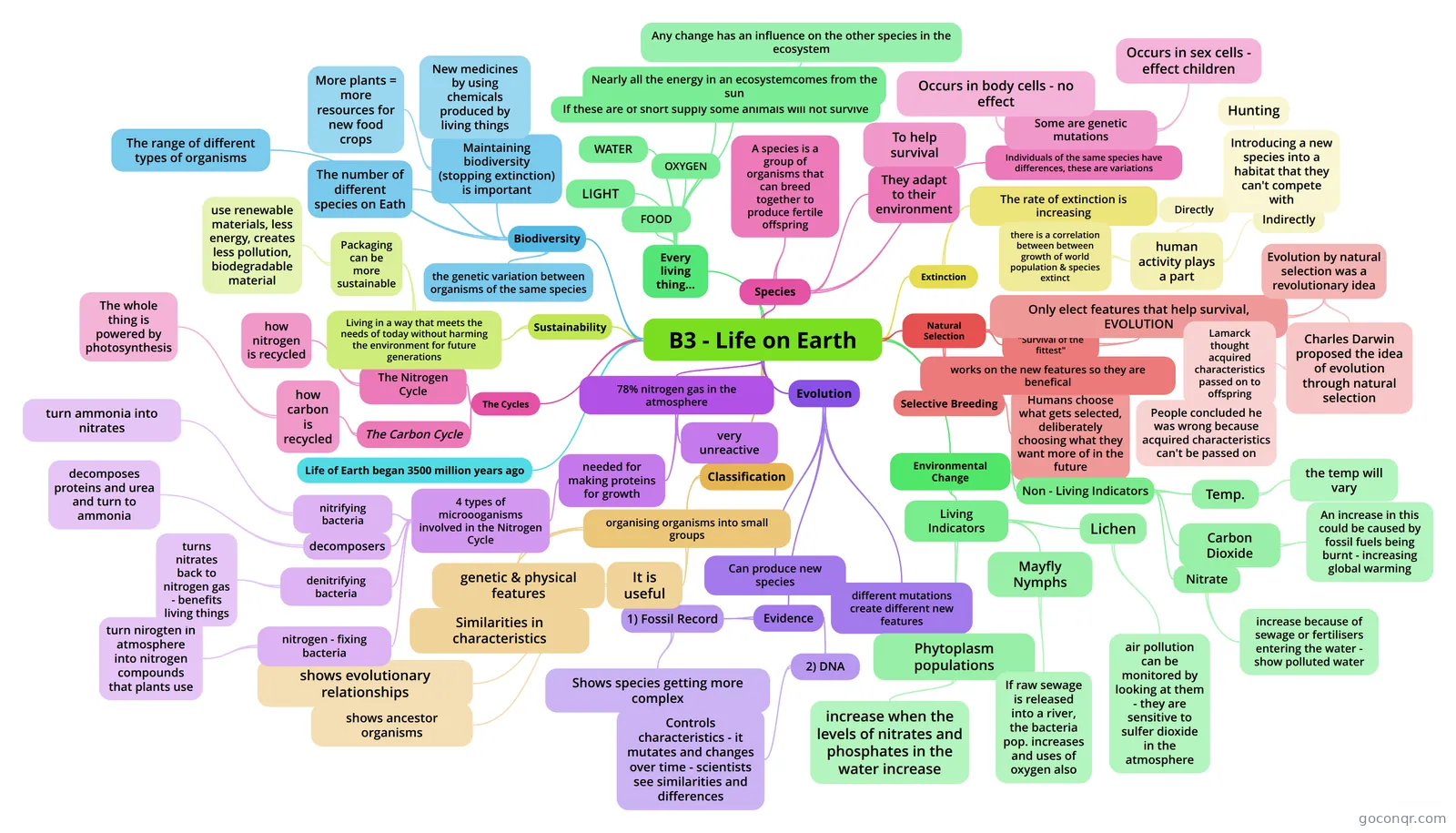
Mind map: Life on Earth
Map content
B3 - Life on Earth
Biodiversity
- The number of different species on Eath
- The range of different types of organisms
- the genetic variation between organisms of the same species
- Maintaining biodiversity (stopping extinction) is important
- More plants = more resources for new food crops
- New medicines by using chemicals produced by living things
Species
- A species is a group of organisms that can breed together to produce fertile offspring
- They adapt to their environment
- To help survival
- Individuals of the same species have differences, these are variations
- Some are genetic mutations
- Occurs in body cells - no effect
- Occurs in sex cells - effect children
- Some are genetic mutations
Evolution
- Can produce new species
- different mutations create different new features
- Evidence
- 1) Fossil Record
- Shows species getting more complex
- 2) DNA
- Controls characteristics - it mutates and changes over time - scientists see similarities and differences
- 1) Fossil Record
Natural Selection
- "Survival of the fittest"
- Only elect features that help survival, EVOLUTION
- Evolution by natural selection was a revolutionary idea
- Charles Darwin proposed the idea of evolution through natural selection
- Lamarck thought acquired characteristics passed on to offspring
- People concluded he was wrong because acquired characteristics can't be passed on
- Lamarck thought acquired characteristics passed on to offspring
- Charles Darwin proposed the idea of evolution through natural selection
- Evolution by natural selection was a revolutionary idea
- Only elect features that help survival, EVOLUTION
- Selective Breeding
- Humans choose what gets selected, deliberately choosing what they want more of in the future
- works on the new features so they are benefical
- "Survival of the fittest"
Extinction
- The rate of extinction is increasing
- there is a correlation between between growth of world population & species extinct
- human activity plays a part
- Directly
- Hunting
- Indirectly
- Introducing a new species into a habitat that they can't compete with
- Directly
- human activity plays a part
- there is a correlation between between growth of world population & species extinct
- The rate of extinction is increasing
Classification
- organising organisms into small groups
- Similarities in characteristics
- genetic & physical features
- It is useful
- shows evolutionary relationships
- shows ancestor organisms
- organising organisms into small groups
Every living thing...
- LIGHT
- FOOD
- OXYGEN
- WATER
- If these are of short supply some animals will not survive
- Any change has an influence on the other species in the ecosystem
- Nearly all the energy in an ecosystemcomes from the sun
The Cycles
- The Nitrogen Cycle
- how nitrogen is recycled
- The Carbon Cycle
- how carbon is recycled
- The whole thing is powered by photosynthesis
- how carbon is recycled
- The Nitrogen Cycle
Environmental Change
- Non - Living Indicators
- Temp.
- the temp will vary
- Nitrate
- increase because of sewage or fertilisers entering the water - show polluted water
- Carbon Dioxide
- An increase in this could be caused by fossil fuels being burnt - increasing global warming
- Temp.
- Living Indicators
- Lichen
- air pollution can be monitored by looking at them - they are sensitive to sulfer dioxide in the atmosphere
- Mayfly Nymphs
- If raw sewage is released into a river, the bacteria pop. increases and uses of oxygen also
- Phytoplasm populations
- increase when the levels of nitrates and phosphates in the water increase
- Lichen
- Non - Living Indicators
Sustainability
- Living in a way that meets the needs of today without harming the environment for future generations
- Packaging can be more sustainable
- use renewable materials, less energy, creates less pollution, biodegradable material
- Packaging can be more sustainable
- Living in a way that meets the needs of today without harming the environment for future generations
Life of Earth began 3500 million years ago
78% nitrogen gas in the atmosphere
- very unreactive
- needed for making proteins for growth
- 4 types of microooganisms involved in the Nitrogen Cycle
- decomposers
- decomposes proteins and urea and turn to ammonia
- nitrifying bacteria
- turn ammonia into nitrates
- nitrogen - fixing bacteria
- turn nirogten in atmosphere into nitrogen compounds that plants use
- denitrifying bacteria
- turns nitrates back to nitrogen gas - benefits living things
- decomposers
- 4 types of microooganisms involved in the Nitrogen Cycle
Information
- Description
- Mind Map on B3 - Life on Earth, created by littlemissmakes9 on 08/12/2013.
- Created by
- littlemissmakes9
- Views
- 14
- Rating