
Mind map
Psychodynamic approach:
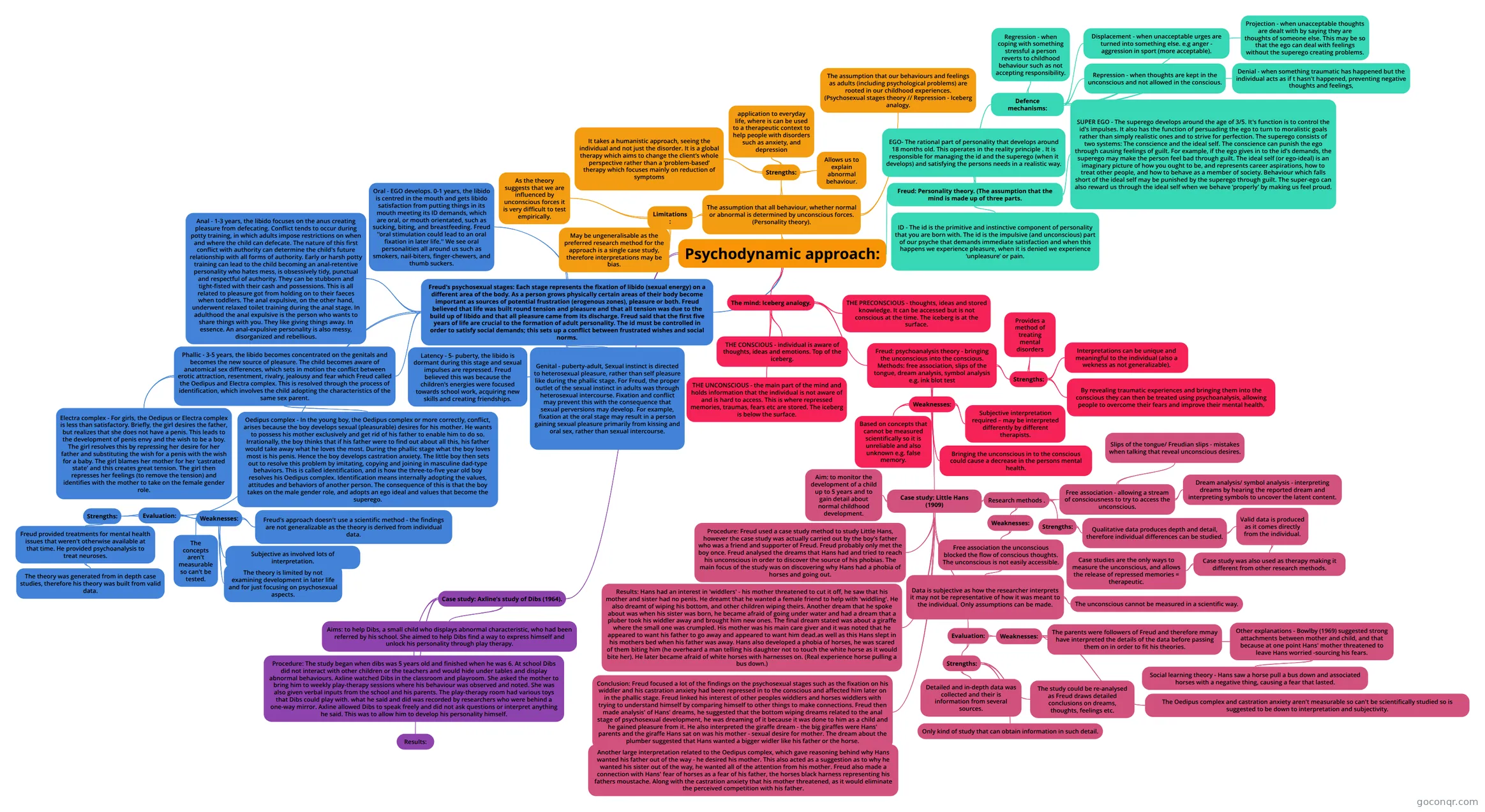
Mind map: Psychodynamic approach
Map content
Psychodynamic approach:
The mind: Iceberg analogy.
- THE CONSCIOUS - individual is aware of thoughts, ideas and emotions. Top of the iceberg.
- THE PRECONSCIOUS - thoughts, ideas and stored knowledge. It can be accessed but is not conscious at the time. The iceberg is at the surface.
- THE UNCONSCIOUS - the main part of the mind and holds information that the individual is not aware of and is hard to access. This is where repressed memories, traumas, fears etc are stored. The iceberg is below the surface.
- Freud: psychoanalysis theory - bringing the unconscious into the conscious. Methods: free association, slips of the tongue, dream analysis, symbol analysis e.g. ink blot test
- Strengths:
- Provides a method of treating mental disorders
- Interpretations can be unique and meaningful to the individual (also a wekness as not generalizable).
- By revealing traumatic experiences and bringing them into the conscious they can then be treated using psychoanalysis, allowing people to overcome their fears and improve their mental health.
- Weaknesses:
- Subjective interpretation required – may be interpreted differently by different therapists.
- Based on concepts that cannot be measured scientifically so it is unreliable and also unknown e.g. false memory.
- Bringing the unconscious in to the conscious could cause a decrease in the persons mental health.
- Case study: Little Hans (1909)
- Research methods .
- Free association - allowing a stream of consciousness to try to access the unconscious.
- Slips of the tongue/ Freudian slips - mistakes when talking that reveal unconscious desires.
- Dream analysis/ symbol analysis - interpreting dreams by hearing the reported dream and interpreting symbols to uncover the latent content.
- Strengths:
- Qualitative data produces depth and detail, therefore individual differences can be studied.
- Valid data is produced as it comes directly from the individual.
- Case study was also used as therapy making it different from other research methods.
- Case studies are the only ways to measure the unconscious, and allows the release of repressed memories = therapeutic.
- Case study was also used as therapy making it different from other research methods.
- Valid data is produced as it comes directly from the individual.
- Qualitative data produces depth and detail, therefore individual differences can be studied.
- Weaknesses:
- Free association the unconscious blocked the flow of conscious thoughts. The unconscious is not easily accessible.
- Data is subjective as how the researcher interprets it may not be representative of how it was meant to the individual. Only assumptions can be made.
- The unconscious cannot be measured in a scientific way.
- Data is subjective as how the researcher interprets it may not be representative of how it was meant to the individual. Only assumptions can be made.
- Free association the unconscious blocked the flow of conscious thoughts. The unconscious is not easily accessible.
- Free association - allowing a stream of consciousness to try to access the unconscious.
- Aim: to monitor the development of a child up to 5 years and to gain detail about normal childhood development.
- Procedure: Freud used a case study method to study Little Hans, however the case study was actually carried out by the boy’s father who was a friend and supporter of Freud. Freud probably only met the boy once. Freud analysed the dreams that Hans had and tried to reach his unconscious in order to discover the source of his phobias. The main focus of the study was on discovering why Hans had a phobia of horses and going out.
- Results: Hans had an interest in 'widdlers' - his mother threatened to cut it off, he saw that his mother and sister had no penis. He dreamt that he wanted a female friend to help with 'widdling'. He also dreamt of wiping his bottom, and other children wiping theirs. Another dream that he spoke about was when his sister was born, he became afraid of going under water and had a dream that a pluber took his widdler away and brought him new ones. The final dream stated was about a giraffe where the small one was crumpled. His mother was his main care giver and it was noted that he appeared to want his father to go away and appeared to want him dead.as well as this Hans slept in his mothers bed when his father was away. Hans also developed a phobia of horses, he was scared of them biting him (he overheard a man telling his daughter not to touch the white horse as it would bite her). He later became afraid of white horses with harnesses on. (Real experience horse pulling a bus down.)
- Conclusion: Freud focused a lot of the findings on the psychosexual stages such as the fixation on his widdler and his castration anxiety had been repressed in to the conscious and affected him later on in the phallic stage. Freud linked his interest of other peoples widdlers and horses widdlers with trying to understand himself by comparing himself to other things to make connections. Freud then made analysis' of Hans' dreams, he suggested that the bottom wiping dreams related to the anal stage of psychosexual development, he was dreaming of it because it was done to him as a child and he gained pleasure from it. He also interpreted the giraffe dream - the big giraffes were Hans' parents and the giraffe Hans sat on was his mother - sexual desire for mother. The dream about the plumber suggested that Hans wanted a bigger widler like his father or the horse.
- Another large interpretation related to the Oedipus complex, which gave reasoning behind why Hans wanted his father out of the way - he desired his mother. This also acted as a suggestion as to why he wanted his sister out of the way, he wanted all of the attention from his mother. Freud also made a connection with Hans' fear of horses as a fear of his father, the horses black harness representing his fathers moustache. Along with the castration anxiety that his mother threatened, as it would eliminate the perceived competition with his father.
- Evaluation:
- Strengths:
- Detailed and in-depth data was collected and their is information from several sources.
- The study could be re-analysed as Freud draws detailed conclusions on dreams, thoughts, feelings etc.
- Only kind of study that can obtain information in such detail.
- Weaknesses:
- The parents were followers of Freud and therefore mmay have interpreted the details of the data before passing them on in order to fit his theories.
- Other explanations - Bowlby (1969) suggested strong attachments between mother and child, and that because at one point Hans' mother threatened to leave Hans worried -sourcing his fears.
- Social learning theory - Hans saw a horse pull a bus down and associated horses with a negative thing, causing a fear that lasted.
- The Oedipus complex and castration anxiety aren't measurable so can't be scientifically studied so is suggested to be down to interpretation and subjectivity.
- Strengths:
- Research methods .
- Strengths:
Freud: Personality theory. (The assumption that the mind is made up of three parts.
- ID - The id is the primitive and instinctive component of personality that you are born with. The id is the impulsive (and unconscious) part of our psyche that demands immediate satisfaction and when this happens we experience pleasure, when it is denied we experience ‘unpleasure’ or pain.
- EGO- The rational part of personality that develops around 18 months old. This operates in the reality principle . It is responsible for managing the id and the superego (when it develops) and satisfying the persons needs in a realistic way.
- SUPER EGO - The superego develops around the age of 3/5. It's function is to control the id's impulses. It also has the function of persuading the ego to turn to moralistic goals rather than simply realistic ones and to strive for perfection. The superego consists of two systems: The conscience and the ideal self. The conscience can punish the ego through causing feelings of guilt. For example, if the ego gives in to the id's demands, the superego may make the person feel bad through guilt. The ideal self (or ego-ideal) is an imaginary picture of how you ought to be, and represents career aspirations, how to treat other people, and how to behave as a member of society. Behaviour which falls short of the ideal self may be punished by the superego through guilt. The super-ego can also reward us through the ideal self when we behave ‘properly’ by making us feel proud.
- Defence mechanisms:
- Repression - when thoughts are kept in the unconscious and not allowed in the conscious.
- Denial - when something traumatic has happened but the individual acts as if t hasn't happened, preventing negative thoughts and feelings,
- Projection - when unacceptable thoughts are dealt with by saying they are thoughts of someone else. This may be so that the ego can deal with feelings without the superego creating problems.
- Displacement - when unacceptable urges are turned into something else. e.g anger - aggression in sport (more acceptable).
- Regression - when coping with something stressful a person reverts to childhood behaviour such as not accepting responsibility.
The assumption that all behaviour, whether normal or abnormal is determined by unconscious forces. (Personality theory).
- Strengths:
- application to everyday life, where is can be used to a therapeutic context to help people with disorders such as anxiety, and depression
- Allows us to explain abnormal behaviour.
- It takes a humanistic approach, seeing the individual and not just the disorder. It is a global therapy which aims to change the client’s whole perspective rather than a ‘problem-based’ therapy which focuses mainly on reduction of symptoms
- Limitations :
- May be ungeneralisable as the preferred research method for the approach is a single case study, therefore interpretations may be bias.
- As the theory suggests that we are influenced by unconscious forces it is very difficult to test empirically.
- The assumption that our behaviours and feelings as adults (including psychological problems) are rooted in our childhood experiences. (Psychosexual stages theory // Repression - Iceberg analogy.
- Strengths:
Freud's psychosexual stages: Each stage represents the fixation of libido (sexual energy) on a different area of the body. As a person grows physically certain areas of their body become important as sources of potential frustration (erogenous zones), pleasure or both. Freud believed that life was built round tension and pleasure and that all tension was due to the build up of libido and that all pleasure came from its discharge. Freud said that the first five years of life are crucial to the formation of adult personality. The id must be controlled in order to satisfy social demands; this sets up a conflict between frustrated wishes and social norms.
- Oral - EGO develops. 0-1 years, the libido is centred in the mouth and gets libido satisfaction from putting things in its mouth meeting its ID demands, which are oral, or mouth orientated, such as sucking, biting, and breastfeeding. Freud ''oral stimulation could lead to an oral fixation in later life.'' We see oral personalities all around us such as smokers, nail-biters, finger-chewers, and thumb suckers.
- Phallic - 3-5 years, the libido becomes concentrated on the genitals and becomes the new source of pleasure. The child becomes aware of anatomical sex differences, which sets in motion the conflict between erotic attraction, resentment, rivalry, jealousy and fear which Freud called the Oedipus and Electra complex. This is resolved through the process of identification, which involves the child adopting the characteristics of the same sex parent.
- Oedipus complex - In the young boy, the Oedipus complex or more correctly, conflict, arises because the boy develops sexual (pleasurable) desires for his mother. He wants to possess his mother exclusively and get rid of his father to enable him to do so. Irrationally, the boy thinks that if his father were to find out about all this, his father would take away what he loves the most. During the phallic stage what the boy loves most is his penis. Hence the boy develops castration anxiety. The little boy then sets out to resolve this problem by imitating, copying and joining in masculine dad-type behaviors. This is called identification, and is how the three-to-five year old boy resolves his Oedipus complex. Identification means internally adopting the values, attitudes and behaviors of another person. The consequence of this is that the boy takes on the male gender role, and adopts an ego ideal and values that become the superego.
- Electra complex - For girls, the Oedipus or Electra complex is less than satisfactory. Briefly, the girl desires the father, but realizes that she does not have a penis. This leads to the development of penis envy and the wish to be a boy. The girl resolves this by repressing her desire for her father and substituting the wish for a penis with the wish for a baby. The girl blames her mother for her 'castrated state' and this creates great tension. The girl then represses her feelings (to remove the tension) and identifies with the mother to take on the female gender role.
- Latency - 5- puberty, the libido is dormant during this stage and sexual impulses are repressed. Freud believed this was because the children's energies were focused towards school work, acquiring new skills and creating friendships.
- Genital - puberty-adult, Sexual instinct is directed to heterosexual pleasure, rather than self pleasure like during the phallic stage. For Freud, the proper outlet of the sexual instinct in adults was through heterosexual intercourse. Fixation and conflict may prevent this with the consequence that sexual perversions may develop. For example, fixation at the oral stage may result in a person gaining sexual pleasure primarily from kissing and oral sex, rather than sexual intercourse.
- Anal - 1-3 years, the libido focuses on the anus creating pleasure from defecating. Conflict tends to occur during potty training, in which adults impose restrictions on when and where the child can defecate. The nature of this first conflict with authority can determine the child's future relationship with all forms of authority. Early or harsh potty training can lead to the child becoming an anal-retentive personality who hates mess, is obsessively tidy, punctual and respectful of authority. They can be stubborn and tight-fisted with their cash and possessions. This is all related to pleasure got from holding on to their faeces when toddlers. The anal expulsive, on the other hand, underwent relaxed toilet training during the anal stage. In adulthood the anal expulsive is the person who wants to share things with you. They like giving things away. In essence. An anal-expulsive personality is also messy, disorganized and rebellious.
- Evaluation:
- Strengths:
- Freud provided treatments for mental health issues that weren't otherwise available at that time. He provided psychoanalysis to treat neuroses.
- The theory was generated from in depth case studies, therefore his theory was built from valid data.
- Freud provided treatments for mental health issues that weren't otherwise available at that time. He provided psychoanalysis to treat neuroses.
- Weaknesses:
- Freud's approach doesn't use a scientific method - the findings are not generalizable as the theory is derived from individual data.
- The concepts aren't measurable so can't be tested.
- Subjective as involved lots of interpretation.
- The theory is limited by not examining development in later life and for just focusing on psychosexual aspects.
- Strengths:
Case study: Axline's study of Dibs (1964).
- Aims: to help Dibs, a small child who displays abnormal characteristic, who had been referred by his school. She aimed to help Dibs find a way to express himself and unlock his personality through play therapy.
- Procedure: The study began when dibs was 5 years old and finished when he was 6. At school Dibs did not interact with other children or the teachers and would hide under tables and display abnormal behaviours. Axline watched Dibs in the classroom and playroom. She asked the mother to bring him to weekly play-therapy sessions where his behaviour was observed and noted. She was also given verbal inputs from the school and his parents. The play-therapy room had various toys that Dibs could play with. what he said and did was recorded by researchers who were behind a one-way mirror. Axline allowed Dibs to speak freely and did not ask questions or interpret anything he said. This was to allow him to develop his personality himself.
- Results:
Information
- Description
- Mind Map on Psychodynamic approach:, created by elliemayboelema on 07/01/2016.
- Created by
- elliemayboelema
- Views
- 0
- Rating