
Mind map
English Midterm
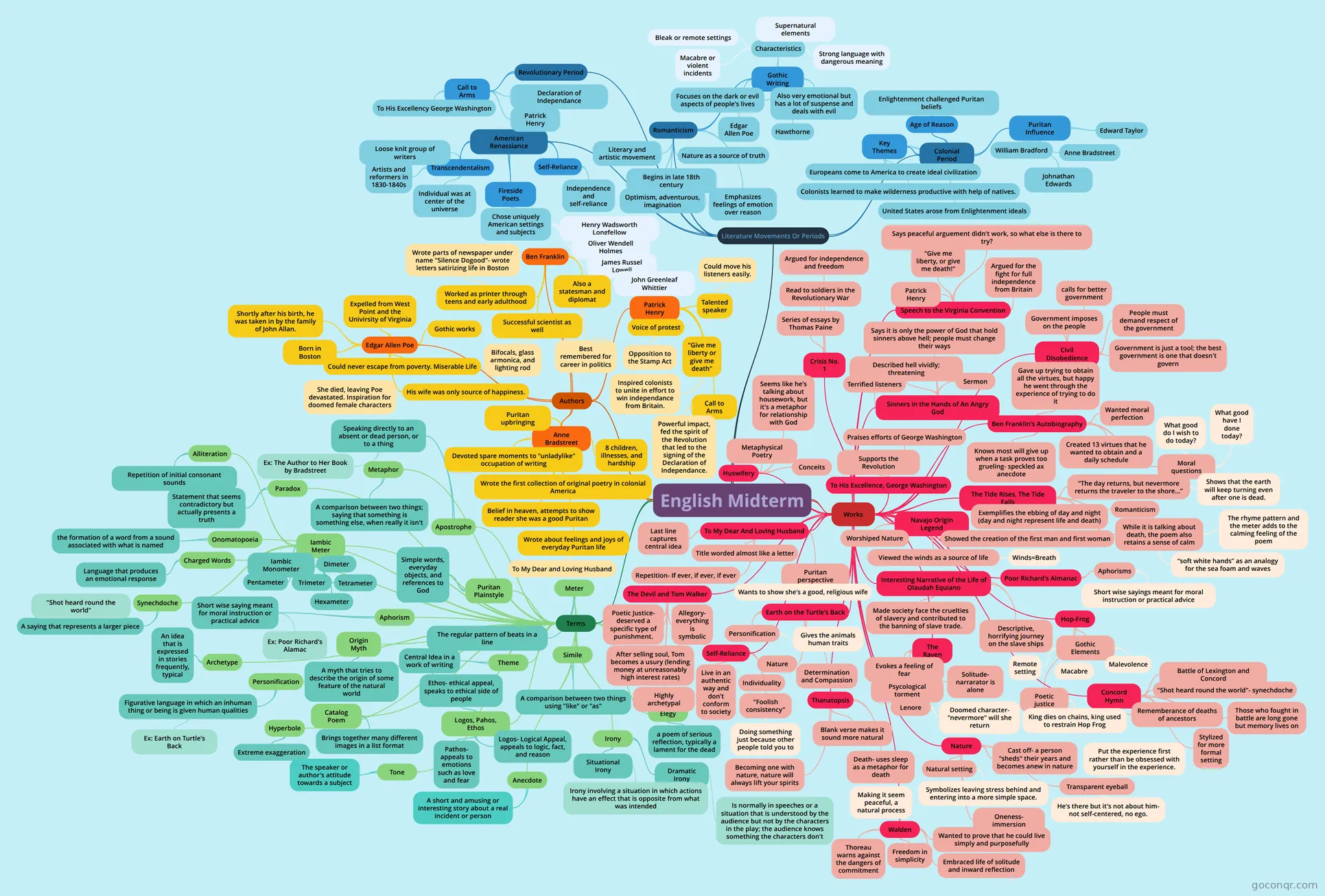
Mind map: English midterm literature
Map content
English Midterm
Works
- Navajo Origin Legend
- Viewed the winds as a source of life
- Winds=Breath
- Worshiped Nature
- Showed the creation of the first man and first woman
- Viewed the winds as a source of life
- Earth on the Turtle's Back
- Personification
- Gives the animals human traits
- Determination and Compassion
- If you are perceived as weak, determination and hard work will bring you where you want to go.
- Nature
- nature can be good for us, do not harm nature, use it for your benefit but also give back to the earth as well and do not harm it.
- Personification
- Interesting Narrative of the Life of Olaudah Equiano
- Made society face the cruelties of slavery and contributed to the banning of slave trade.
- Descriptive, horrifying journey on the slave ships
- To My Dear And Loving Husband
- Last line captures central idea
- "That when we live no more, we may live ever" Her poem was a way to immortalize her husband's love for her and her love for her husband
- Title worded almost like a letter
- Communicates not only to the world but also to her husband. Compares herself to other women. Seems like she's talking to her husband. Uses Apostrophe.
- Repetition- If ever, if ever, if ever
- Wants to repeat over and over how much she loves him
- Puritan perspective
- Wants to show she's a good, religious wife
- It shows belief in heaven and shows the reader that she is a good, Puritan wife
- Wants to show she's a good, religious wife
- Last line captures central idea
- Huswifery
- Edward Taylor
- Metaphysical Poetry
- Classifies groups that share common characteristics using strong imagery and complicated plots.
- Conceits
- Elaborate, unusual metaphors that compare unlike things. Writing about housework, but not about real housework- actually about God and him.
- Seems like he's talking about housework, but it's a metaphor for relationship with God
- Giving imagery for religion- says he wants God to use him like a spinning wheel to make something God will be proud of.
- To His Excellence, George Washington
- Supports the Revolution
- Praises efforts of George Washington
- Sinners in the Hands of An Angry God
- Terrified listeners
- Sermon
- Described hell vividly; threatening
- Says it is only the power of God that hold sinners above hell; people must change their ways
- Crisis No. 1
- Series of essays by Thomas Paine
- Read to soldiers in the Revolutionary War
- Argued for independence and freedom
- Speech to the Virginia Convention
- Argued for the fight for full independence from Britain
- Says peaceful arguement didn't work, so what else is there to try?
- Patrick Henry
- "Give me liberty, or give me death!"
- Ben Franklin's Autobiography
- Created 13 virtues that he wanted to obtain and a daily schedule
- Moral questions
- What good do I wish to do today?
- What good have I done today?
- Knows most will give up when a task proves too grueling- speckled ax anecdote
- Gave up trying to obtain all the virtues, but happy he went through the experience of trying to do it
- Wanted moral perfection
- Poor Richard's Almanac
- Aphorisms
- Short wise sayings meant for moral instruction or practical advice
- Aphorisms
- The Tide Rises, The Tide Falls
- “The day returns, but nevermore returns the traveler to the shore…”
- Shows that the earth will keep turning even after one is dead.
- Romanticism
- Exemplifies the ebbing of day and night (day and night represent life and death)
- While it is talking about death, the poem also retains a sense of calm
- The rhyme pattern and the meter adds to the calming feeling of the poem
- “soft white hands” as an analogy for the sea foam and waves
- “The day returns, but nevermore returns the traveler to the shore…”
- Thanatopsis
- Becoming one with nature, nature will always lift your spirits
- Death- uses sleep as a metaphor for death
- Making it seem peaceful, a natural process
- Blank verse makes it sound more natural
- The Raven
- Evokes a feeling of fear
- Solitude- narrarator is alone
- Psycological torment
- Lenore
- Doomed character- "nevermore" will she return
- Hop-Frog
- Gothic Elements
- Macabre
- Remote setting
- Malevolence
- Poetic justice
- King dies on chains, king used to restrain Hop Frog
- Gothic Elements
- The Devil and Tom Walker
- After selling soul, Tom becomes a usury (lending money at unreasonably high interest rates)
- Poetic Justice- deserved a specific type of punishment.
- Allegory- everything is symbolic
- Highly archetypal
- Nature
- Natural setting
- Symbolizes leaving stress behind and entering into a more simple space.
- RWE equates this with youth (innocence)
- Symbolizes leaving stress behind and entering into a more simple space.
- Cast off- a person "sheds" their years and becomes anew in nature
- Transparent eyeball
- not really there just a disembodied thing who is taking everything in
- He's there but it's not about him- not self-centered, no ego.
- Put the experience first rather than be obsessed with yourself in the experience.
- Oneness- immersion
- Natural setting
- Self-Reliance
- Live in an authentic way and don't conform to society
- Individuality
- "Foolish consistency"
- Doing something just because other people told you to
- Concord Hymn
- Battle of Lexington and Concord
- "Shot heard round the world"- synechdoche
- Rememberance of deaths of ancestors
- Stylized for more formal setting
- Those who fought in battle are long gone but memory lives on
- Walden
- Thoreau warns against the dangers of commitment
- Wanted to prove that he could live simply and purposefully
- Embraced life of solitude and inward reflection
- Freedom in simplicity
- Civil Disobedience
- Government is just a tool; the best government is one that doesn't govern
- Government imposes on the people
- People must demand respect of the government
- calls for better government
- Navajo Origin Legend
Authors
- Edgar Allen Poe
- Born in Boston
- Could never escape from poverty. Miserable Life
- Gothic works
- His wife was only source of happiness.
- She died, leaving Poe devastated. Inspiration for doomed female characters
- Doomed female characters- Madeline (Fall of the House of Usher) Lenore (The Raven) Annabel Lee
- She died, leaving Poe devastated. Inspiration for doomed female characters
- Shortly after his birth, he was taken in by the family of John Allan.
- Expelled from West Point and the Univirsity of Virginia
- Ben Franklin
- Wrote Poor Richard's Almanac Wrote his Autobiography
- Worked as printer through teens and early adulthood
- Wrote parts of newspaper under name "Silence Dogood"- wrote letters satirizing life in Boston
- Successful scientist as well
- Bifocals, glass armonica, and lighting rod
- Also a statesman and diplomat
- Best remembered for career in politics
- "father of his country"
- Best remembered for career in politics
- Anne Bradstreet
- Puritan upbringing
- 8 children, illnesses, and hardship
- Devoted spare moments to "unladylike" occupation of writing
- Wrote the first collection of original poetry in colonial America
- Wrote about feelings and joys of everyday Puritan life
- To My Dear and Loving Husband
- Belief in heaven, attempts to show reader she was a good Puritan
- Patrick Henry
- Talented speaker
- Could move his listeners easily.
- "Give me liberty or give me death"
- Inspired colonists to unite in effort to win independance from Britain.
- Voice of protest
- powerful speech in opposition to the Stamp Act
- Opposition to the Stamp Act
- Call to Arms
- Speech to the Virginia Convention
- Powerful impact, fed the spirit of the Revolution that led to the signing of the Declaration of Independance.
- Talented speaker
- Edgar Allen Poe
Terms
- Puritan Plainstyle
- Simple words, everyday objects, and references to God
- Meter
- The regular pattern of beats in a line
- Metaphor
- A comparison between two things; saying that something is something else, when really it isn't
- Simile
- A comparison between two things using "like" or "as"
- Apostrophe
- Speaking directly to an absent or dead person, or to a thing
- Ex: The Author to Her Book by Bradstreet
- Speaking directly to an absent or dead person, or to a thing
- Logos, Pahos, Ethos
- Ethos- ethical appeal, speaks to ethical side of people
- Logos- Logical Appeal, appeals to logic, fact, and reason
- Pathos- appeals to emotions such as love and fear
- Paradox
- Statement that seems contradictory but actually presents a truth
- Elegy
- a poem of serious reflection, typically a lament for the dead
- Concord Hymn
- a poem of serious reflection, typically a lament for the dead
- Anecdote
- A short and amusing or interesting story about a real incident or person
- Aphorism
- Short wise saying meant for moral instruction or practical advice
- Ex: Poor Richard's Alamac
- Short wise saying meant for moral instruction or practical advice
- Origin Myth
- A myth that tries to describe the origin of some feature of the natural world
- Iambic Meter
- Iambic Monometer
- Dimeter
- Trimeter
- Tetrameter
- Pentameter
- Hexameter
- Alliteration
- Repetition of initial consonant sounds
- Synechdoche
- A saying that represents a larger piece
- "Shot heard round the world"
- A saying that represents a larger piece
- Personification
- Figurative language in which an inhuman thing or being is given human qualities
- Ex: Earth on Turtle's Back
- Figurative language in which an inhuman thing or being is given human qualities
- Hyperbole
- Extreme exaggeration
- Catalog Poem
- Brings together many different images in a list format
- Tone
- The speaker or author's attitude towards a subject
- Theme
- Central Idea in a work of writing
- Onomatopoeia
- the formation of a word from a sound associated with what is named
- Charged Words
- Language that produces an emotional response
- Archetype
- An idea that is expressed in stories frequently, typical
- Irony
- Situational Irony
- Irony involving a situation in which actions have an effect that is opposite from what was intended
- Dramatic Irony
- Is normally in speeches or a situation that is understood by the audience but not by the characters in the play; the audience knows something the characters don't
- Situational Irony
- Puritan Plainstyle
Literature Movements Or Periods
- Romanticism
- Gothic Writing
- Focuses on the dark or evil aspects of people's lives
- Also very emotional but has a lot of suspense and deals with evil
- Edgar Allen Poe
- Raven Hop Frog
- Characteristics
- Bleak or remote settings
- Macabre or violent incidents
- Supernatural elements
- Strong language with dangerous meaning
- Hawthorne
- Scarlet Letter Minister's Black Veil
- Ministers Black Veil
- Literary and artistic movement
- Nature as a source of truth
- Begins in late 18th century
- Emphasizes feelings of emotion over reason
- Optimism, adventurous, imagination
- Gothic Writing
- Colonial Period
- Age of Reason
- Enlightenment challenged Puritan beliefs
- Key Themes
- Europeans come to America to create ideal civilization
- Colonists learned to make wilderness productive with help of natives.
- United States arose from Enlightenment ideals
- Puritan Influence
- William Bradford
- Anne Bradstreet
- To My Dear and Loving Husband
- Edward Taylor
- Johnathan Edwards
- Sinners in the Hand of an Angry God
- Puritan, angry speaker
- Age of Reason
- Revolutionary Period
- Call to Arms
- Declaration of Independance
- To His Excellency George Washington
- Patrick Henry
- Speech to the Virginia Convention
- Call to Arms
- American Renassiance
- Transcendentalism
- Loose knit group of writers
- Artists and reformers in 1830-1840s
- Individual was at center of the universe
- Self-Reliance
- Independence and self-reliance
- Fireside Poets
- Chose uniquely American settings and subjects
- Henry Wadsworth Longfellow
- Oliver Wendell Holmes
- James Russel Lowell
- John Greenleaf Whittier
- Chose uniquely American settings and subjects
- Transcendentalism
- Romanticism
Information
- Description
- academy of the holy angels sophomore midterms 2016 english II HH
- Created by
- Noelani Buonomo
- Views
- 216
- Tags
- Rating