
Mind map
Defining 'Superpower'
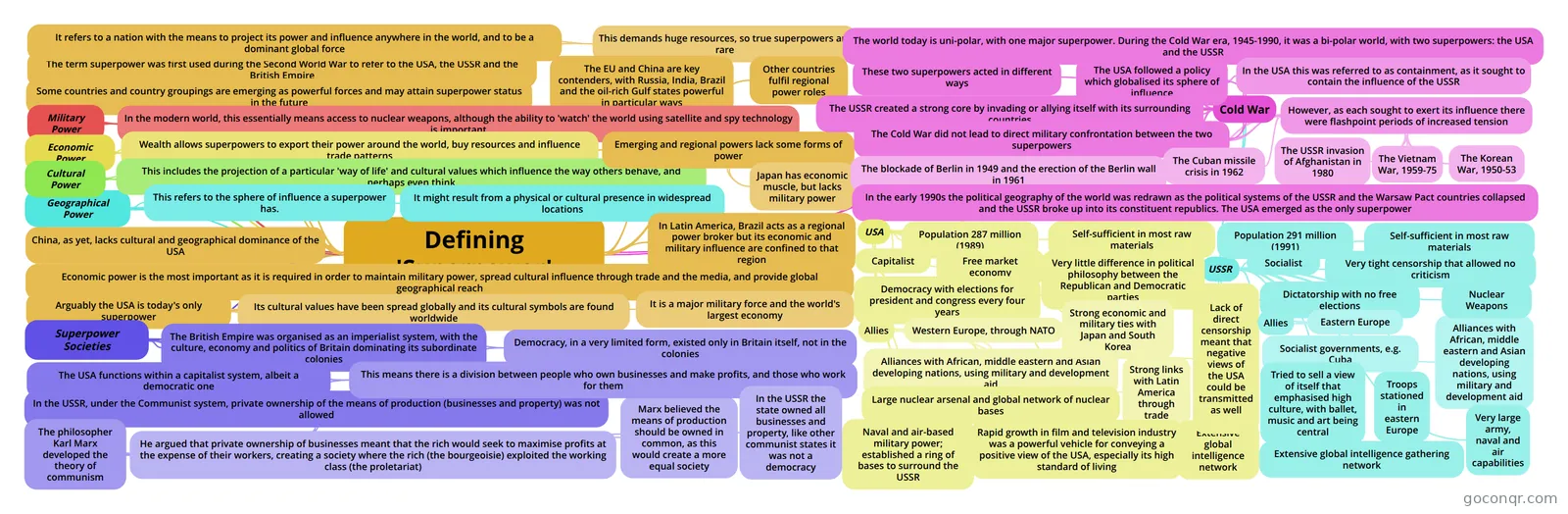
Mind map: defining superpower
Map content
Defining 'Superpower'
The term superpower was first used during the Second World War to refer to the USA, the USSR and the British Empire
It refers to a nation with the means to project its power and influence anywhere in the world, and to be a dominant global force
- This demands huge resources, so true superpowers are rare
Some countries and country groupings are emerging as powerful forces and may attain superpower status in the future
The EU and China are key contenders, with Russia, India, Brazil and the oil-rich Gulf states powerful in particular ways
Other countries fulfil regional power roles
Military Power
- In the modern world, this essentially means access to nuclear weapons, although the ability to 'watch' the world using satellite and spy technology is important
Economic Power
- Wealth allows superpowers to export their power around the world, buy resources and influence trade patterns
Geographical Power
- This refers to the sphere of influence a superpower has.
- It might result from a physical or cultural presence in widespread locations
Cultural Power
- This includes the projection of a particular 'way of life' and cultural values which influence the way others behave, and perhaps even think
Economic power is the most important as it is required in order to maintain military power, spread cultural influence through trade and the media, and provide global geographical reach
Arguably the USA is today's only superpower
- It is a major military force and the world's largest economy
- Its cultural values have been spread globally and its cultural symbols are found worldwide
Emerging and regional powers lack some forms of power
- Japan has economic muscle, but lacks military power
In Latin America, Brazil acts as a regional power broker but its economic and military influence are confined to that region
China, as yet, lacks cultural and geographical dominance of the USA
Superpower Societies
- The British Empire was organised as an imperialist system, with the culture, economy and politics of Britain dominating its subordinate colonies
- Democracy, in a very limited form, existed only in Britain itself, not in the colonies
- The USA functions within a capitalist system, albeit a democratic one
- This means there is a division between people who own businesses and make profits, and those who work for them
- In the USSR, under the Communist system, private ownership of the means of production (businesses and property) was not allowed
- The philosopher Karl Marx developed the theory of communism
- He argued that private ownership of businesses meant that the rich would seek to maximise profits at the expense of their workers, creating a society where the rich (the bourgeoisie) exploited the working class (the proletariat)
- Marx believed the means of production should be owned in common, as this would create a more equal society
- In the USSR the state owned all businesses and property, like other communist states it was not a democracy
- The philosopher Karl Marx developed the theory of communism
- The British Empire was organised as an imperialist system, with the culture, economy and politics of Britain dominating its subordinate colonies
Cold War
- The world today is uni-polar, with one major superpower. During the Cold War era, 1945-1990, it was a bi-polar world, with two superpowers: the USA and the USSR
- These two superpowers acted in different ways
- The USA followed a policy which globalised its sphere of influence
- In the USA this was referred to as containment, as it sought to contain the influence of the USSR
- The USSR created a strong core by invading or allying itself with its surrounding countries
- The Cold War did not lead to direct military confrontation between the two superpowers
- However, as each sought to exert its influence there were flashpoint periods of increased tension
- The Korean War, 1950-53
- The Vietnam War, 1959-75
- The blockade of Berlin in 1949 and the erection of the Berlin wall in 1961
- The Cuban missile crisis in 1962
- The USSR invasion of Afghanistan in 1980
- However, as each sought to exert its influence there were flashpoint periods of increased tension
- In the early 1990s the political geography of the world was redrawn as the political systems of the USSR and the Warsaw Pact countries collapsed and the USSR broke up into its constituent republics. The USA emerged as the only superpower
- USA
- Population 287 million (1989)
- Self-sufficient in most raw materials
- Capitalist
- Free market economy
- Democracy with elections for president and congress every four years
- Very little difference in political philosophy between the Republican and Democratic parties
- Allies
- Western Europe, through NATO
- Strong links with Latin America through trade
- Alliances with African, middle eastern and Asian developing nations, using military and development aid
- Strong economic and military ties with Japan and South Korea
- Naval and air-based military power; established a ring of bases to surround the USSR
- Large nuclear arsenal and global network of nuclear bases
- Extensive global intelligence network
- Rapid growth in film and television industry was a powerful vehicle for conveying a positive view of the USA, especially its high standard of living
- Lack of direct censorship meant that negative views of the USA could be transmitted as well
- USSR
- Population 291 million (1991)
- Self-sufficient in most raw materials
- Socialist
- Dictatorship with no free elections
- Allies
- Eastern Europe
- Socialist governments, e.g. Cuba
- Alliances with African, middle eastern and Asian developing nations, using military and development aid
- Very large army, naval and air capabilities
- Nuclear Weapons
- Troops stationed in eastern Europe
- Extensive global intelligence gathering network
- Tried to sell a view of itself that emphasised high culture, with ballet, music and art being central
- Very tight censorship that allowed no criticism
Information
- Description
- A-Levels Geography (Superpower Geographies) Mind Map on Defining 'Superpower', created by Jodie Goodacre on 26/12/2013.
- Created by
- Jodie Goodacre
- Views
- 129
- Tags
- Rating