
Mind map
Adaptation and variation
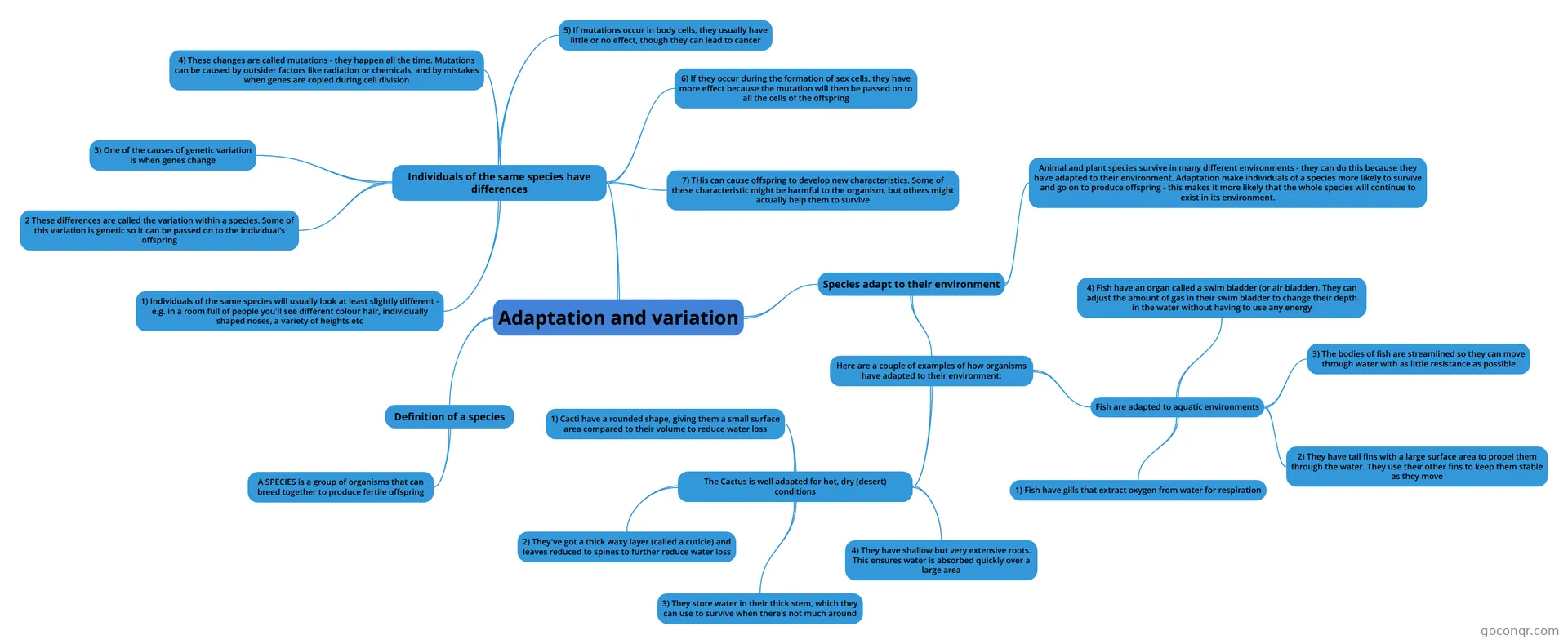
Mind map: Adaptation and variation
Map content
Adaptation and variation
Definition of a species
- A SPECIES is a group of organisms that can breed together to produce fertile offspring
Individuals of the same species have differences
- 1) Individuals of the same species will usually look at least slightly different - e.g. in a room full of people you'll see different colour hair, individually shaped noses, a variety of heights etc
- 2 These differences are called the variation within a species. Some of this variation is genetic so it can be passed on to the individual's offspring
- 3) One of the causes of genetic variation is when genes change
- 4) These changes are called mutations - they happen all the time. Mutations can be caused by outsider factors like radiation or chemicals, and by mistakes when genes are copied during cell division
- 5) If mutations occur in body cells, they usually have little or no effect, though they can lead to cancer
- 6) If they occur during the formation of sex cells, they have more effect because the mutation will then be passed on to all the cells of the offspring
- 7) THis can cause offspring to develop new characteristics. Some of these characteristic might be harmful to the organism, but others might actually help them to survive
Species adapt to their environment
- Animal and plant species survive in many different environments - they can do this because they have adapted to their environment. Adaptation make individuals of a species more likely to survive and go on to produce offspring - this makes it more likely that the whole species will continue to exist in its environment.
- Here are a couple of examples of how organisms have adapted to their environment:
- The Cactus is well adapted for hot, dry (desert) conditions
- 1) Cacti have a rounded shape, giving them a small surface area compared to their volume to reduce water loss
- 2) They've got a thick waxy layer (called a cuticle) and leaves reduced to spines to further reduce water loss
- 3) They store water in their thick stem, which they can use to survive when there's not much around
- 4) They have shallow but very extensive roots. This ensures water is absorbed quickly over a large area
- Fish are adapted to aquatic environments
- 1) Fish have gills that extract oxygen from water for respiration
- 2) They have tail fins with a large surface area to propel them through the water. They use their other fins to keep them stable as they move
- 3) The bodies of fish are streamlined so they can move through water with as little resistance as possible
- 4) Fish have an organ called a swim bladder (or air bladder). They can adjust the amount of gas in their swim bladder to change their depth in the water without having to use any energy
- The Cactus is well adapted for hot, dry (desert) conditions
Information
- Description
- Mind Map on Adaptation and variation, created by ygreent12 on 01/04/2016.
- Created by
- ygreent12
- Views
- 2
- Rating