
Mind map
Jenkins
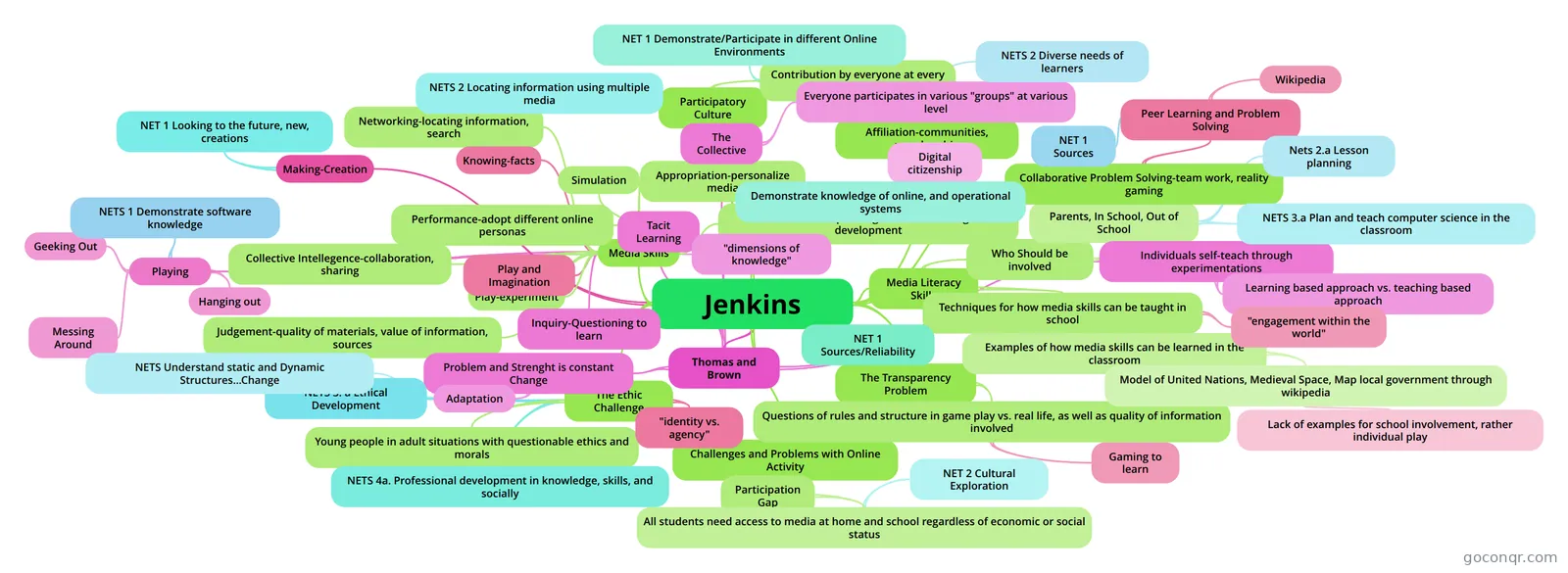
Mind map: Jenkins participatory culture
Map content
Jenkins
Challenges and Problems with Online Activity
- Participation Gap
- All students need access to media at home and school regardless of economic or social status
- NET 2 Cultural Exploration
- All students need access to media at home and school regardless of economic or social status
- Participation Gap
The Transparency Problem
- Questions of rules and structure in game play vs. real life, as well as quality of information involved
- Gaming to learn
- NET 1 Sources/Reliability
- Questions of rules and structure in game play vs. real life, as well as quality of information involved
The Ethic Challenge
- Young people in adult situations with questionable ethics and morals
- "identity vs. agency"
- NETS 4a. Professional development in knowledge, skills, and socially
- NETS 3. a Ethical Development
Media Literacy Skills
- Techniques for how media skills can be taught in school
- Examples of how media skills can be learned in the classroom
- Model of United Nations, Medieval Space, Map local government through wikipedia
- Lack of examples for school involvement, rather individual play
- Model of United Nations, Medieval Space, Map local government through wikipedia
- "engagement within the world"
- Examples of how media skills can be learned in the classroom
- Who Should be involved
- Parents, In School, Out of School
- NETS 3.a Plan and teach computer science in the classroom
- Nets 2.a Lesson planning
- Parents, In School, Out of School
- Techniques for how media skills can be taught in school
Media Skills
- Play-experiment
- Performance-adopt different online personas
- Simulation
- Appropriation-personalize media
- Distribution-manipulating tools for learning and development
- Demonstrate knowledge of online, and operational systems
- Collective Intellegence-collaboration, sharing
- Judgement-quality of materials, value of information, sources
- Networking-locating information, search
- NETS 2 Locating information using multiple media
- Play and Imagination
- Inquiry-Questioning to learn
- Knowing-facts
- Playing
- Hanging out
- Messing Around
- Geeking Out
- NETS 1 Demonstrate software knowledge
Affiliation-communities, membership
Collaborative Problem Solving-team work, reality gaming
- Peer Learning and Problem Solving
- Wikipedia
- NET 1 Sources
- Peer Learning and Problem Solving
Participatory Culture
- Contribution by everyone at every level
- NET 1 Demonstrate/Participate in different Online Environments
- Contribution by everyone at every level
Thomas and Brown
- The Collective
- Everyone participates in various "groups" at various level
- Digital citizenship
- NETS 2 Diverse needs of learners
- Everyone participates in various "groups" at various level
- Individuals self-teach through experimentations
- Learning based approach vs. teaching based approach
- Problem and Strenght is constant Change
- Adaptation
- NETS Understand static and Dynamic Structures...Change
- Adaptation
- Tacit Learning
- "dimensions of knowledge"
- The Collective
Making-Creation
- NET 1 Looking to the future, new, creations
Information
- Description
- Thomas and Brown notes compared with Jenkins notes
- Created by
- mlf11970
- Views
- 57
- Rating