
Mind map
Physics module 2- Radiation
Map content
Physics module 2- Radiation
nuclear radiation
- causes ionisation
- when an unstable nucleus decays, it gives off one or more kinds of nuclear radiation
- radioactive materials- give out nuclear radiation over time
- alpha,beta and gamma
- cause ionisation- radiation causes atoms to lose or gain electrons, turning those atoms into ions
- ionisation can trigger chemical reactions
- when radiation enters human cells it can ionise molecules and damage DNA
- causes mutations in cells that could lead to cancer
- the further the radiation can penetrate before hitting an atom, the less ionising it is
- causes mutations in cells that could lead to cancer
- when radiation enters human cells it can ionise molecules and damage DNA
- ionisation can trigger chemical reactions
- cause ionisation- radiation causes atoms to lose or gain electrons, turning those atoms into ions
- alpha,beta and gamma
- radioactive materials- give out nuclear radiation over time
- when an unstable nucleus decays, it gives off one or more kinds of nuclear radiation
- alpha particles
- relatively big, heavy and slow moving
- because of size-stopped quickly
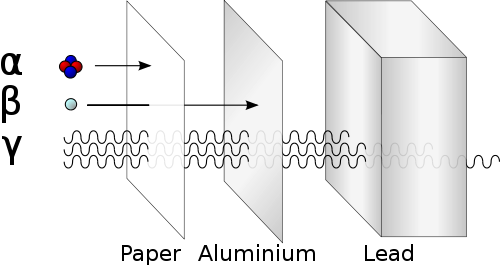
- stopped by skin or paper
- means they're strongly ionising, less penetrating
- bash into loads of atoms and knock electrons off them before they slow down
- means they're strongly ionising, less penetrating
- stopped by skin or paper
- because of size-stopped quickly
- relatively big, heavy and slow moving
- beta particles
- electrons
- they're small and move quite fast
- penetrate moderately before colliding-moderately ionising, moderately penetraing
- stopped by thin sheet of metal- few millimetres of aluminium
- penetrate moderately before colliding-moderately ionising, moderately penetraing
- they're small and move quite fast
- electrons
- gamma rays
- very high frequency electromagnetic waves
- no mass and no charge
- they can penetrate a long way into materials without being stopped
- weakly ionising, most penetrating
- stopped by thick concrete or a few centimetres of lead
- weakly ionising, most penetrating
- they can penetrate a long way into materials without being stopped
- no mass and no charge
- very high frequency electromagnetic waves
- radiation source and Geiger counter to test(detector)
- causes ionisation
radiation- the emission of energy as electromagnetic waves and particles from a source
how smoke detectors work
- smoke detectors use alpha radiation
- air is ionised so it conducts a very small current
- current flows between the two electrodes
- if smoke particles get in they will block the alpha particles so there is less ionisation
- electric current will decrease, the circuit breaks
- causing alarm to go off
- electric current will decrease, the circuit breaks
- if smoke particles get in they will block the alpha particles so there is less ionisation
- current flows between the two electrodes
- air is ionised so it conducts a very small current
- smoke detectors use alpha radiation
uses
- prepare a tracer
- chemical which accumulates in target organ and emits gamma rays e.g radiopharmaceutical
- inject into patient-time to flow around blood stream
- patient is scanned by gamma camera-external radiation detector
- show where strongest reading is coming from
- doctors use beta or gamma emitters as tracers because this radiation passes out of the body
- they also choose things that are only radioactive for a few hours- alpha never used
- doctors use beta or gamma emitters as tracers because this radiation passes out of the body
- show where strongest reading is coming from
- patient is scanned by gamma camera-external radiation detector
- inject into patient-time to flow around blood stream
- chemical which accumulates in target organ and emits gamma rays e.g radiopharmaceutical
- beta radiation is used in thickness control (thickness gauges)
- direct radiation through the stuff being made (paper or cardboard)
- and put a detector on the other side, connected to a control unit
- when the amount of detected radiation goes down, it means the paper is coming out too thick
- so the control unit pinches the rollers to make it thinner
- if the reading goes up-paper is too thin, control unit opens the rollers out a bit
- for this use, your radioactive substance mustn't decay away too quickly
- otherwise its strength would gradually fall- the control unit would keep pinching up the rollers trying to compensate
- you need to use a beta source- the paper or cardboard will partly block the radiation
- if it all goes through( or none of it does) then the reading wont change at all as the thickness changes
- you need to use a beta source- the paper or cardboard will partly block the radiation
- otherwise its strength would gradually fall- the control unit would keep pinching up the rollers trying to compensate
- less radiation being absorbed
- for this use, your radioactive substance mustn't decay away too quickly
- if the reading goes up-paper is too thin, control unit opens the rollers out a bit
- more radiation is being absorbed
- so the control unit pinches the rollers to make it thinner
- when the amount of detected radiation goes down, it means the paper is coming out too thick
- and put a detector on the other side, connected to a control unit
- direct radiation through the stuff being made (paper or cardboard)
- prepare a tracer
medical and industrial uses
- high doses of gamma rays will kill all living cells-used to treat cancer
- rays have to be directed carefully so tumour recieves high dosage, but given in small doses, without damaging normal cells-radiotherapy
- used to sterilise medical instruments-killing all microbes
- need to use a strongly radioactive source that lasts a long time-doesn't need replacing too often
- also used for non-destructive testing
- airlines can check turbine blades of their jet engines
- directing gamma rays at them
- if too much radiation gets through the blade to the detector
- know blade is cracked or there's a fault in the welding
- if too much radiation gets through the blade to the detector
- directing gamma rays at them
- airlines can check turbine blades of their jet engines
- also used for non-destructive testing
- need to use a strongly radioactive source that lasts a long time-doesn't need replacing too often
- used to sterilise medical instruments-killing all microbes
- rays have to be directed carefully so tumour recieves high dosage, but given in small doses, without damaging normal cells-radiotherapy
- high doses of gamma rays will kill all living cells-used to treat cancer
Nuclear power
- uses uranium as fuel
- but with nuclear fission producing the heat to make steam
- difference is in the boiler
- atoms in the nuclear fuel( uranium) are split in to two- releasing lots of heat energy
- water is used as a coolant to take away the heat produced by the fission process
- this heat is used to produce steam to drive a turbine and generator
- water is used as a coolant to take away the heat produced by the fission process
- atoms in the nuclear fuel( uranium) are split in to two- releasing lots of heat energy
- difference is in the boiler
- but with nuclear fission producing the heat to make steam
- advanatges
- make lots of energy without releasing Co2
- nuclear reactions release a lot more energy than chemical reactions
- e.g burning so it takes a lot less uranium to produce the same amount of power as fossil fuel
- nuclear fuel is relatively cheap
- still plenty of uranium left in the ground
- nuclear fuel is relatively cheap
- e.g burning so it takes a lot less uranium to produce the same amount of power as fossil fuel
- nuclear reactions release a lot more energy than chemical reactions
- make lots of energy without releasing Co2
- disadvantages
- expensive to build and maintain
- longer to start up NP stations than FF power stations
- processing the uranium before you start causes pollution
- always a risk of leaks of radioactive material or even major - like chernobyl disaster
- cause cancer and sickness
- radioactive waste-difficult to dispose of and reprocess
- when the stations are too old/ inefficient- have to be decommissioned- expensive
- uranium is non renewable source
- lot of money and energy to make it suitable for use in a reactor
- uranium is non renewable source
- when used uranium fuel is reprocessed
- left with more uranium and plutonium
- can reuse uranium in the power station
- plutonium can be used to make nuclear bombs
- can reuse uranium in the power station
- left with more uranium and plutonium
- when the stations are too old/ inefficient- have to be decommissioned- expensive
- always a risk of leaks of radioactive material or even major - like chernobyl disaster
- processing the uranium before you start causes pollution
- longer to start up NP stations than FF power stations
- expensive to build and maintain
- uses uranium as fuel
danger from radioactive material
- radioactive sources stored in labelled lead box- can only be short amount of exposure
- handle with tongs-never skin
- keep at arms length, pointing away and avoid directly looking at it
- industrial nuclear workers wear full protective suits to prevent tiny radioactive particles being inhaled
- or lodging on the skin or under fingernails
- lead lined suits, lead/concrete barriers and thick lead screens shield workers from gamma rays in highly radioactive areas
- workers use remote controlled robot arms- tasks in highly radioactive areas
- lead lined suits, lead/concrete barriers and thick lead screens shield workers from gamma rays in highly radioactive areas
- or lodging on the skin or under fingernails
- industrial nuclear workers wear full protective suits to prevent tiny radioactive particles being inhaled
- keep at arms length, pointing away and avoid directly looking at it
- handle with tongs-never skin
- low level waste
- paper,clothing,gloves,syringes etc from stations and hospitals
- disposed of by burying it in secure landfill sits
- high level waste
- stays highly radioactive for tens of thousand of years
- sealed in glass boxes then sealed in metal canisters-could be buried deep underground
- difficult to find suitable places
- site has to be geologically stable-not prone to earthquakes- in case disturbance and leakage
- if material gets in to ground water- contaminate the soil, plants, rivers etc- get in to drinking water
- when do find suitable sites-people nearby object
- so at the moment, high level waste is kept on site at nuclear power stations
- some is reprocessed to reclaim useful radioactive material- but even this leaves waste behind
- when do find suitable sites-people nearby object
- if material gets in to ground water- contaminate the soil, plants, rivers etc- get in to drinking water
- site has to be geologically stable-not prone to earthquakes- in case disturbance and leakage
- difficult to find suitable places
- sealed in glass boxes then sealed in metal canisters-could be buried deep underground
- stays highly radioactive for tens of thousand of years
- high level waste
- disposed of by burying it in secure landfill sits
- paper,clothing,gloves,syringes etc from stations and hospitals
- security
- high fences and security checks on people going in and out
- still target for terrorists
- use stolen radioactive material-make bombs
- strict regulations on how we dispose
- rules could change- what might be low level waste could be high level in the future
- strict regulations on how we dispose
- use stolen radioactive material-make bombs
- still target for terrorists
- high fences and security checks on people going in and out
- radioactive sources stored in labelled lead box- can only be short amount of exposure
Images and files in the map
Information
- Description
- Mind Map on Physics module 2- Radiation, created by bashton on 11/04/2016.
- Created by
- bashton
- Views
- 1
- Rating