
Mind map
Attachment 2
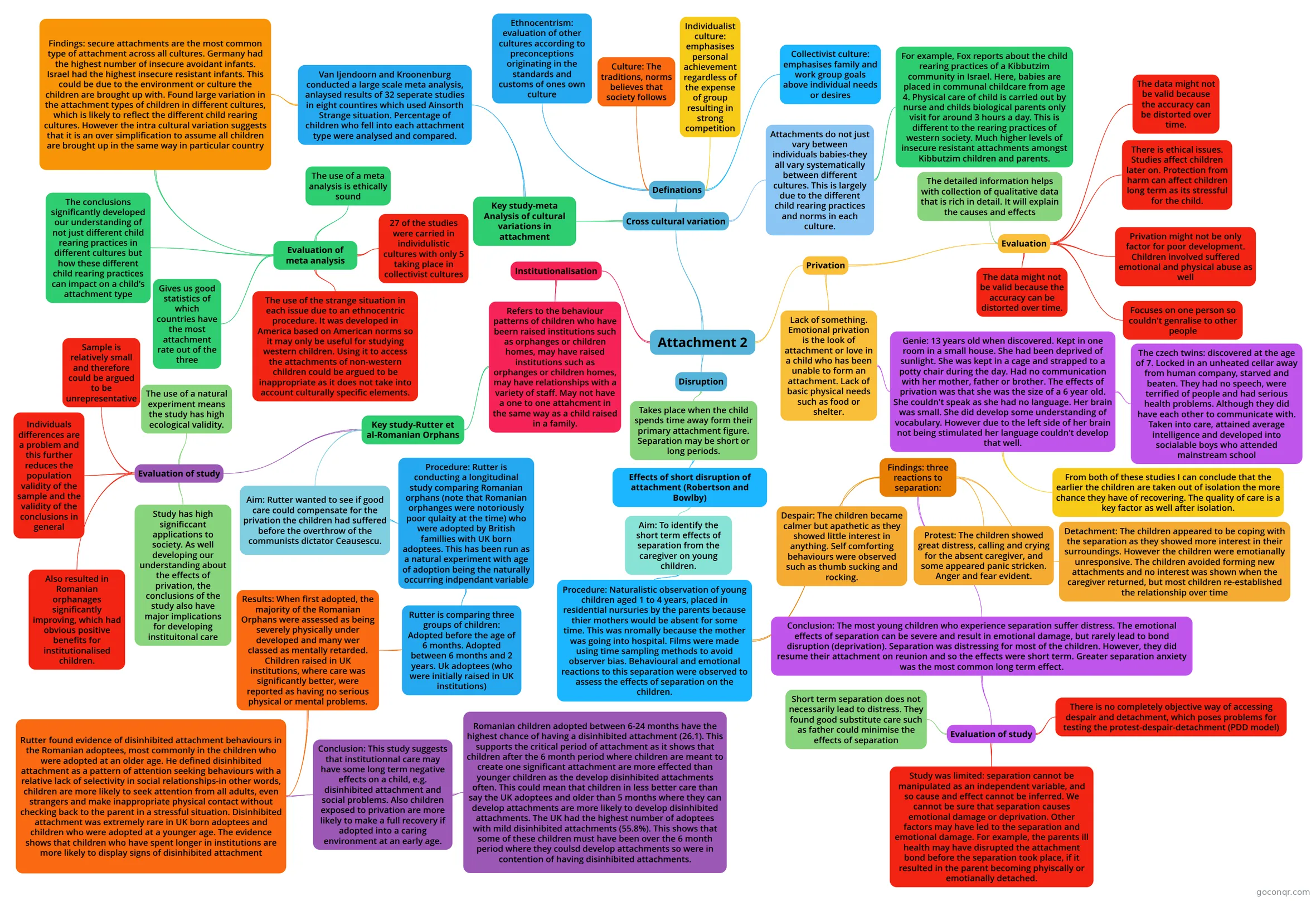
Mind map: Attachment
Map content
Attachment 2
Cross cultural variation
- Definations
- Culture: The traditions, norms believes that society follows
- Individualist culture: emphasises personal achievement regardless of the expense of group resulting in strong competition
- Collectivist culture: emphasises family and work group goals above individual needs or desires
- Ethnocentrism: evaluation of other cultures according to preconceptions originating in the standards and customs of ones own culture
- Attachments do not just vary between individuals babies-they all vary systematically between different cultures. This is largely due to the different child rearing practices and norms in each culture.
- For example, Fox reports about the child rearing practices of a Kibbutzim community in Israel. Here, babies are placed in communal childcare from age 4. Physical care of child is carried out by nurse and childs biological parents only visit for around 3 hours a day. This is different to the rearing practices of western society. Much higher levels of insecure resistant attachments amongst Kibbutzim children and parents.
- Key study-meta Analysis of cultural variations in attachment
- Van Ijendoorn and Kroonenburg conducted a large scale meta analysis, anlaysed results of 32 seperate studies in eight countires which used Ainsorth Strange situation. Percentage of children who fell into each attachment type were analysed and compared.
- Findings: secure attachments are the most common type of attachment across all cultures. Germany had the highest number of insecure avoidant infants. Israel had the highest insecure resistant infants. This could be due to the environment or culture the children are brought up with. Found large variation in the attachment types of children in different cultures, which is likely to reflect the different child rearing cultures. However the intra cultural variation suggests that it is an over simplification to assume all children are brought up in the same way in particular country
- Evaluation of meta analysis
- The use of a meta analysis is ethically sound
- Gives us good statistics of which countries have the most attachment rate out of the three
- The conclusions significantly developed our understanding of not just different child rearing practices in different cultures but how these different child rearing practices can impact on a child's attachment type
- 27 of the studies were carried in individulistic cultures with only 5 taking place in collectivist cultures
- The use of the strange situation in each issue due to an ethnocentric procedure. It was developed in America based on American norms so it may only be useful for studying western children. Using it to access the attachments of non-western children could be argued to be inappropriate as it does not take into account culturally specific elements.
- Evaluation of meta analysis
- Findings: secure attachments are the most common type of attachment across all cultures. Germany had the highest number of insecure avoidant infants. Israel had the highest insecure resistant infants. This could be due to the environment or culture the children are brought up with. Found large variation in the attachment types of children in different cultures, which is likely to reflect the different child rearing cultures. However the intra cultural variation suggests that it is an over simplification to assume all children are brought up in the same way in particular country
- Van Ijendoorn and Kroonenburg conducted a large scale meta analysis, anlaysed results of 32 seperate studies in eight countires which used Ainsorth Strange situation. Percentage of children who fell into each attachment type were analysed and compared.
- Definations
Privation
- Lack of something. Emotional privation is the look of attachment or love in a child who has been unable to form an attachment. Lack of basic physical needs such as food or shelter.
- Genie: 13 years old when discovered. Kept in one room in a small house. She had been deprived of sunlight. She was kept in a cage and strapped to a potty chair during the day. Had no communication with her mother, father or brother. The effects of privation was that she was the size of a 6 year old. She couldn't speak as she had no language. Her brain was small. She did develop some understanding of vocabulary. However due to the left side of her brain not being stimulated her language couldn't develop that well.
- The czech twins: discovered at the age of 7. Locked in an unheated cellar away from human company, starved and beaten. They had no speech, were terrified of people and had serious health problems. Although they did have each other to communicate with. Taken into care, attained average intelligence and developed into socialable boys who attended mainstream school
- From both of these studies I can conclude that the earlier the children are taken out of isolation the more chance they have of recovering. The quality of care is a key factor as well after isolation.
- Genie: 13 years old when discovered. Kept in one room in a small house. She had been deprived of sunlight. She was kept in a cage and strapped to a potty chair during the day. Had no communication with her mother, father or brother. The effects of privation was that she was the size of a 6 year old. She couldn't speak as she had no language. Her brain was small. She did develop some understanding of vocabulary. However due to the left side of her brain not being stimulated her language couldn't develop that well.
- Evaluation
- The detailed information helps with collection of qualitative data that is rich in detail. It will explain the causes and effects
- Focuses on one person so couldn't genralise to other people
- The data might not be valid because the accuracy can be distorted over time.
- The data might not be valid because the accuracy can be distorted over time.
- There is ethical issues. Studies affect children later on. Protection from harm can affect children long term as its stressful for the child.
- Privation might not be only factor for poor development. Children involved suffered emotional and physical abuse as well
- Lack of something. Emotional privation is the look of attachment or love in a child who has been unable to form an attachment. Lack of basic physical needs such as food or shelter.
Institutionalisation
- Refers to the behaviour patterns of children who have beern raised institutions such as orphanges or children homes, may have raised institutions such as orphanges or children homes, may have relationships with a variety of staff. May not have a one to one attahcment in the same way as a child raised in a family.
- Key study-Rutter et al-Romanian Orphans
- Aim: Rutter wanted to see if good care could compensate for the privation the children had suffered before the overthrow of the communists dictator Ceausescu.
- Procedure: Rutter is conducting a longitudinal study comparing Romanian orphans (note that Romanian orphanges were notoriously poor qulaity at the time) who were adopted by British famillies with UK born adoptees. This has been run as a natural experiment with age of adoption being the naturally occurring indpendant variable
- Rutter is comparing three groups of children: Adopted before the age of 6 months. Adopted between 6 months and 2 years. Uk adoptees (who were initially raised in UK institutions)
- Results: When first adopted, the majority of the Romanian Orphans were assessed as being severely physically under developed and many wer classed as mentally retarded. Children raised in UK institutions, where care was significantly better, were reported as having no serious physical or mental problems.
- Rutter found evidence of disinhibited attachment behaviours in the Romanian adoptees, most commonly in the children who were adopted at an older age. He defined disinhibited attachment as a pattern of attention seeking behaviours with a relative lack of selectivity in social relationships-in other words, children are more likely to seek attention from all adults, even strangers and make inappropriate physical contact without checking back to the parent in a stressful situation. Disinhibited attachment was extremely rare in UK born adoptees and children who were adopted at a younger age. The evidence shows that children who have spent longer in institutions are more likely to display signs of disinhibited attachment
- Conclusion: This study suggests that institutionnal care may have some long term negative effects on a child, e.g. disinhibited attachment and social problems. Also children exposed to privation are more likely to make a full recovery if adopted into a caring environment at an early age.
- Romanian children adopted between 6-24 months have the highest chance of having a disinhibited attachment (26.1). This supports the critical period of attachment as it shows that children after the 6 month period where children are meant to create one significant attachment are more effected than younger children as the develop disinhibited attachments often. This could mean that children in less better care than say the UK adoptees and older than 5 months where they can develop attachments are more likely to develop disinhibited attachments. The UK had the highest number of adoptees with mild disinhibited attachments (55.8%). This shows that some of these children must have been over the 6 month period where they coulsd develop attachments so were in contention of having disinhibited attachments.
- Conclusion: This study suggests that institutionnal care may have some long term negative effects on a child, e.g. disinhibited attachment and social problems. Also children exposed to privation are more likely to make a full recovery if adopted into a caring environment at an early age.
- Rutter found evidence of disinhibited attachment behaviours in the Romanian adoptees, most commonly in the children who were adopted at an older age. He defined disinhibited attachment as a pattern of attention seeking behaviours with a relative lack of selectivity in social relationships-in other words, children are more likely to seek attention from all adults, even strangers and make inappropriate physical contact without checking back to the parent in a stressful situation. Disinhibited attachment was extremely rare in UK born adoptees and children who were adopted at a younger age. The evidence shows that children who have spent longer in institutions are more likely to display signs of disinhibited attachment
- Results: When first adopted, the majority of the Romanian Orphans were assessed as being severely physically under developed and many wer classed as mentally retarded. Children raised in UK institutions, where care was significantly better, were reported as having no serious physical or mental problems.
- Rutter is comparing three groups of children: Adopted before the age of 6 months. Adopted between 6 months and 2 years. Uk adoptees (who were initially raised in UK institutions)
- Procedure: Rutter is conducting a longitudinal study comparing Romanian orphans (note that Romanian orphanges were notoriously poor qulaity at the time) who were adopted by British famillies with UK born adoptees. This has been run as a natural experiment with age of adoption being the naturally occurring indpendant variable
- Evaluation of study
- The use of a natural experiment means the study has high ecological validity.
- Study has high significcant applications to society. As well developing our understanding about the effects of privation, the conclusions of the study also have major implications for developing instituitonal care
- Sample is relatively small and therefore could be argued to be unrepresentative
- Individuals differences are a problem and this further reduces the population validity of the sample and the validity of the conclusions in general
- Also resulted in Romanian orphanages significantly improving, which had obvious positive benefits for institutionalised children.
- Aim: Rutter wanted to see if good care could compensate for the privation the children had suffered before the overthrow of the communists dictator Ceausescu.
- Key study-Rutter et al-Romanian Orphans
- Refers to the behaviour patterns of children who have beern raised institutions such as orphanges or children homes, may have raised institutions such as orphanges or children homes, may have relationships with a variety of staff. May not have a one to one attahcment in the same way as a child raised in a family.
Disruption
- Takes place when the child spends time away form their primary attachment figure. Separation may be short or long periods.
- Effects of short disruption of attachment (Robertson and Bowlby)
- Aim: To identify the short term effects of separation from the caregiver on young children.
- Procedure: Naturalistic observation of young children aged 1 to 4 years, placed in residential nursuries by the parents because thier mothers would be absent for some time. This was nromally because the mother was going into hospital. Films were made using time sampling methods to avoid observer bias. Behavioural and emotional reactions to this separation were observed to assess the effects of separation on the children.
- Findings: three reactions to separation:
- Protest: The children showed great distress, calling and crying for the absent caregiver, and some appeared panic stricken. Anger and fear evident.
- Despair: The children became calmer but apathetic as they showed little interest in anything. Self comforting behaviours were observed such as thumb sucking and rocking.
- Detachment: The children appeared to be coping with the separation as they showed more interest in their surroundings. However the children were emotianally unresponsive. The children avoided forming new attachments and no interest was shown when the caregiver returned, but most children re-established the relationship over time
- Conclusion: The most young children who experience separation suffer distress. The emotional effects of separation can be severe and result in emotional damage, but rarely lead to bond disruption (deprivation). Separation was distressing for most of the children. However, they did resume their attachment on reunion and so the effects were short term. Greater separation anxiety was the most common long term effect.
- Evaluation of study
- Short term separation does not necessarily lead to distress. They found good substitute care such as father could minimise the effects of separation
- Study was limited: separation cannot be manipulated as an independent variable, and so cause and effect cannot be inferred. We cannot be sure that separation causes emotional damage or deprivation. Other factors may have led to the separation and emotional damage. For example, the parents ill health may have disrupted the attachment bond before the separation took place, if it resulted in the parent becoming phyiscally or emotianally detached.
- There is no completely objective way of accessing despair and detachment, which poses problems for testing the protest-despair-detachment (PDD model)
- Evaluation of study
- Findings: three reactions to separation:
- Procedure: Naturalistic observation of young children aged 1 to 4 years, placed in residential nursuries by the parents because thier mothers would be absent for some time. This was nromally because the mother was going into hospital. Films were made using time sampling methods to avoid observer bias. Behavioural and emotional reactions to this separation were observed to assess the effects of separation on the children.
- Aim: To identify the short term effects of separation from the caregiver on young children.
- Effects of short disruption of attachment (Robertson and Bowlby)
- Takes place when the child spends time away form their primary attachment figure. Separation may be short or long periods.
Information
- Description
- Mind Map on Attachment 2, created by dan15 on 25/04/2016.
- Created by
- dan15
- Views
- 0
- Rating