
Mind map
Physics Section 3 - Mechanics and Materials
Map content
Physics Section 3 - Mechanics and Materials
6 ~ Forces in Equilibrium
- 6.1 Vectors and scalars
- Representing a vector
- A vector is any physical quantity that has a direction as well as a magnitude
- displacement - straight line distance
- velocity
- force and acceleration
- A scalar is any physical quantity that is not directional
- A vector is any physical quantity that has a direction as well as a magnitude
- Vectors and scale diagrams
- OB = OA + AB to find overall displacement
- sometimes need to move perpendicular lines to calculate resultant force and direction
- Pythagoras and trigonometry
- Use Pythagoras to calculate separate components
- Representing a vector
- 6.2 Balanced forces
- Equilibrium of a point object
- if two forces act on point object and are equal and opposite, object is in equilibrium
- two forces said to be balanced
- for object at rest on surface, weight = support
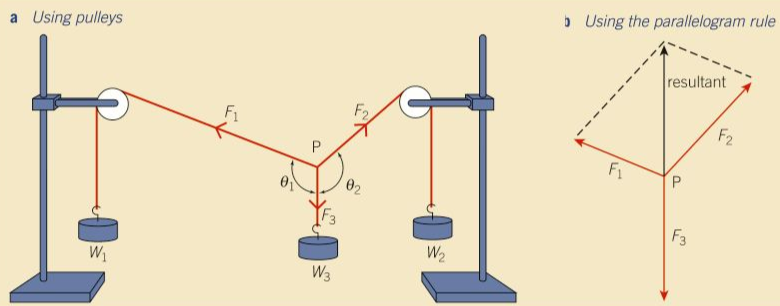
- when three forces act on point object, to be in equilibrium, resultant components must be 0
- if two forces act on point object and are equal and opposite, object is in equilibrium
- Three forces in equilibrium test
- Equilibrium of a point object
- 6.3 The principle of moments
- The moment of a force about any point is defined as the force x the perpendicular distance from the line of action of the force to the point
- unit is Nm
- when in equilibrium, clockwise moments = anticlockwise moments
- Principle of moments
- Centre of mass
- The centre of mass of a body is the point through which a single force on the body has no turning effect
- irregular shapes
- plumb line from three points
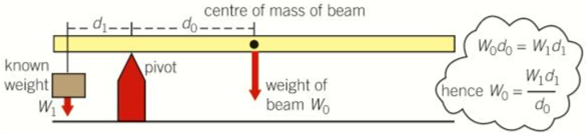
- Calculating the weight of a uniform metre rule
- 6.4 More on moments
- Support forces
- total weight = total upwards support force
- Couples
- a couple is a pair of equal and opposite forces acting on a boy, but not along the same line
- moment of a couple = force x perpendicular distance between the lines of action of the forces
- turns a beam
- Support forces
- 6.5 Stability
- Stable and unstable equilibrium
- stable - returns to equilibrium position when displaced eg coat hanger, hanging basket
- unstable - small displacement results in object moving further from equilibrium position eg plank on a barrel
- Tilting and toppling
- Tilting
- centre of mass lies inside base still
- Toppling
- centre of mass has passed the pivot so object topples over
- Tilting
- Slopes
- high sided object have higher centres of mass eg lorries so when on a slope, the angle of the slope does not have to be too great for them to topple over
- Stable and unstable equilibrium
- 6.6 Equilibrium rules
- Free body diagrams
- show only forces acting on an object
- Triangle of forces
- for equilibrium of 3 forces,a triangle should be able to be formed
- vector sum F1 + F2 + F3 = 0
- scale diagrams
- for equilibrium of 3 forces,a triangle should be able to be formed
- Conditions for equilibrium of a body
- resultant force must be 0
- principle of moments must apply
- Free body diagrams
- 6.1 Vectors and scalars
7 ~ On the Move
- 7.1 Speed and velocity
- Speed
- displacement is distance is given direction
- speed is change of distance per unit time
- velocity is change of displacement per unit time
- Motion at constant speed
- v=s/t
- moving in a circle: v =2πr/T where T is time to move round once
- Motion at changing speed
- average speed =s/t
- v=Δs/Δt
- Distance-time graphs
- gradient = speed of object
- take gradient of tangent at a point for object with changing speed
- gradient = speed of object
- Displacement-time graphs
- when displacement = 0, object at initial point
- Speed
- 7.2 Acceleration
- Acceleration is the change of velocity per unit time
- deceleration is negative acceleration
- Uniform acceleration
- a=(v-u)/t
- v=u+at
- a=(v-u)/t
- Non-uniform acceleration
- find gradient of tangent on velocity-time graph
- Acceleration is the change of velocity per unit time
- 7.3 Motion along a straight line at constant acceleration
- v=u+at
- s=(u+v)t/2
- s=ut+0.5 x at^2
- v^2=u^2+2as
- 7.4 Free Fall
- objects fall at the same rate even if they have different masses - discovered by Galileo
- inclined plane test show a ball gains speed as it moves down the slope
- Acceleration due to gravity
- on Earth, g=9.81ms^-2
- 7.5 Motion graphs
- distance-time and displacement-time
- speed-time and velocity-time
- 7.6 More calculations on motion along a straight line
- two stage problems
- 7.7 Projectile Motion 1
- SUVAT
- if horizontal projection involved, ignore effects of air resistance so horizontal component is constant
- 7.8 Projectile Motion 2
- be able to consider effects of air resistance
- 7.1 Speed and velocity
8 ~ Newton's Laws of Motion
- 8.1 Force and acceleration
- Motion without force
- ice - no friction
- air track allows motion to be observed in the absence of friction as glider on air track floats on cushion of air
- provided track is level, glider moves at constant velocity along the track because friction is absent
- Newton's first law of motion
- objects either stay at rest or moves with constant velocity unless acted on by a force
- Investigating force and motion
- Newton's second law of motion
- F=ma
- Newton's second law of motion
- Weight
- W=mg
- mass of an object is a measure of its inertia, which is its resistance to change of motion
- Motion without force
- 8.2 Using F=ma
- Two forces in opposite directions
- where F1>F2, resultant force, F1 - F2 = ma
- towing a trailer
- F=Ma+ma=(M+m)a
- Further F-ma problems
- pulley problems
- Mg-mg=(M+m)a
- sliding down slopes
- pulley problems
- Two forces in opposite directions
- 8.3 Terminal speed
- drag force depends on object shape, speed and viscosity of the fluid it is travelling through
- Motion of an object falling in a fluid
- speed of object released from rest in fluid increases as it falls until it reaches terminal speed, when drag force is equal and opposite to weight
- Motion of a powered vehicle
- top speed depends on engine power and shape
- if Fe represents the motive force (driving force) provided by engine, resultant force = Fe-Fr where Fr is resistive force opposing motion
- a=(Fe-Fr)/m
- 8.4 On the road
- Stopping distances
- thinking + braking
- thinking - reaction time + speed
- braking - speed
- thinking + braking
- Practical: Testing friction
- measure limiting friction between underside of a block and the surface it is on by pulling with increasing force until it slides. Affect of more mass
- Stopping distances
- 8.5 Vehicle safety
- Impact forces
- measuring impact forces
- F=ma
- measuring impact forces
- Contact time and impact time
- impact time t=s2/(u+v)
- acceleration a=(v-u)/t
- features: bumpers, crumple zones, seat belts, collapsible steering wheel, airbags
- Impact forces
- 8.1 Force and acceleration
9 ~ Force and Momentum
- 9.1 Momentum and impulse
- Momentum
- mass x velocity
- unit is kg m/s or Ns
- Momentum and Newton's laws of motion
- 1st law: an object remains at rest or in uniform motion unless acted on by a force
- 2nd law: rate of change of momentum of an object is proportional to the resultant force on it or the resultant force is proportional to the change of momentum per second
- impulse=FΔt=Δ(mv)
- Force-time graphs
- area under graph represents change of momentum or impulse of force
- Momentum
- 9.2 Impact forces
- F=Δ(mv)/t=(mv-mu)/t
- Force-time graphs for impacts
- variation of impact force with time on a ball can be recorded using a force sensor connected using suitably long wires or a radio link to a computer
- Rebound impacts
- remember direction when calculating change in momentum and impact force
- 9.3 Conservation of momentum
- Newton's 3rd law of motion
- when two objects interact, they exert equal and opposite forces on each other
- two forces must be of the same type, and acting on different objects, for the forces to be considered a force pair
- when two objects interact, they exert equal and opposite forces on each other
- Principle of conservation of momentum
- for a system of interacting objects, the total momentum remains constant, provided no external resultant force acts on the system
- Testing conservation of momentum
- colliding trolleys
- Newton's 3rd law of motion
- 9.4 Elastic and inelastic collisions
- elastic - no loss of kinetic energy
- inelastic collision occurs where the colliding objects have less kinetic energy after the collision than before the collision
- 9.5 Explosions
- using conservation of momentum (ma)(va)+(mb)(vb)=0
- Testing a model explosion
- spring released between two trolleys so trolleys push each other apart
- 9.1 Momentum and impulse
10 ~ Work, Energy, and Power
- 10.1 Work and energy
- Energy rules
- energy needed to make stationary objects move, change shape or warm them up.
- energy types all measured in joules (J)
- energy can be transferred between objects in difference ways, including: by radiation (e.g. light), electrically, mechanically (e.g. by sound)
- energy cannot be created or destroyed (principle of conservation of energy)
- Forces at work
- Work done = force x distance moved in the direction of the force
- work done measured in Nm
- Work done = force x distance moved in the direction of the force
- Force and displacement
- use trigonometry
- Force-distance graphs
- area under line represents work done
- Energy rules
- 10.2 Kinetic energy and potential energy
- Kinetic energy
- Ek = (mv^2)/2
- Potential energy
- ΔEpmgΔh
- Energy changes inloving kinetic and potential energy
- equate two equations
- (v^2)/2=gΔh
- equate two equations
- Pendulum bob
- passes through equilibrium position at max. speed
- kinetic energy = loss of potential energy from max. height, h0 is initial height above equilibrium position
- (mv^2)/2=mg(h0-h)
- Kinetic energy
- 10.3 Power
- Power and energy
- energy can be transferred by work done or heat transfer (conduction, convection, radiation) as well as electricity, sound and em radiation
- power is defined as the rate of transfer of energy =ΔE/Δt=ΔW/Δt
- Power measurements
- electrical
- engine power
- when a powered object moves at constant velocity and constant height, resistive forces are equal and opposite to motive force
- motive force=energy per second wasted due to the resistive force + gain of kinetic energy per second
- Power and energy
- 10.4 Energy and efficiency
- Machines at work
- work done, W=Fs
- output power, Pout=Fv
- Efficiency measures
- useful energy is energy transferred for a purpose
- efficiency=useful energy transferred by machine/energy supplied to machine=work done by machine/energy supplied to machine
- Improving efficiency
- reduce heat production
- Machines at work
- 10.1 Work and energy
11 ~ Materials
- 11.1 Density
- mass per unit volume
- m/v (kgm^-3)
- Density of alloys
- ρ=(ΡaVa+ΡbVb)/V
- 11.2 Springs
- Hooke's Law
- the force needed to stretch a spring is directly proportional to the extension of the spring from its natural length
- only true until spring is stretched past its elastic limit
- the force needed to stretch a spring is directly proportional to the extension of the spring from its natural length
- Combinations
- parallel
- W=Fp+Fq=kpΔL+kqΔL=kΔL
- Series
- ΔL=ΔLp+ΔLq=(W/kp)+(W/kq)=W/k
- parallel
- Energy stored in a stretched spring
- Ep=(FΔL)/2=(kΔL^2)/2
- Hooke's Law
- 11.3 Deformation of solids
- Force and solid materials
- elasticity of a solid material is its ability to regain its shape after it has been deformed or distorted and the forces that deformed it have been released.
- deformation that stretches an object is tensile, whereas deformation that compresses an object is compressive
- Tensile stress and tensile strain
- tensile stress = T/A with unit Pascal (Pa) equal to 1 Nm^-2
- tensile strain = ΔL/L this is a ratio and therefore has no unit
- Young's Modulus = tensile stress / tensile strain
- Graph
- between elastic limit and yield point, the wire weakens temporarily
- beyond elastic limit, plastic deformation occurs
- beyond Y2, a small increase in the tensile stress causes a large increase in tensile strain as the material of the wire undergoes plastic flow
- beyond max. tensile stress, the Ultimate Tensile Stress (UTS), the wire loses its strength, extends and becomes narrower at its weakest point
- UTS is sometimes called the breaking stress
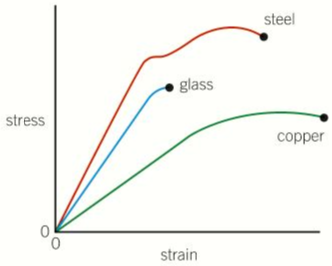
- Stress-strain curves for different materials
- stiffness is the gradient of the stress-strain line
- strength is its UTS
- a brittle material snaps without any noticaable yield eg glass
- a ductile material can be drawn into a wire - copper is more ductile than steel
- Force and solid materials
- 11.4 More about stress and strain
- Loading and unloading of different materials
- metal wire
- same curve is limit of proportionality isn't reached
- parallel curve if permanent extension occurs
- rubber band
- loading curve is higher than unloading curve but returns to the same position
- polythene strip
- low limit of proportionality so plastic deformation occurs meaning similar loading curve to elastic band but straight line staying at almost the same extension as when being stretched
- metal wire
- Strain energy
- elastic energy stored in a stretched wire = 0.5 x TΔL (area under line)
- area between two curves for rubber band show difference between energy stored and recovered energy
- area between curves for polythene represents work done to deform the material permanently
- Loading and unloading of different materials
- 11.1 Density
Images and files in the map
Information
- Description
- Physics Section 3 - Mechanics and Materials revision mind map
- Created by
- Joseph McAuliffe
- Views
- 103
- Tags
- Rating