
Mind map
Chapter 4: Warehouseing
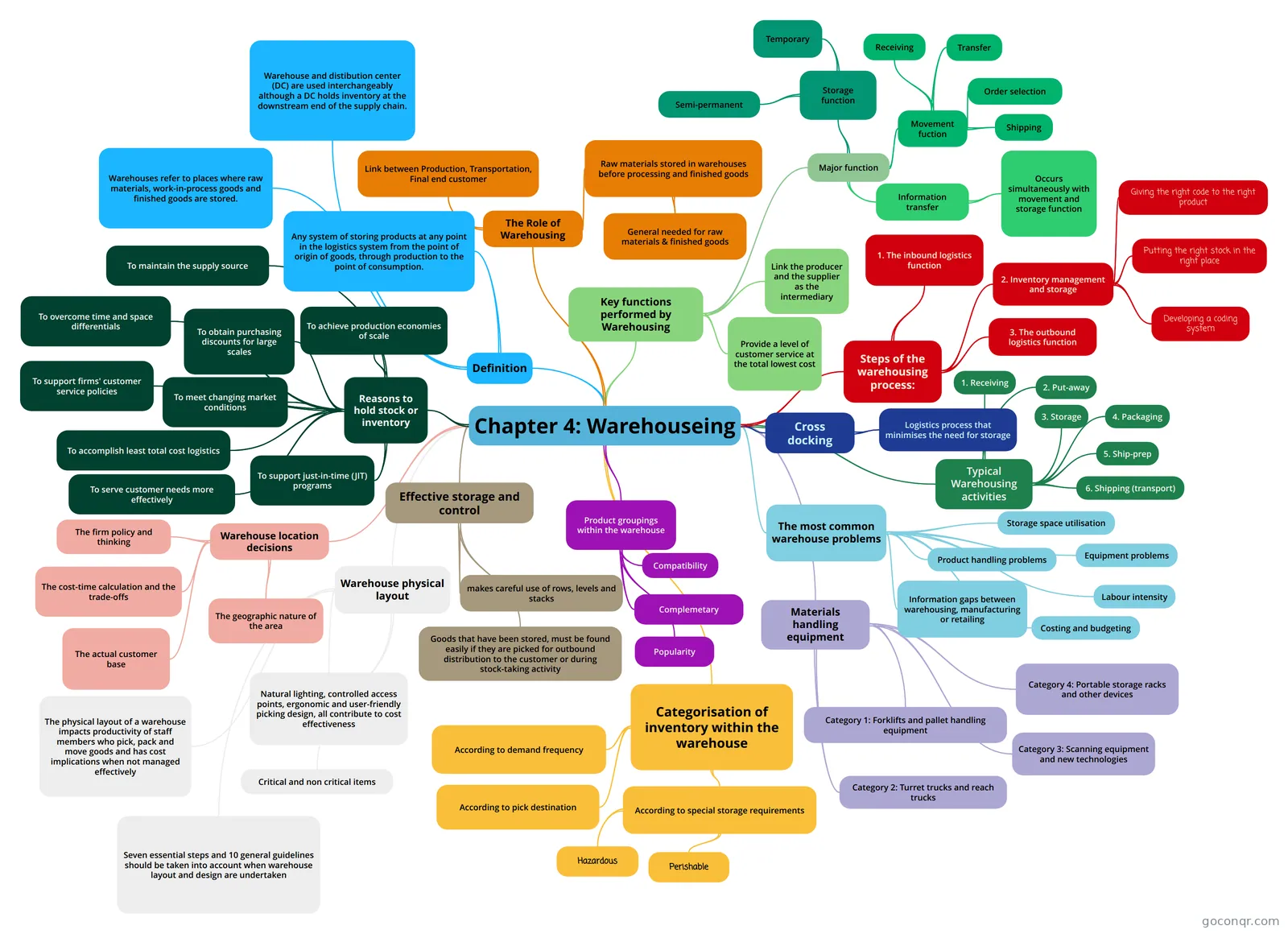
Mind map: warehousing chapter 4
Map content
Chapter 4: Warehouseing
The Role of Warehousing
- Warehouses and distribution centers fulfil a critical role in the SC
- Link between Production, Transportation, Final end customer
- Raw materials stored in warehouses before processing and finished goods
- General needed for raw materials & finished goods
Key functions performed by Warehousing
- Provide a level of customer service at the total lowest cost
- Link the producer and the supplier as the intermediary
- Major function
- Movement fuction
- Receiving
- Transfer
- Order selection
- Shipping
- Storage function
- Semi-permanent
- Temporary
- Information transfer
- Occurs simultaneously with movement and storage function
- Movement fuction
Definition
- Any system of storing products at any point in the logistics system from the point of origin of goods, through production to the point of consumption.
- Warehouse and distibution center (DC) are used interchangeably although a DC holds inventory at the downstream end of the supply chain.
- Warehouses refer to places where raw materials, work-in-process goods and finished goods are stored.
Reasons to hold stock or inventory
- To achieve production economies of scale
- To obtain purchasing discounts for large scales
- To maintain the supply source
- To support firms' customer service policies
- To meet changing market conditions
- To overcome time and space differentials
- To accomplish least total cost logistics
- To serve customer needs more effectively
- To support just-in-time (JIT) programs
Warehouse location decisions
- Deciding how many warehouses to build and where to locate them, depends on the following main factors:
- The firm policy and thinking
- Do they prefer centralized distribution or many decentralized distribution
- The cost-time calculation and the trade-offs
- increase in price of petrol and diesel has become a major factor
- The actual customer base
- The geographic nature of the area
Warehouse physical layout
- The physical layout of a warehouse impacts productivity of staff members who pick, pack and move goods and has cost implications when not managed effectively
- Natural lighting, controlled access points, ergonomic and user-friendly picking design, all contribute to cost effectiveness
- Seven essential steps and 10 general guidelines should be taken into account when warehouse layout and design are undertaken
- Critical and non critical items
- Table 4.1 Page 63
Effective storage and control
- makes careful use of rows, levels and stacks
- Goods that have been stored, must be found easily if they are picked for outbound distribution to the customer or during stock-taking activity
Product groupings within the warehouse
- Compatibility
- In terms of similarity
- Complemetary
- How often products are ordered together
- Popularity
- Dependent on turnover rates or demand rates
- Compatibility
Categorisation of inventory within the warehouse
- According to demand frequency
- According to pick destination
- According to special storage requirements
- Hazardous
- Perishable
Steps of the warehousing process:
- 1. The inbound logistics function
- 2. Inventory management and storage
- Putting the right stock in the right place
- Giving the right code to the right product
- Developing a coding system
- 3. The outbound logistics function
Cross docking
- Logistics process that minimises the need for storage
Typical Warehousing activities
- 1. Receiving
- 2. Put-away
- 3. Storage
- 4. Packaging
- 5. Ship-prep
- 6. Shipping (transport)
The most common warehouse problems
- Storage space utilisation
- Product handling problems
- Equipment problems
- Labour intensity
- Information gaps between warehousing, manufacturing or retailing
- Costing and budgeting
Materials handling equipment
- Category 1: Forklifts and pallet handling equipment
- Category 2: Turret trucks and reach trucks
- Category 3: Scanning equipment and new technologies
- Category 4: Portable storage racks and other devices
Information
- Description
- Degree Business managment Mind Map on Chapter 4: Warehouseing, created by Jonas Lo on 04/05/2016.
- Created by
- Jonas Lo
- Views
- 207
- Tags
- Rating