
Mind map
LOGICAL THINKING
Map content
LOGICAL THINKING
OBSTACLES TO LOGICAL THINKING
- confirmation bias
- availability heuristic
- time-saving bias
- framing problems
- common fallacies
INTRODUCING ARGUMENTS
- statements
- Definition: Statements are the kind of sentences that are either true or false.
- non statements
- arguments
- Definition: An argument is a group of statements some of which, thepremises, are offered in support of another statement, the conclusion.
- premises
- The standard form of an argument is a way of presenting the argument which makes clear which propositions are premises, how many premises there are and which proposition is the conclusion. In standard form, the conclusion of the argument is listed last.
- conclusion
- statements
TYPES OF ARGUMENTS
- deductive
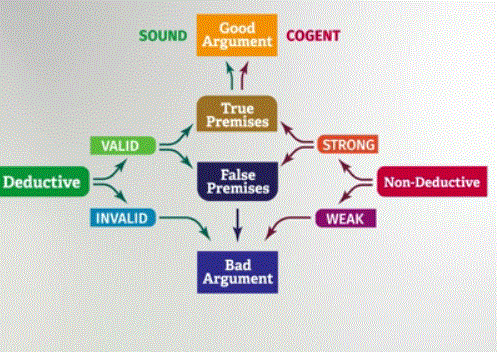
- Definition: A deductive argument is an argument for which the premises are offered to provide logically conclusive support for its conclusion.
- validity
- A valid argument is a deductive argument that succeeds in providing decisive logical support. An invalid argument is a deductive argument that fails in providing conclusive support.
- non-deductive
- Definition: A non-deductive argument is an argument for which the premises are offered to provide probable – but not conclusive – support for its conclusions.
- strength
- Definition: A strong argument is a non-deductive argument that succeeds in providing probable, but not conclusive, logical support for its conclusion. A weak argument is a non-deductive argument that fails to provide probable support for its conclusion.
- principle of charity
- deductive
GOOD AND BAD REASONING
- What, if any, statements does this passage contain?If it’s an argument, what’s the conclusion? And what premises are supplied?If it’s an argument, does it have any suppressed premises? If so, what are they?How does the whole argument look in standard form with all premises made explicit?Is the argument deductive or non-deductive?If it’s deductive, is it valid? If it’s non-deductive, how strong is it? Can you think of a (plausible) counter-example?Are the premises true?So, is it a good or a bad argument?
- counter-example
- Definition: A counter-example to an argument is a situation which shows that the argument can have true premises and a false conclusion.
- sound arguments
- Definition: A sound argument is a valid argument that has true premises.
- cogent arguments
- A cogent argument is a strong non-deductive argument that has true premises.
- irrelevant premises
SCIENCE AND THE SCIENTIFIC METHOD
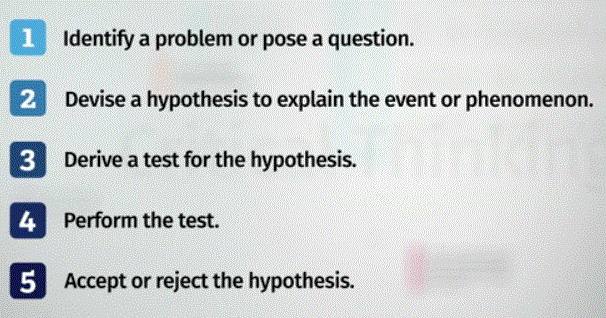
- verification
- verification, showing something to be true
- falsification
- falsification, showing something to be false. That’s why we have to avoid the fallacy of affirming the consequent.
- inferences to the best explanation
- Inferences to the best explanation are common in scientific reasoning.We offer an inference to the best explanation when we conclude that the best available explanation of an observation or state of affairs is probably true because it’s the best available explanation of the observation. A little more formally:S is a state of affairs, a collection of data, facts, observations, givens.An hypothesis, H, would, if true, explain S.No other hypothesis can explain S as well as H does.Therefore, probably,H is true.
- random controlled trials
- blinded
- double blinded
- scientific theories
- In science, by contrast, “theory” is a technical term used to describe a comprehensive account of some aspect of nature, supported by a large body of converging evidence, based on repeated observations and testing, usually integrating and generalising hypotheses, and making consistently accurate predictions across a broad area of scientific inquiry.
- verification
LEGAL REASONING
- reasoning by analogy
- P is similar to Q in certain known respects.P has some further feature– R.Therefore, probably,Q also has the feature R.
- the burden of proof
- To have the burden of proof is to be rationally required to produce evidence for your assertion claims.Burdens of proof come in degrees.To have a heavier burden of proof than some opponent is to be rationally required to produce more or better evidence for your assertion claims than your opponent is rationally required to produce.On that account, the allocation of the burden of proof– who has it and what weight it has– has implications for what we have to do as logical and critical thinkers.If we have it, we have to do more, produce more reasons or stronger reasons perhaps. And if we don’t have it, it seems we can get away with doing less.
- authority
- It is often illegitimate to simply appeal to an authority to seal an argument. It leads us to accept claims in the absence of adequate evidence. And it seems to be at odds with the core idea that the good logical and critical thinker always considers the reasons for his or her beliefs, always takes responsibility for evaluating the grounds for those beliefs.But appeals to authority are central to legal reasoning.Is there a special reason to think appeals to authority are legitimate in law even though they will normally not be in other contexts?
- reasoning by analogy
MORAL REASONING
- the ought-is reasoning
- David Hume claimed that you can’t derive and ought conclusion from entirely factual or is premises. Why not? Well, here’s an example: humans die if you electrocute them (Descriptive).Tim is human. (Descriptive). Therefore,you ought not electrocute Tim. (Moral). That looks like a valid deductive argument, but notice that premises one and two do not entail the conclusion, 3. Suppose you’re an executioner somewhere that uses the electric chair and that Tim has been properly convicted of a ghastly capital offence. You might agree with premises one and two. After all, that’s why you use the electric chair.
- moral theories
- utilitarianism
- According to ‘act utilitarianism’, for instance, the right action is the one that generates the most utility, understood by early proponents as the greatest happiness for the greatest number of people. The theory claims, that is, that right actions have a common property – their tendency to generate utility.
- kant
- An important alternative theory responds to the fact that utilitarianism makes moral rightness depend upon what in fact would make people happy. According to Immanuel Kant the ultimate principle of morality must be capable of guiding us to the right action in any circumstances. He tells us to ask if the motive we are considering acting from could become a universal law, a law to be followed by anyone in any situation. He is concerned with consistency and rationality, not consequences. It could not be moral to make a promise intending it to break it, he thought, because breaking promises as a rule would be inconsistent with the very idea of a promise: rational people could not will that such practice become a universal law.
- Aristotelian virtue theory
- moral relativism
- utilitarianism
- the ought-is reasoning
Images and files in the map
Information
- Description
- Mind Map on LOGICAL THINKING, created by Ángel Brioso on 09/05/2016.
- Created by
- Ángel Brioso
- Views
- 1
- Rating