
Mind map
Lecture 7 - Intelligence
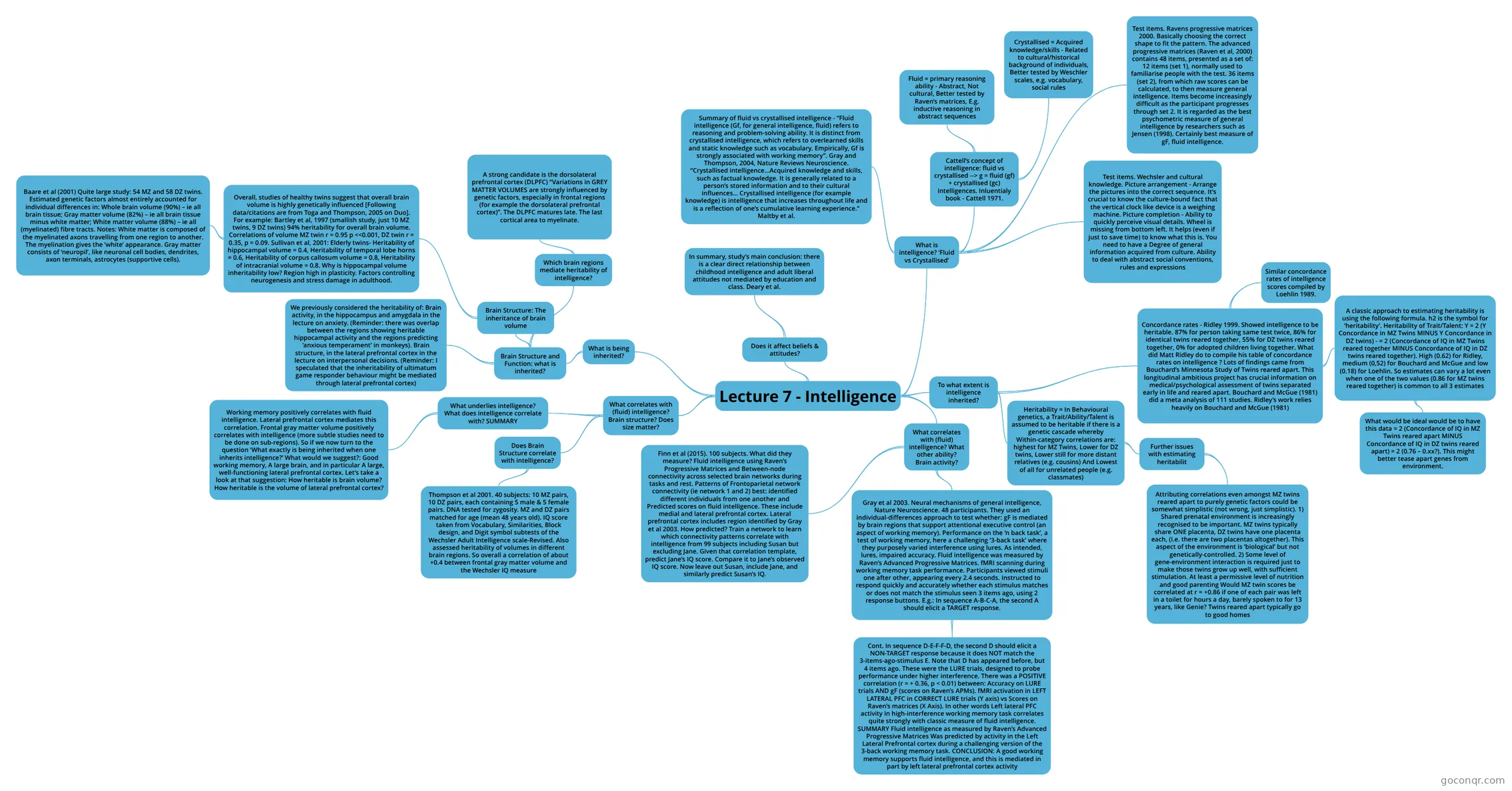
Mind map: Lecture 7 Intelligence
Map content
Lecture 7 - Intelligence
What is intelligence? ‘Fluid vs Crystallised’
- Cattell’s concept of intelligence: fluid vs crystallised --> g = fluid (gf) + crystallised (gc) intelligences. Inluentialy book - Cattell 1971.
- Fluid = primary reasoning ability - Abstract, Not cultural, Better tested by Raven’s matrices, E.g. inductive reasoning in abstract sequences
- Crystallised = Acquired knowledge/skills - Related to cultural/historical background of individuals, Better tested by Weschler scales, e.g. vocabulary, social rules
- Test items. Wechsler and cultural knowledge. Picture arrangement - Arrange the pictures into the correct sequence. It’s crucial to know the culture-bound fact that the vertical clock like device is a weighing machine. Picture completion - Ability to quickly perceive visual details. Wheel is missing from bottom left. It helps (even if just to save time) to know what this is. You need to have a Degree of general information acquired from culture. Ability to deal with abstract social conventions, rules and expressions
- Test items. Ravens progressive matrices 2000. Basically choosing the correct shape to fit the pattern. The advanced progressive matrices (Raven et al, 2000) contains 48 items, presented as a set of: 12 items (set 1), normally used to familiarise people with the test. 36 items (set 2), from which raw scores can be calculated, to then measure general intelligence. Items become increasingly difficult as the participant progresses through set 2. It is regarded as the best psychometric measure of general intelligence by researchers such as Jensen (1998). Certainly best measure of gF, fluid intelligence.
- Summary of fluid vs crystallised intelligence - “Fluid intelligence (Gf, for general intelligence, fluid) refers to reasoning and problem-solving ability. It is distinct from crystallised intelligence, which refers to overlearned skills and static knowledge such as vocabulary. Empirically, Gf is strongly associated with working memory”. Gray and Thompson, 2004, Nature Reviews Neuroscience. “Crystallised intelligence…Acquired knowledge and skills, such as factual knowledge. It is generally related to a person’s stored information and to their cultural influences… Crystallised intelligence (for example knowledge) is intelligence that increases throughout life and is a reflection of one’s cumulative learning experience.” Maltby et al.
- Cattell’s concept of intelligence: fluid vs crystallised --> g = fluid (gf) + crystallised (gc) intelligences. Inluentialy book - Cattell 1971.
To what extent is intelligence inherited?
- Heritability = In Behavioural genetics, a Trait/Ability/Talent is assumed to be heritable if there is a genetic cascade whereby Within-category correlations are: highest for MZ Twins, Lower for DZ twins, Lower still for more distant relatives (e.g. cousins) And Lowest of all for unrelated people (e.g. classmates)
- Further issues with estimating heritabilit
- Attributing correlations even amongst MZ twins reared apart to purely genetic factors could be somewhat simplistic (not wrong, just simplistic). 1) Shared prenatal environment is increasingly recognised to be important. MZ twins typically share ONE placenta, DZ twins have one placenta each, (i.e. there are two placentas altogether). This aspect of the environment is ‘biological’ but not genetically-controlled. 2) Some level of gene-environment interaction is required just to make those twins grow up well, with sufficient stimulation. At least a permissive level of nutrition and good parenting Would MZ twin scores be correlated at r = +0.86 if one of each pair was left in a toilet for hours a day, barely spoken to for 13 years, like Genie? Twins reared apart typically go to good homes
- Further issues with estimating heritabilit
- Concordance rates - Ridley 1999. Showed intelligence to be heritable. 87% for person taking same test twice, 86% for identical twins reared together, 55% for DZ twins reared together, 0% for adopted children living together. What did Matt Ridley do to compile his table of concordance rates on intelligence ? Lots of findings came from Bouchard’s Minnesota Study of Twins reared apart. This longitudinal ambitious project has crucial information on medical/psychological assessment of twins separated early in life and reared apart. Bouchard and McGue (1981) did a meta analysis of 111 studies. Ridley’s work relies heavily on Bouchard and McGue (1981)
- Similar concordance rates of intelligence scores compiled by Loehlin 1989.
- A classic approach to estimating heritability is using the following formula. h2 is the symbol for ‘heritability’. Heritability of Trait/Talent: Y = 2 (Y Concordance in MZ Twins MINUS Y Concordance in DZ twins) - = 2 (Concordance of IQ in MZ Twins reared together MINUS Concordance of IQ in DZ twins reared together). High (0.62) for Ridley, medium (0,52) for Bouchard and McGue and low (0.18) for Loehlin. So estimates can vary a lot even when one of the two values (0.86 for MZ twins reared together) is common to all 3 estimates
- What would be ideal would be to have this data = 2 (Concordance of IQ in MZ Twins reared apart MINUS Concordance of IQ in DZ twins reared apart) = 2 (0.76 – 0.xx?). This might better tease apart genes from environment.
- Heritability = In Behavioural genetics, a Trait/Ability/Talent is assumed to be heritable if there is a genetic cascade whereby Within-category correlations are: highest for MZ Twins, Lower for DZ twins, Lower still for more distant relatives (e.g. cousins) And Lowest of all for unrelated people (e.g. classmates)
What correlates with (fluid) intelligence? What other ability? Brain activity?
- Gray et al 2003. Neural mechanisms of general intelligence, Nature Neuroscience. 48 participants. They used an individual-differences approach to test whether: gF is mediated by brain regions that support attentional executive control (an aspect of working memory). Performance on the ‘n back task’, a test of working memory, here a challenging ‘3-back task’ where they purposely varied interference using lures. As intended, lures, impaired accuracy. Fluid intelligence was measured by Raven’s Advanced Progressive Matrices. fMRI scanning during working memory task performance. Participants viewed stimuli one after other, appearing every 2.4 seconds. Instructed to respond quickly and accurately whether each stimulus matches or does not match the stimulus seen 3 items ago, using 2 response buttons. E.g.: In sequence A-B-C-A, the second A should elicit a TARGET response.
- Cont. In sequence D-E-F-F-D, the second D should elicit a NON-TARGET response because it does NOT match the 3-items-ago-stimulus E. Note that D has appeared before, but 4 items ago. These were the LURE trials, designed to probe performance under higher interference. There was a POSITIVE correlation (r = + 0.36, p < 0.01) between: Accuracy on LURE trials AND gF (scores on Raven’s APMs). fMRI activation in LEFT LATERAL PFC in CORRECT LURE trials (Y axis) vs Scores on Raven’s matrices (X Axis). In other words Left lateral PFC activity in high-interference working memory task correlates quite strongly with classic measure of fluid intelligence. SUMMARY Fluid intelligence as measured by Raven’s Advanced Progressive Matrices Was predicted by activity in the Left Lateral Prefrontal cortex during a challenging version of the 3-back working memory task. CONCLUSION: A good working memory supports fluid intelligence, and this is mediated in part by left lateral prefrontal cortex activity
- Finn et al (2015). 100 subjects. What did they measure? Fluid intelligence using Raven’s Progressive Matrices and Between-node connectivity across selected brain networks during tasks and rest. Patterns of Frontoparietal network connectivity (ie network 1 and 2) best: identified different individuals from one another and Predicted scores on fluid intelligence. These include medial and lateral prefrontal cortex. Lateral prefrontal cortex includes region identified by Gray et al 2003. How predicted? Train a network to learn which connectivity patterns correlate with intelligence from 99 subjects including Susan but excluding Jane. Given that correlation template, predict Jane’s IQ score. Compare it to Jane’s observed IQ score. Now leave out Susan, include Jane, and similarly predict Susan’s IQ.
- Gray et al 2003. Neural mechanisms of general intelligence, Nature Neuroscience. 48 participants. They used an individual-differences approach to test whether: gF is mediated by brain regions that support attentional executive control (an aspect of working memory). Performance on the ‘n back task’, a test of working memory, here a challenging ‘3-back task’ where they purposely varied interference using lures. As intended, lures, impaired accuracy. Fluid intelligence was measured by Raven’s Advanced Progressive Matrices. fMRI scanning during working memory task performance. Participants viewed stimuli one after other, appearing every 2.4 seconds. Instructed to respond quickly and accurately whether each stimulus matches or does not match the stimulus seen 3 items ago, using 2 response buttons. E.g.: In sequence A-B-C-A, the second A should elicit a TARGET response.
What correlates with (fluid) intelligence? Brain structure? Does size matter?
- Does Brain Structure correlate with intelligence?
- Thompson et al 2001. 40 subjects: 10 MZ pairs, 10 DZ pairs, each containing 5 male & 5 female pairs. DNA tested for zygosity. MZ and DZ pairs matched for age (mean 48 years old). IQ score taken from Vocabulary, Similarities, Block design, and Digit symbol subtests of the Wechsler Adult Intelligence scale-Revised. Also assessed heritability of volumes in different brain regions. So overall a correlation of about +0.4 between frontal gray matter volume and the Wechsler IQ measure
- What underlies intelligence? What does intelligence correlate with? SUMMARY
- Working memory positively correlates with fluid intelligence. Lateral prefrontal cortex mediates this correlation. Frontal gray matter volume positively correlates with intelligence (more subtle studies need to be done on sub-regions). So if we now turn to the question ‘What exactly is being inherited when one inherits intelligence?’ What would we suggest?: Good working memory, A large brain, and in particular A large, well-functioning lateral prefrontal cortex. Let’s take a look at that suggestion: How heritable is brain volume? How heritable is the volume of lateral prefrontal cortex?
- Does Brain Structure correlate with intelligence?
What is being inherited?
- Brain Structure and Function: what is inherited?
- We previously considered the heritability of: Brain activity, in the hippocampus and amygdala in the lecture on anxiety. (Reminder: there was overlap between the regions showing heritable hippocampal activity and the regions predicting ‘anxious temperament’ in monkeys). Brain structure, in the lateral prefrontal cortex in the lecture on interpersonal decisions. (Reminder: I speculated that the inheritability of ultimatum game responder behaviour might be mediated through lateral prefrontal cortex)
- Brain Structure: The inheritance of brain volume
- Overall, studies of healthy twins suggest that overall brain volume is highly genetically influenced [Following data/citations are from Toga and Thompson, 2005 on Duo]. For example: Bartley et al, 1997 (smallish study, just 10 MZ twins, 9 DZ twins) 94% heritability for overall brain volume. Correlations of volume MZ twin r = 0.95 p <<0.001, DZ twin r = 0.35, p = 0.09. Sullivan et al, 2001: Elderly twins- Heritability of hippocampal volume = 0.4, Heritability of temporal lobe horns = 0.6, Heritability of corpus callosum volume = 0.8, Heritability of intracranial volume = 0.8. Why is hippocampal volume inheritability low? Region high in plasticity. Factors controlling neurogenesis and stress damage in adulthood.
- Baare et al (2001) Quite large study: 54 MZ and 58 DZ twins. Estimated genetic factors almost entirely accounted for individual differences in: Whole brain volume (90%) – ie all brain tissue; Gray matter volume (82%) – ie all brain tissue minus white matter; White matter volume (88%) – ie all (myelinated) fibre tracts. Notes: White matter is composed of the myelinated axons travelling from one region to another. The myelination gives the ‘white’ appearance. Gray matter consists of ‘neuropil’, like neuronal cell bodies, dendrites, axon terminals, astrocytes (supportive cells).
- Overall, studies of healthy twins suggest that overall brain volume is highly genetically influenced [Following data/citations are from Toga and Thompson, 2005 on Duo]. For example: Bartley et al, 1997 (smallish study, just 10 MZ twins, 9 DZ twins) 94% heritability for overall brain volume. Correlations of volume MZ twin r = 0.95 p <<0.001, DZ twin r = 0.35, p = 0.09. Sullivan et al, 2001: Elderly twins- Heritability of hippocampal volume = 0.4, Heritability of temporal lobe horns = 0.6, Heritability of corpus callosum volume = 0.8, Heritability of intracranial volume = 0.8. Why is hippocampal volume inheritability low? Region high in plasticity. Factors controlling neurogenesis and stress damage in adulthood.
- Which brain regions mediate heritability of intelligence?
- A strong candidate is the dorsolateral prefrontal cortex (DLPFC) “Variations in GREY MATTER VOLUMES are strongly influenced by genetic factors, especially in frontal regions (for example the dorsolateral prefrontal cortex)”. The DLPFC matures late. The last cortical area to myelinate.
- Brain Structure and Function: what is inherited?
Does it affect beliefs & attitudes?
- In summary, study’s main conclusion: there is a clear direct relationship between childhood intelligence and adult liberal attitudes not mediated by education and class. Deary et al.
Information
- Description
- Yr 2 Unit Individual psychology Mind Map on Lecture 7 - Intelligence, created by Issy de Silva on 10/05/2016.
- Created by
- Issy de Silva
- Views
- 2
- Rating