
Mind map
IR THEORIES
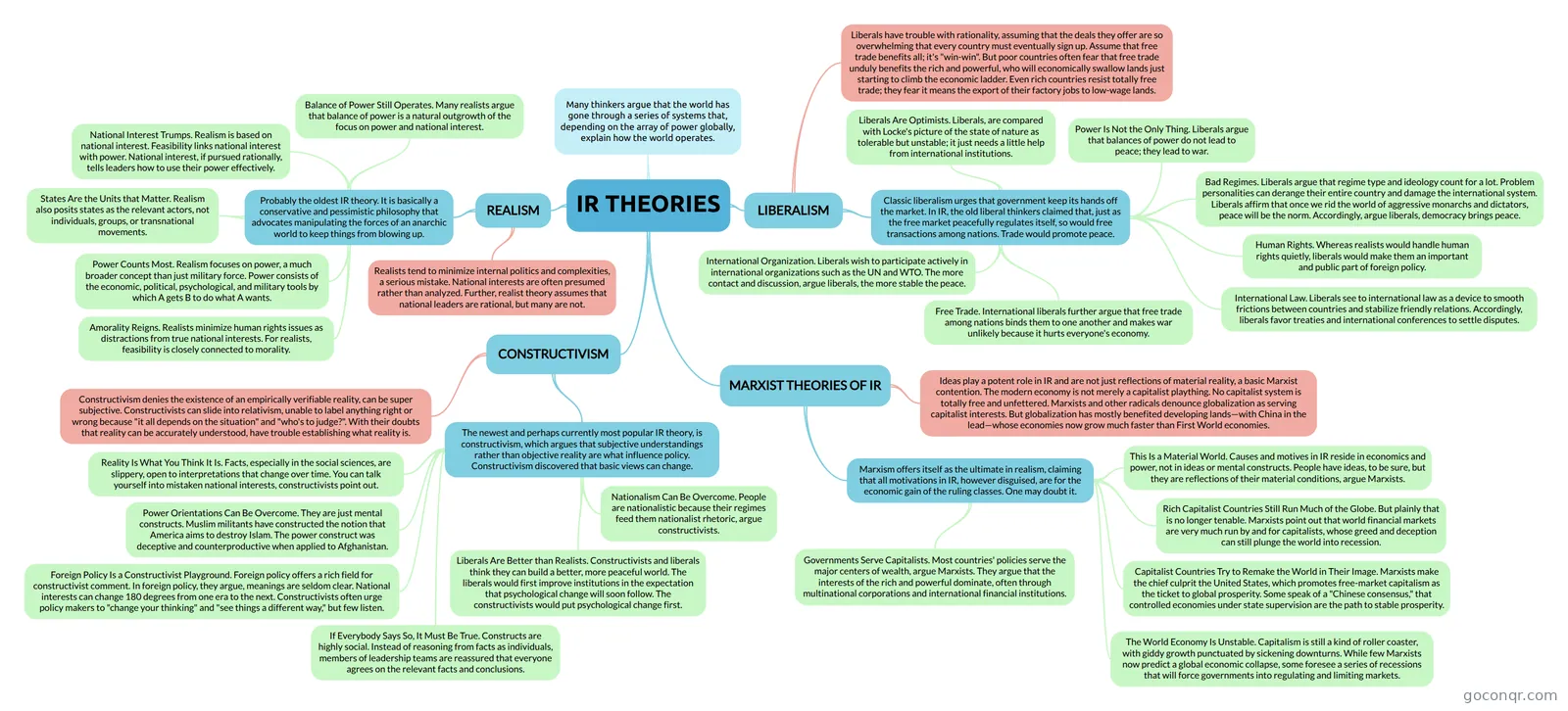
Mind map: IR theories
Map content
IR THEORIES
Many thinkers argue that the world has gone through a series of systems that, depending on the array of power globally, explain how the world operates.
REALISM
- Probably the oldest IR theory. It is basically a conservative and pessimistic philosophy that advocates manipulating the forces of an anarchic world to keep things from blowing up.
- Power Counts Most. Realism focuses on power, a much broader concept than just military force. Power consists of the economic, political, psychological, and military tools by which A gets B to do what A wants.
- Balance of Power Still Operates. Many realists argue that balance of power is a natural outgrowth of the focus on power and national interest.
- States Are the Units that Matter. Realism also posits states as the relevant actors, not individuals, groups, or transnational movements.
- National Interest Trumps. Realism is based on national interest. Feasibility links national interest with power. National interest, if pursued rationally, tells leaders how to use their power effectively.
- Amorality Reigns. Realists minimize human rights issues as distractions from true national interests. For realists, feasibility is closely connected to morality.
- Realists tend to minimize internal politics and complexities, a serious mistake. National interests are often presumed rather than analyzed. Further, realist theory assumes that national leaders are rational, but many are not.
- Probably the oldest IR theory. It is basically a conservative and pessimistic philosophy that advocates manipulating the forces of an anarchic world to keep things from blowing up.
LIBERALISM
- Classic liberalism urges that government keep its hands off the market. In IR, the old liberal thinkers claimed that, just as the free market peacefully regulates itself, so would free transactions among nations. Trade would promote peace.
- International Law. Liberals see to international law as a device to smooth frictions between countries and stabilize friendly relations. Accordingly, liberals favor treaties and international conferences to settle disputes.
- Human Rights. Whereas realists would handle human rights quietly, liberals would make them an important and public part of foreign policy.
- International Organization. Liberals wish to participate actively in international organizations such as the UN and WTO. The more contact and discussion, argue liberals, the more stable the peace.
- Free Trade. International liberals further argue that free trade among nations binds them to one another and makes war unlikely because it hurts everyone's economy.
- Power Is Not the Only Thing. Liberals argue that balances of power do not lead to peace; they lead to war.
- Bad Regimes. Liberals argue that regime type and ideology count for a lot. Problem personalities can derange their entire country and damage the international system. Liberals affirm that once we rid the world of aggressive monarchs and dictators, peace will be the norm. Accordingly, argue liberals, democracy brings peace.
- Liberals Are Optimists. Liberals, are compared with Locke's picture of the state of nature as tolerable but unstable; it just needs a little help from international institutions.
- Liberals have trouble with rationality, assuming that the deals they offer are so overwhelming that every country must eventually sign up. Assume that free trade benefits all; it's "win-win". But poor countries often fear that free trade unduly benefits the rich and powerful, who will economically swallow lands just starting to climb the economic ladder. Even rich countries resist totally free trade; they fear it means the export of their factory jobs to low-wage lands.
- Classic liberalism urges that government keep its hands off the market. In IR, the old liberal thinkers claimed that, just as the free market peacefully regulates itself, so would free transactions among nations. Trade would promote peace.
CONSTRUCTIVISM
- The newest and perhaps currently most popular IR theory, is constructivism, which argues that subjective understandings rather than objective reality are what influence policy. Constructivism discovered that basic views can change.
- Reality Is What You Think It Is. Facts, especially in the social sciences, are slippery, open to interpretations that change over time. You can talk yourself into mistaken national interests, constructivists point out.
- If Everybody Says So, It Must Be True. Constructs are highly social. Instead of reasoning from facts as individuals, members of leadership teams are reassured that everyone agrees on the relevant facts and conclusions.
- Power Orientations Can Be Overcome. They are just mental constructs. Muslim militants have constructed the notion that America aims to destroy Islam. The power construct was deceptive and counterproductive when applied to Afghanistan.
- Nationalism Can Be Overcome. People are nationalistic because their regimes feed them nationalist rhetoric, argue constructivists.
- Foreign Policy Is a Constructivist Playground. Foreign policy offers a rich field for constructivist comment. In foreign policy, they argue, meanings are seldom clear. National interests can change 180 degrees from one era to the next. Constructivists often urge policy makers to "change your thinking" and "see things a different way," but few listen.
- Liberals Are Better than Realists. Constructivists and liberals think they can build a better, more peaceful world. The liberals would first improve institutions in the expectation that psychological change will soon follow. The constructivists would put psychological change first.
- Constructivism denies the existence of an empirically verifiable reality, can be super subjective. Constructivists can slide into relativism, unable to label anything right or wrong because "it all depends on the situation" and "who's to judge?". With their doubts that reality can be accurately understood, have trouble establishing what reality is.
- The newest and perhaps currently most popular IR theory, is constructivism, which argues that subjective understandings rather than objective reality are what influence policy. Constructivism discovered that basic views can change.
MARXIST THEORIES OF IR
- Ideas play a potent role in IR and are not just reflections of material reality, a basic Marxist contention. The modern economy is not merely a capitalist plaything. No capitalist system is totally free and unfettered. Marxists and other radicals denounce globalization as serving capitalist interests. But globalization has mostly benefited developing lands—with China in the lead—whose economies now grow much faster than First World economies.
- Marxism offers itself as the ultimate in realism, claiming that all motivations in IR, however disguised, are for the economic gain of the ruling classes. One may doubt it.
- This Is a Material World. Causes and motives in IR reside in economics and power, not in ideas or mental constructs. People have ideas, to be sure, but they are reflections of their material conditions, argue Marxists.
- Governments Serve Capitalists. Most countries' policies serve the major centers of wealth, argue Marxists. They argue that the interests of the rich and powerful dominate, often through multinational corporations and international financial institutions.
- Rich Capitalist Countries Still Run Much of the Globe. But plainly that is no longer tenable. Marxists point out that world financial markets are very much run by and for capitalists, whose greed and deception can still plunge the world into recession.
- Capitalist Countries Try to Remake the World in Their Image. Marxists make the chief culprit the United States, which promotes free-market capitalism as the ticket to global prosperity. Some speak of a "Chinese consensus," that controlled economies under state supervision are the path to stable prosperity.
- The World Economy Is Unstable. Capitalism is still a kind of roller coaster, with giddy growth punctuated by sickening downturns. While few Marxists now predict a global economic collapse, some foresee a series of recessions that will force governments into regulating and limiting markets.
Information
- Description
- Negocios Internacionales Mind Map on IR THEORIES, created by Marlon Castillo Escobar on 22/07/2016.
- Created by
- Marlon Castillo Escobar
- Views
- 4
- Rating