
Mind map
T013 Foundation types
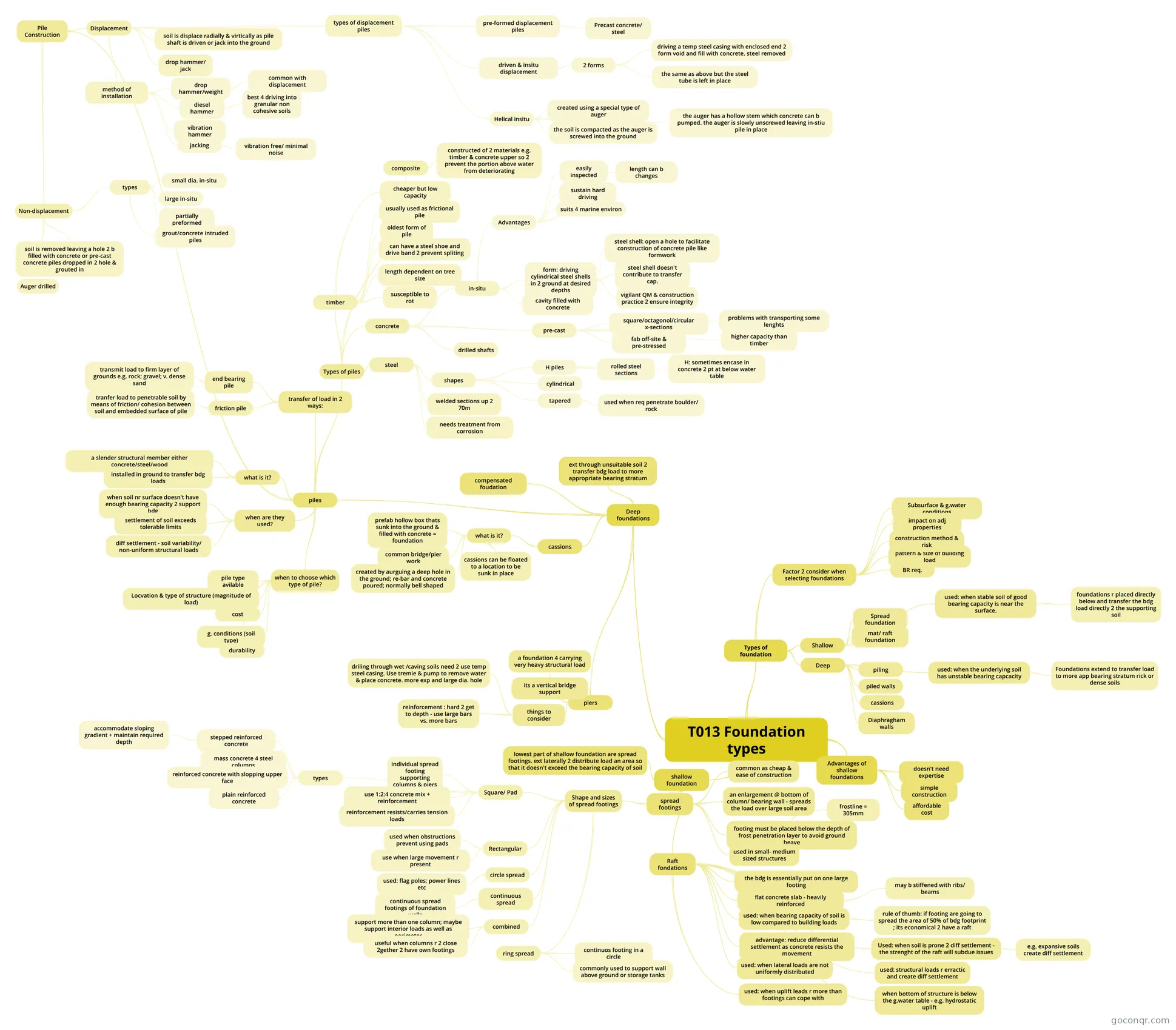
Mind map: Foundation types
Map content
T013 Foundation types
Types of foundation
- Shallow
- Spread foundation
- mat/ raft foundation
- used: when stable soil of good bearing capacity is near the surface.
- foundations r placed directly below and transfer the bdg load directly 2 the supporting soil
- Deep
- piling
- piled walls
- Diaphragham walls
- cassions
- used: when the underlying soil has unstable bearing capcacity
- Foundations extend to transfer load to more app bearing stratum rick or dense soils
- Factor 2 consider when selecting foundations
- pattern & size of building load
- Subsurface & g.water conditions
- impact on adj properties
- BR req.
- construction method & risk
- Shallow
Advantages of shallow foundations
- affordable cost
- simple construction
- doesn't need expertise
shallow foundation
- spread footings
- an enlargement @ bottom of column/ bearing wall - spreads the load over large soil area
- footing must be placed below the depth of frost penetration layer to avoid ground heave
- frostline = 305mm
- common as cheap & ease of construction
- used in small- medium sized structures
- Shape and sizes of spread footings
- Square/ Pad
- individual spread footing supporting columns & piers
- use 1:2:4 concrete mix + reinforcement
- reinforcement resists/carries tension loads
- types
- mass concrete 4 steel columns
- reinforced concrete with slopping upper face
- plain reinforced concrete
- stepped reinforced concrete
- accommodate sloping gradient + maintain required depth
- Rectangular
- used when obstructions prevent using pads
- use when large movement r present
- circle spread
- used: flag poles; power lines etc
- combined
- support more than one column; maybe support interior loads as well as perimeter
- useful when columns r 2 close 2gether 2 have own footings
- continuous spread
- continuous spread footings of foundation walls
- ring spread
- continuos footing in a circle
- commonly used to support wall above ground or storage tanks
- Square/ Pad
- lowest part of shallow foundation are spread footings. ext laterally 2 distribute load an area so that it doesn't exceed the bearing capacity of soil
- Raft fondations
- the bdg is essentially put on one large footing
- flat concrete slab - heavily reinforced
- may b stiffened with ribs/ beams
- used: when bearing capacity of soil is low compared to building loads
- rule of thumb: if footing are going to spread the area of 50% of bdg footprint ; its economical 2 have a raft
- advantage: reduce differential settlement as concrete resists the movement
- Used: when soil is prone 2 diff settlement - the strenght of the raft will subdue issues
- e.g. expansive soils create diff settlement
- used: structural loads r erractic and create diff settlement
- used: when lateral loads are not uniformly distributed
- used: when uplift leads r more than footings can cope with
- when bottom of structure is below the g.water table - e.g. hydrostatic uplift
- spread footings
Deep foundations
- ext through unsuitable soil 2 transfer bdg load to more appropriate bearing stratum
- piles
- what is it?
- a slender structural member either concrete/steel/wood
- installed in ground to transfer bdg loads
- when are they used?
- when soil nr surface doesn't have enough bearing capacity 2 support bdg
- settlement of soil exceeds tolerable limits
- diff settlement - soil variability/ non-uniform structural loads
- transfer of load in 2 ways:
- end bearing pile
- transmit load to firm layer of grounds e.g. rock; gravel; v. dense sand
- friction pile
- tranfer load to penetrable soil by means of friction/ cohesion between soil and embedded surface of pile
- end bearing pile
- Types of piles
- concrete
- in-situ
- form: driving cylindrical steel shells in 2 ground at desired depths
- steel shell doesn't contribute to transfer cap.
- steel shell: open a hole to facilitate construction of concrete pile like formwork
- vigilant QM & construction practice 2 ensure integrity
- cavity filled with concrete
- Advantages
- sustain hard driving
- suits 4 marine environ
- easily inspected
- length can b changes
- form: driving cylindrical steel shells in 2 ground at desired depths
- pre-cast
- square/octagonol/circular x-sections
- fab off-site & pre-stressed
- problems with transporting some lenghts
- higher capacity than timber
- drilled shafts
- in-situ
- steel
- shapes
- H piles
- rolled steel sections
- H: sometimes encase in concrete 2 pt at below water table
- cylindrical
- tapered
- used when req penetrate boulder/ rock
- H piles
- welded sections up 2 70m
- needs treatment from corrosion
- shapes
- timber
- oldest form of pile
- length dependent on tree size
- usually used as frictional pile
- can have a steel shoe and drive band 2 prevent spliting
- susceptible to rot
- cheaper but low capacity
- composite
- constructed of 2 materials e.g. timber & concrete upper so 2 prevent the portion above water from deteriorating
- concrete
- when to choose which type of pile?
- pile type avilable
- Locvation & type of structure (magnitude of load)
- g. conditions (soil type)
- cost
- durability
- Pile Construction
- Displacement
- soil is displace radially & virtically as pile shaft is driven or jack into the ground
- drop hammer/ jack
- types of displacement piles
- pre-formed displacement piles
- Precast concrete/ steel
- driven & insitu displacement
- 2 forms
- driving a temp steel casing with enclosed end 2 form void and fill with concrete. steel removed
- the same as above but the steel tube is left in place
- 2 forms
- Helical insitu
- created using a special type of auger
- the soil is compacted as the auger is screwed into the ground
- the auger has a hollow stem which concrete can b pumped. the auger is slowly unscrewed leaving in-stiu pile in place
- pre-formed displacement piles
- method of installation
- drop hammer/weight
- common with displacement
- diesel hammer
- best 4 driving into granular non cohesive soils
- vibration hammer
- jacking
- vibration free/ minimal noise
- drop hammer/weight
- Non-displacement
- soil is removed leaving a hole 2 b filled with concrete or pre-cast concrete piles dropped in 2 hole & grouted in
- Auger drilled
- types
- small dia. in-situ
- large in-situ
- partially preformed
- grout/concrete intruded piles
- Displacement
- what is it?
- piers
- its a vertical bridge support
- a foundation 4 carrying very heavy structural load
- things to consider
- driling through wet /caving soils need 2 use temp steel casing. Use tremie & pump to remove water & place concrete. more exp and large dia. hole
- reinforcement : hard 2 get to depth - use large bars vs. more bars
- cassions
- what is it?
- prefab hollow box thats sunk into the ground & filled with concrete = foundation
- common bridge/pier work
- cassions can be floated to a location to be sunk in place
- created by aurguing a deep hole in the ground; re-bar and concrete poured; normally bell shaped
- what is it?
- compensated foudation
Information
- Description
- M007 & T013 Mind Map on T013 Foundation types, created by alison_patey0437 on 28/04/2013.
- Created by
- alison_patey0437
- Views
- 141
- Tags
- Rating