
Mind map
Samsara
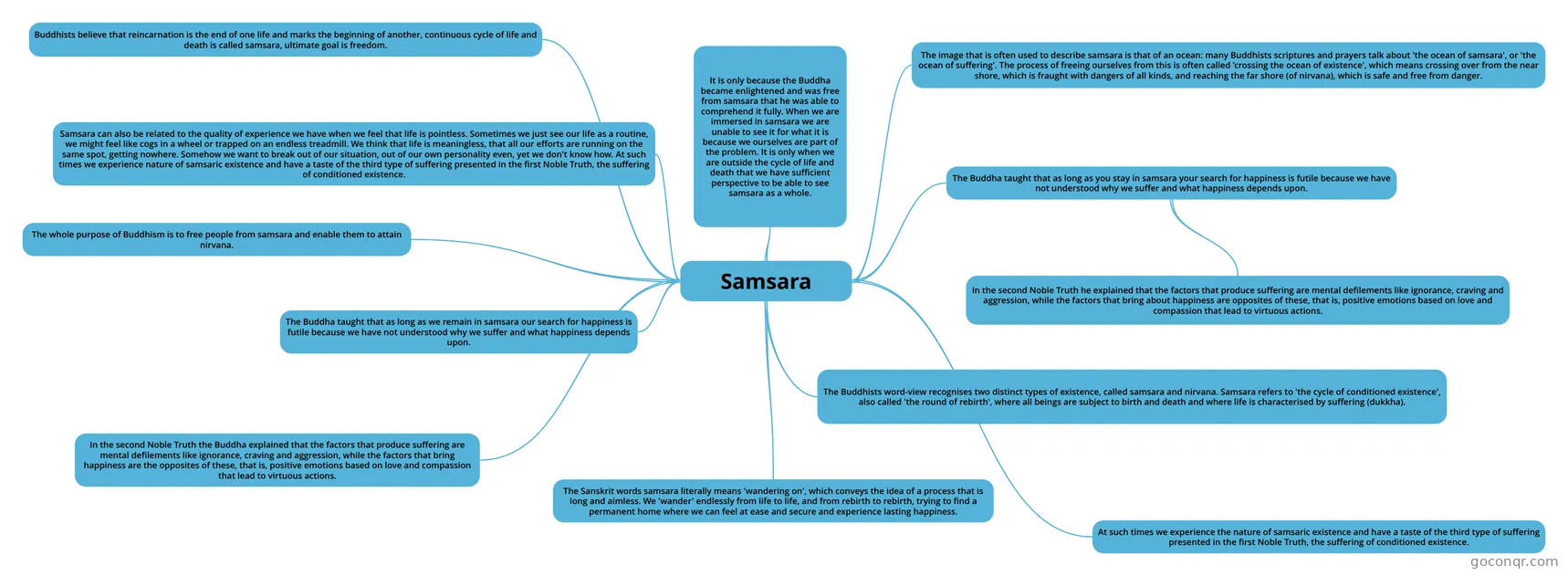
Mind map: Samsara in Buddhism
Map content
Samsara
Buddhists believe that reincarnation is the end of one life and marks the beginning of another, continuous cycle of life and death is called samsara, ultimate goal is freedom.
The image that is often used to describe samsara is that of an ocean: many Buddhists scriptures and prayers talk about 'the ocean of samsara', or 'the ocean of suffering'. The process of freeing ourselves from this is often called 'crossing the ocean of existence', which means crossing over from the near shore, which is fraught with dangers of all kinds, and reaching the far shore (of nirvana), which is safe and free from danger.
Samsara can also be related to the quality of experience we have when we feel that life is pointless. Sometimes we just see our life as a routine, we might feel like cogs in a wheel or trapped on an endless treadmill. We think that life is meaningless, that all our efforts are running on the same spot, getting nowhere. Somehow we want to break out of our situation, out of our own personality even, yet we don't know how. At such times we experience nature of samsaric existence and have a taste of the third type of suffering presented in the first Noble Truth, the suffering of conditioned existence.
The Buddha taught that as long as you stay in samsara your search for happiness is futile because we have not understood why we suffer and what happiness depends upon.
- In the second Noble Truth he explained that the factors that produce suffering are mental defilements like ignorance, craving and aggression, while the factors that bring about happiness are opposites of these, that is, positive emotions based on love and compassion that lead to virtuous actions.
The Buddhists word-view recognises two distinct types of existence, called samsara and nirvana. Samsara refers to 'the cycle of conditioned existence', also called 'the round of rebirth', where all beings are subject to birth and death and where life is characterised by suffering (dukkha).
It is only because the Buddha became enlightened and was free from samsara that he was able to comprehend it fully. When we are immersed in samsara we are unable to see it for what it is because we ourselves are part of the problem. It is only when we are outside the cycle of life and death that we have sufficient perspective to be able to see samsara as a whole.
The whole purpose of Buddhism is to free people from samsara and enable them to attain nirvana.
The Buddha taught that as long as we remain in samsara our search for happiness is futile because we have not understood why we suffer and what happiness depends upon.
In the second Noble Truth the Buddha explained that the factors that produce suffering are mental defilements like ignorance, craving and aggression, while the factors that bring happiness are the opposites of these, that is, positive emotions based on love and compassion that lead to virtuous actions.
At such times we experience the nature of samsaric existence and have a taste of the third type of suffering presented in the first Noble Truth, the suffering of conditioned existence.
The Sanskrit words samsara literally means 'wandering on', which conveys the idea of a process that is long and aimless. We 'wander' endlessly from life to life, and from rebirth to rebirth, trying to find a permanent home where we can feel at ease and secure and experience lasting happiness.
Information
- Description
- Mind Map on Samsara, created by Jasvinder Kaur on 05/11/2016.
- Created by
- Jasvinder Kaur
- Views
- 8
- Rating