
Mind map
Direct and Indirect Effect
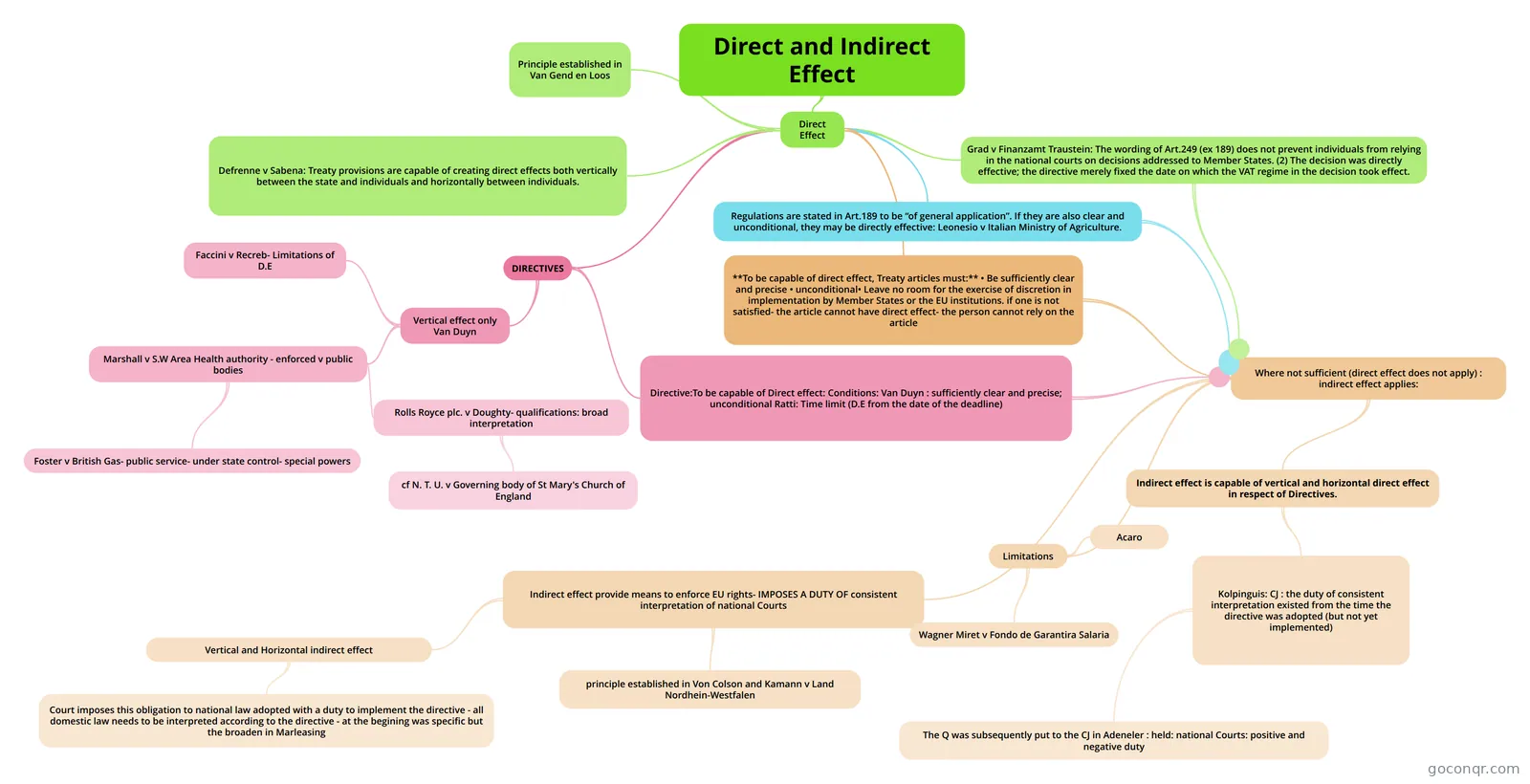
Mind map: Direct and indirect effect EU law
Map content
Direct and Indirect Effect
Direct Effect
- Principle established in Van Gend en Loos
- Defrenne v Sabena: Treaty provisions are capable of creating direct effects both vertically between the state and individuals and horizontally between individuals.
- DIRECTIVES
- Vertical effect only Van Duyn
- Marshall v S.W Area Health authority - enforced v public bodies
- Foster v British Gas- public service- under state control- special powers
- Rolls Royce plc. v Doughty- qualifications: broad interpretation
- cf N. T. U. v Governing body of St Mary's Church of England
- Faccini v Recreb- Limitations of D.E
- Marshall v S.W Area Health authority - enforced v public bodies
- Directive:To be capable of Direct effect: Conditions: Van Duyn : sufficiently clear and precise; unconditional Ratti: Time limit (D.E from the date of the deadline)
- Vertical effect only Van Duyn
- **To be capable of direct effect, Treaty articles must:** • Be sufficiently clear and precise • unconditional• Leave no room for the exercise of discretion in implementation by Member States or the EU institutions. if one is not satisfied- the article cannot have direct effect- the person cannot rely on the article
- Where not sufficient (direct effect does not apply) : indirect effect applies:
- Indirect effect provide means to enforce EU rights- IMPOSES A DUTY OF consistent interpretation of national Courts
- principle established in Von Colson and Kamann v Land Nordhein-Westfalen
- Vertical and Horizontal indirect effect
- Court imposes this obligation to national law adopted with a duty to implement the directive - all domestic law needs to be interpreted according to the directive - at the begining was specific but the broaden in Marleasing
- Indirect effect is capable of vertical and horizontal direct effect in respect of Directives.
- Kolpinguis: CJ : the duty of consistent interpretation existed from the time the directive was adopted (but not yet implemented)
- The Q was subsequently put to the CJ in Adeneler : held: national Courts: positive and negative duty
- Kolpinguis: CJ : the duty of consistent interpretation existed from the time the directive was adopted (but not yet implemented)
- Limitations
- Wagner Miret v Fondo de Garantira Salaria
- Acaro
- Indirect effect provide means to enforce EU rights- IMPOSES A DUTY OF consistent interpretation of national Courts
- Where not sufficient (direct effect does not apply) : indirect effect applies:
- Regulations are stated in Art.189 to be “of general application”. If they are also clear and unconditional, they may be directly effective: Leonesio v Italian Ministry of Agriculture.
- Grad v Finanzamt Traustein: The wording of Art.249 (ex 189) does not prevent individuals from relying in the national courts on decisions addressed to Member States. (2) The decision was directly effective; the directive merely fixed the date on which the VAT regime in the decision took effect.
Information
- Description
- Mind Map on Direct and Indirect Effect, created by Terataki on 19/04/2014.
- Created by
- Terataki
- Views
- 153
- Tags
- Rating