
Mind map
Climate Change
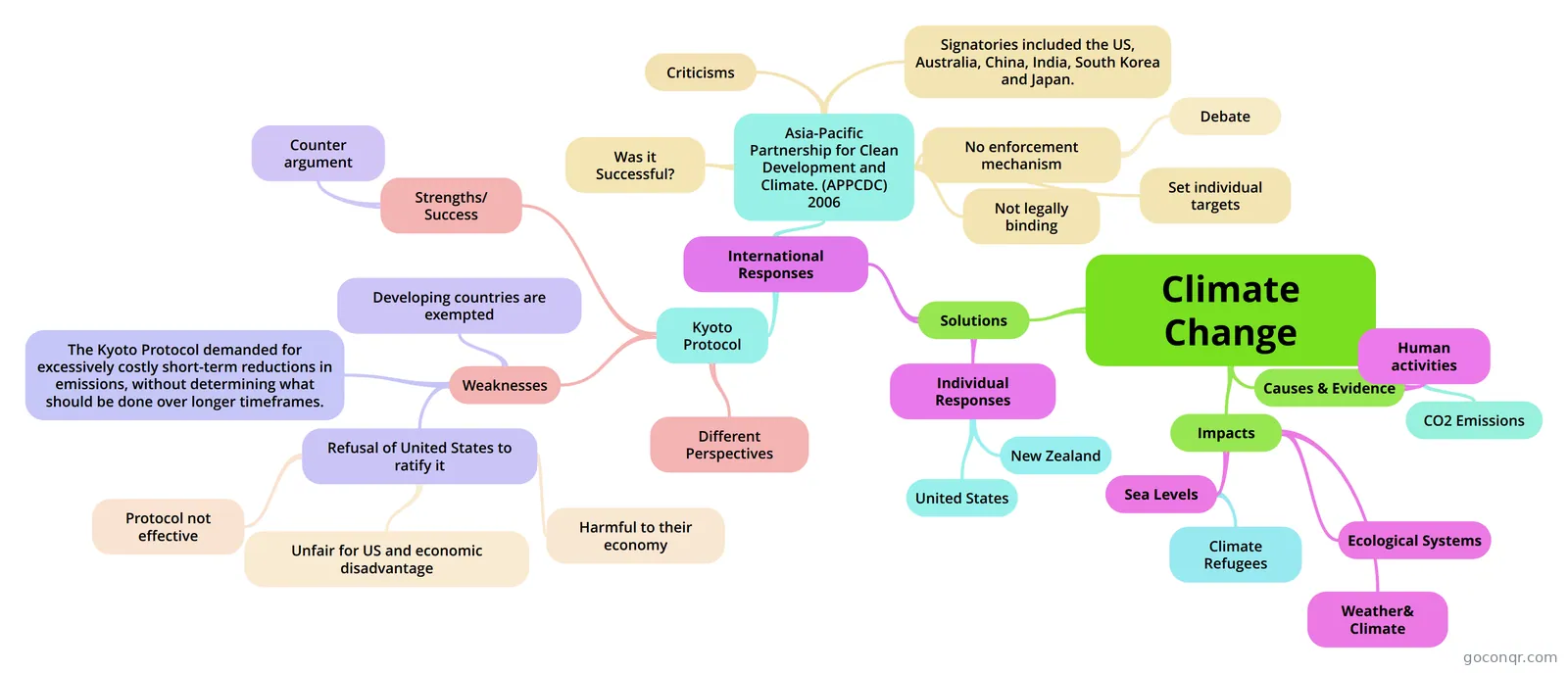
Mind map: Climate change
Map content
Climate Change
Causes & Evidence
- Human activities
- CO2 Emissions
- CO2 levels in the atmosphere now stand at 387 parts per million (ppm), up almost 40% since the industrial revolution and the highest for at least the last 650,000 years.
- CO2 Emissions
- Human activities
Impacts
- Weather& Climate
- Average global temperatures are expected to rise by 1.5 - 5.8°C by 2100
- Sea Levels
- Higher temperatures will lead to the melting of glaciers and polar ice-sheets. This may lead to a rise in sea-levels. Sea-levels are expected to rise by between 5-32 cm by the year 2050
- Climate Refugees
- Maldives Papua New GuineaThe 1,500 residents of Carteret Island, an atoll of the Autonomous Region of Bougainville, Papua New Guinea, are fast becoming the world's first climate change refugees. they urgently need assistance to be relocated to higher ground. Sea levels around the atoll have risen 10cm in the past 20 years, inundating plantations, and the situation is deterioratingMany of the island's inhabitants have run out of food and their staple, coconuts, are being wiped out as the sea level rises.
- The poorest countries are likely to be the most vulnerable to the effects of climate change.
- Ecological Systems
- The worry is that warming is taking place so quickly that species will not have time to adapt and avoid extinction.
- during past events of climatic change thousands of years ago, animals could try to beat the heat by retreating to cooler places in the higher latitudes or on higher ground. However, today, animals’ possible habitats are limited since they have to compete for space with 6.3 billion humans.
- Weather& Climate
Solutions
- International Responses
- Asia-Pacific Partnership for Clean Development and Climate. (APPCDC) 2006
- agreed to co-operate on the development and transfer of technology which enables reduction of greenhouse gas emissions
- No enforcement mechanism
- the Partnership engages member countries to accelerate the development and deployment of clean energy technologies, with no mandatory enforcement mechanism
- Debate
- Criticism that the Partnership is worthless, by other governments, climate scientists and environmental groups. Proponents, on the other hand, argue that unrestricted economic growth and emission reductions can only be brought about through active engagement by all major polluters, which includes India and China, within the Kyoto Protocol framework neither India nor China are yet required to reduce emissions.
- Not legally binding
- Signatories included the US, Australia, China, India, South Korea and Japan.
- Set individual targets
- Criticisms
- U.S. Senator John McCain said the Partnership "[amounted] to nothing more than a nice little public relations ploy.",[23] while the Economist described the Partnership as "patent fig-leaf for the refusal of America and Australia to ratify Kyoto".[24]
- Was it Successful?
- In the year since the Partnership went into effect, none of the parties have lowered emissions of greenhouse gases
- The Partnership has worked to develop and implement detailed action plans across key sectors of the energy economy, and to date has endorsed 175 collaborative projects including 22 flagship projects across all the seven Partner countries. These projects have, inter alia, helped power plant managers improve the efficiency of their operations, trained cement plant operators how to save energy at their facilities, assisted in pushing solar photovoltaics toward commercialization, and improved design, equipment and operations of buildings and appliances. The Partnership has been widely noted for its innovative work in public-private sector cooperation, and stands as an example of the benefits of international cooperative efforts in addressing climate change.
- Kyoto Protocol
- Strengths/ Success
- The remaining signatories in 2005— 37 developed nations and economies in transition — pledged to reduce their greenhouse-gas emissions from 1990 levels by an average of 4.2% in the period from 2008 to 2012. Eventually, the countries that stuck with the treaty can claim some success. Overall, they met their target with room to spare, cutting their collective emissions by around 16%. Constitutes first international environmental agreement which seeks to achieve environmental targets
- Counter argument
- But most of those cuts came with little or no effort, because of the collapse of greenhouse-gas producing industries in eastern Europe and, the global economic crisis in 2012. (Dependence; not curing root cause of problem) But the reductions made under the treaty were dwarfed by the rise in emissions not covered by the accord, especially in Asia. Since 2000, CO2 emissions in China have nearly tripled to almost 10 billion tonnes, and those in India have doubled to around 2 billion tonnes. (link to weakness)The rise in Asian emissions is partly a result of the migration of heavy industry from developed nations to developing countries, which make products that then get shipped back to wealthy nations. (scale of impact/dependent on developing countries)
- Weaknesses
- Refusal of United States to ratify it
- Largest total emitter Largest emitter per capita Without them, Kyoto protocol could still come into force but effects on climate change would be nonexistent.
- Protocol not effective
- The Kyoto protocol is not effective enough.[1] Even if fully implemented, Kyoto would cut a projected rise in temperatures by just 0.1°C by 2100, according to U.N. projections, a pinprick compared to forecasts by a U.N. climate panel of an overall rise of 1.4-5.8°C by 2100.
- Unfair for US and economic disadvantage
- Big developing countries like India and China are exempted from meeting the requirements of the protocol. They, like many other developing countries, are not held to the same binding targets as Annex I countries, even though they have ratified the Protocol. India and China are developing rapidly and will become one of the biggest emitters of greenhouse gases in the near future.
- Harmful to their economy
- The Kyoto targets were greatly related to economic growth.
- Developing countries are exempted
- Statistics have shown that from 1992-2007, both India and China’s emissions have increased dramatically; 103% and 150% respectively. Without binding targets for developing nations, they will only increase their emissions and it will be harder to reduce them in the future.
- China's per capita carbon dioxide emissions, at 7.1 tonnes, are only marginally lower than the EU average, at 7.4 tonnes (2012). China's CO2 emissions are also rising by over 6 per cent each year, while the EU's are falling
- The Kyoto Protocol demanded for excessively costly short-term reductions in emissions, without determining what should be done over longer timeframes.
- The Protocol does not provide any guidance or formulae linking the action required in the first commitment period to an overall global quantity constraint on emissions, or to a long-term timetable for emissions reductions.
- In Canada, they withdrew from the Kyoto Protocol as they found out that they are unable to meet the quota, and that during the initial signing, they had no proper plans for carbon emissions reduction."At the time we didn't realize how complicated it would be to get the Kyoto Protocol ratified and for it to enter into force internationally," said Steven Guilbeault, co-founder of Equiterre, a Montreal-based environmental charity."If we ratify this thing we'll never hit our targets," Bob Mills, Reform Party MP from Alberta who went to Kyoto, warned Liberal Prime Minister Jean Chrétien at the time, because he was worried Canada's international reputation would take a hit. The controversial and ineffective Kyoto Protocol's first stage comes to an end today, leaving the world with 58 per cent more greenhouse gases than in 1990, as opposed to the five per cent reduction its signatories sought.
- Refusal of United States to ratify it
- Different Perspectives
- Strengths/ Success
- Asia-Pacific Partnership for Clean Development and Climate. (APPCDC) 2006
- Individual Responses
- New Zealand
- New Zealand’s overall plan to reduce greenhouse gas emissions in the long term. To this end, the Projects to Reduce Emissions Programme was developed to encourage lower emissions. Currently, the programme has resulted in projects such as wind farms, bio-energy, landfill gas schemes and hydro-electricity
- United States
- tax incentives to encourage industries to voluntarily cut down on greenhouse gas emissions.
- New Zealand
- International Responses
Information
- Description
- (Geography) Mind Map on Climate Change, created by yukichong1998 on 29/04/2014.
- Created by
- yukichong1998
- Views
- 38
- Rating