
Mind map
Cross-border collateral arrangements

Map content
Cross-border collateral arrangements
Cross-border use of collateral
- As a vehicle for optimising liquidity management and mitigating risks in this environment
- Key factors influencing the demand for cross-border use of collateral
- Managing liquidity in multiple currencies and jurisdictions.
- Rapid technological innovation, has led to greater complexity in financial products
- The shift towards real-time gross settlement in payments and delivery versus payment in securities settlement.
- The current environment: central banks, internationally active banks, markets and infrastructure
- internationally active banks may be more likely to face liquidity shortfalls than purely domestic counterparts.
- Banking sectors and money markets are so highly integrated that the distinction between “domestic” and “foreign” markets becomes increasingly blurred and one might speak of virtually a single (“domestic”) market
- Analysis of the size and usage of each central bank’s eligible pool of collateral might provide some guide as to the existence of such constraints
- The degree to which liquidity and collateral management is centralised within the banking group
Policy considerations
- Potential effects about risk
- Systemic risks
- Monetary policy implementation
- System safety and efficiency
- A problem in one economy can lead to problems in other economies
- Financial crises raise the costs of intermediation and restrict credit
- Emergency cross-border collateral arrangements, it does not appear that such arrangements would have a meaningful impact on a central bank’s monetary policy objectives
- Differences in operating hours could cause problems (or fail to mitigate credit risk) if foreign collateral failed to settle in time to satisfy a liquidity demand in the local payment system
- Cross-border collateral arrangements often present complex legal issues and can result in varying degrees of legal uncertainty, posing risks that individual central banks should consider if they seek to enter such arrangements
- The routine acceptance of foreign collateral by central banks could have some effect on the demand to hold balances of particular currencies, on the demand for government debt, and on financial centres
- Costs will depend upon the existing collateral framework in the country, its existing processes and procedures, and any existing “links” between markets/currency areas
- Potential effects about risk
Arrangements for the use of foreign collateral in intraday/overnight credit operations
- Five stylised arrangements for the use of cross-border collateral (the models described are the essential “building blocks” of cross-border collateral
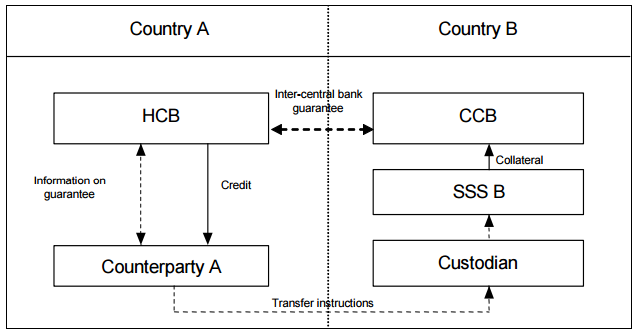
- guarantee model
- national central banks act as guarantors for each other in respect of assets deposited in their local depository or SSS.
- Importantly, the legal instrument backing this arrangement is a guarantee from the CCB on the value of collateral received.
- national central banks act as guarantors for each other in respect of assets deposited in their local depository or SSS.
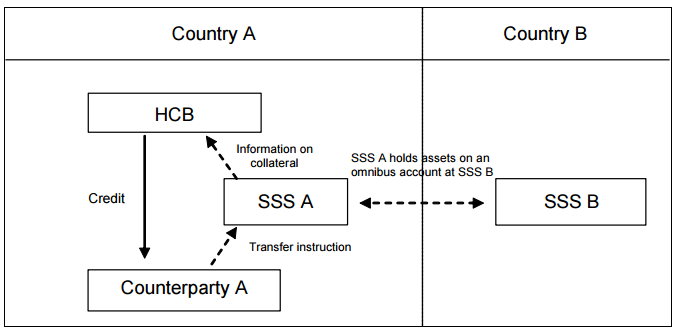
- links between securities settlement systems
- Under this arrangement, the HCB and its counterparts use an SSS “linked” to one or more SSSs this allows a participant in one SSS to hold securities issued in another SSS without being a participant in the latter. With links, the cross-border relationship is between the SSS
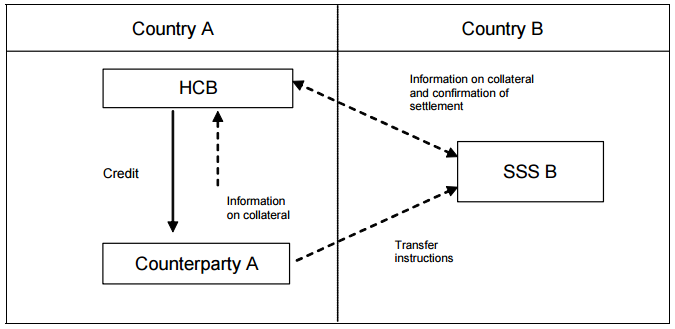
- remote access to a securities settlement system
- Under this arrangement, both the HCB and its counterparties directly access a foreign-located SSS in which the collateral is available.
- Barriers: settlement timetable constraints, processing lags and requirement for significant knowledge of the functioning of the foreign SSS.
- Under this arrangement, both the HCB and its counterparties directly access a foreign-located SSS in which the collateral is available.
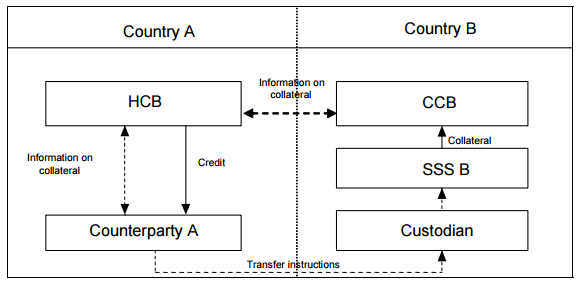
- correspondent central banking model (CCBM)
- Under this arrangement, national central banks act as custodians (“correspondents”) for the HCB in respect of assets located in their local depository or SSS.
- The model addresses routine collateral needs by typically requiring counterparties to predeposit a certain amount of collateral assets in custody with the CCB at all times.
- Under this arrangement, national central banks act as custodians (“correspondents”) for the HCB in respect of assets located in their local depository or SSS.
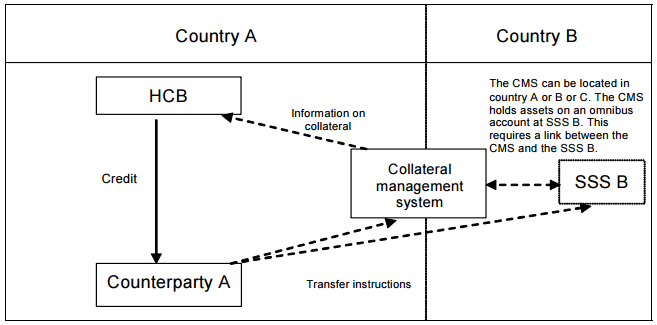
- Recourse collateral management system (CMS)
- the HCB and its counterparties rely on a CMS. The CMS can take the form of a collateral pooling system operated by a central bank, or a tripartite collateral service operated by an SSS or a custodian.
- The CMS can be located in the home country of the HCB or abroad.
- the HCB and its counterparties rely on a CMS. The CMS can take the form of a collateral pooling system operated by a central bank, or a tripartite collateral service operated by an SSS or a custodian.
- guarantee model
- Five stylised arrangements for the use of cross-border collateral (the models described are the essential “building blocks” of cross-border collateral
Analysis of the alternative arrangements
- Criteria for assessment
- Processing speed, accessibility of the arrangement, overcoming time zone frictions, geographical coverage, resilience and risk management, knowledge/staffing, acceptability to market participants/economic feasibility. One important criterion not treated here is “legal soundness”.
- Relevant factors in assessment against these criteria
- Processing speed
- those relying on the fewest steps in the processing chain and the most direct communication channels.
- Accessibility of the arrangement
- where the collateral is held.
- Custody risk has two dimensions:
- legal risk, and in particular possible conflicts of law
- the risk of being unable to access the assets when needed for collateralisation purposes.
- Custody risk has two dimensions:
- where the collateral is held.
- Overcoming time zone frictions
- the operating timetables of the relevant systems will be a key determinant and any moves by (I) CSDs to extend or synchronise operating hours.
- Geographical coverage
- cases of the central bank-based models
- geographical coverage is clearly at the discretion of the central bank(s) involved and so can be achieved “on demand”
- Models involving links
- coverage is a business decision for the local SSS, and hence one step removed from central bank policy.
- cases of the central bank-based models
- Resilience and risk management
- every model could achieve optimal robustness and resilience
- Knowledge and staffing requirements
- For knowledge and resourcing, the most attractive arrangements will be those requiring minimal additional investments.
- most efficient from a knowledge and staffing perspective would be a full-service CMS alternative, in which all processing, valuation, corporate actions and general day-to-day management of collateral were outsourced to the service provider.
- For knowledge and resourcing, the most attractive arrangements will be those requiring minimal additional investments.
- Acceptability to market participants/economic feasibility
- Those arrangements offering full unrestricted access at low cost will best fulfil this criterion
- Processing speed
- Criteria for assessment
Potential central bank actions
- each central bank can choose the approach best suited to its particular circumstances
- Areas for potential cooperation and coordination among G10 central banks
- central banks might seek to deepen their cooperation in order to facilitate the elimination of operational obstacles to safe and efficient crossborder arrangements.
- bilateral agreements between national central banks.
- Support, communication standards, system times, harmonization, tax treatment
- bilateral agreements between national central banks.
- central banks might seek to deepen their cooperation in order to facilitate the elimination of operational obstacles to safe and efficient crossborder arrangements.
- Acceptance of additional categories of foreign collateral
- some banks suggested that there might be value in adding facilities to connect the major financial centres and major currency areas, at least in case of emergency.
- existing routine arrangements should allow for speedy and efficient collateral transfer and a sufficient level of resilience so as to be accessible also in emergency situations.
- some banks suggested that there might be value in adding facilities to connect the major financial centres and major currency areas, at least in case of emergency.
- Improving cross-border collateralisation practices
- Legal issues
- work on harmonising legal practices related to collateralisation should be encouraged, while simplifying procedures to pledge or transfer collateral.
- Harmonised substantive rules regarding indirectly held securitie. 2002 UNIDROIT.
- The Hague Securities Convention
- PRIMA (Place of the Relevant Intermediary) approach, which would enable each intermediary and its immediate account holder to agree on the relevant law as a matter of contractual choice (subject to certain restrictions).
- work on harmonising legal practices related to collateralisation should be encouraged, while simplifying procedures to pledge or transfer collateral.
- The availability of systems
- the key infrastructures used to process collateral and payments meet the highest standards in terms of regulatory requirements and business practices, including resilience and business continuity.
- Legal issues
- Promoting interoperability
- The infrastructures involved in cross-border collateral arrangements should enhance their procedures to ensure maximum safety, speed and efficiency.
- Intraday use of collateral to raise liquidity in an emergency situation requires both a high level of availability of systems and access to realtime settlement services.
- The infrastructures involved in cross-border collateral arrangements should enhance their procedures to ensure maximum safety, speed and efficiency.
- Areas for potential cooperation and coordination among G10 central banks
- each central bank can choose the approach best suited to its particular circumstances
Images and files in the map






















Information
- Description
- Mind Map on Cross-border collateral arrangements, created by Juliana Claros on 19/03/2017.
- Created by
- Juliana Claros
- Views
- 0
- Rating