
Mind map
Software Development Life Cycle
Map content
Software Development Life Cycle
WATERFALL LIFE CYCLE MODEL
- 1. Requeriments
- 2. Desing
- 3. Implementation and Unit Testing
- 4. Integration and System Testing
- 5. Operation
- Advantages of the Waterfall model
- Disadvantages of the Waterfall model
- The Waterfall life cycle model, also known as the classic or linear-sequential life cycle model, is one of the simplest to understand and use. The Waterfall model is characterized by a series of steps that must be completed in a linear, sequential order. Each phase is completed and verified before development progresses to the next phase. Figure 4-2 illustrates the Waterfall life cycle model.
V-SHAPED LIFE CYCLE MODEL
- Requirements
- System Test Planning
- High Level Design
- Integration Test Planning
- Low Level Design
- Unit Test Planning
- Implementation
- Unit Testing
- Integration Testing
- System Testing
- Advantages of the V-Shaped model
- Disadvantages of the V-Shaped model
- Like the Waterfall model, the V-Shaped life cycle model provides a sequential path of discrete phases that must each be completed before development proceeds to the next phase. The phase test plans are developed during each level of development, and once coding is completed, the tests are conducted. Figure 4-3 is a simplified illustration of the V-Shaped life cycle model.
- Requirements
INCREMENTAL LIFE CYCLE MODEL
- Requirements
- Design
- Implementation and Unit Testing
- Integration and System Testing
- Operation
- Advantages of the Incremental model
- Disadvantages of the Incremental model
- The Incremental life cycle model builds an iterative approach into the Waterfall model. Development projects are divided into several smaller, more manageable iterations. Each iteration passes through a mini-Waterfall process. Requirement, design, implementation and testing phases are completed for each iteration. Figure 4-4 illustrates the Incremental life cycle model.
SPIRAL LIFE CYCLE MODEL
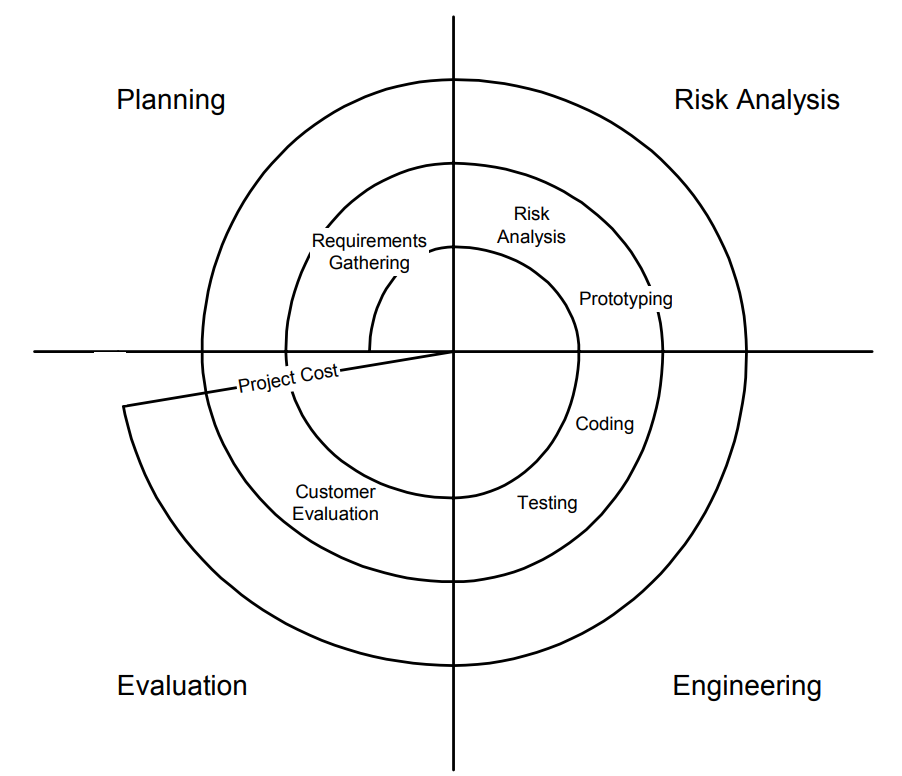
- The Spiral life cycle model is similar to the Incremental model but incorporates risk analysis. It is divided into four phases: planning, risk analysis, engineering, and evaluation. A project passes through each of these phases in sequence, repeatedly, in a series of iterations called spirals. At the beginning of the development process, critical requirements are identified for the first spiral. Subsequent spirals add functionality to this baseline spiral.
SOFTWARE DEVELOPMENT LIFE CYCLE MODEL
- Requirements
- Design
- Implementation
- Testing
- The term software development life cycle model is a way of describing the planning, designing, coding, and testing of a software system, as well as the method in which these steps are implemented. A variety of life cycle models exist, but they all include the same constituent parts. All life cycle models take a project through several primary phases: a requirements-gathering phase, a design phase, a construction or implementation phase, and a testing phase. Figure 4-1 provides a simplified illustration of the general software development life cycle model.
Images and files in the map
Information
- Description
- Mind Map on Software Development Life Cycle, created by Eduard Adrian Caicedo Villada on 07/09/2017.
- Created by
- Eduard Adrian Caicedo Villada
- Views
- 0
- Rating