
Mind map
Media Representations: Gender
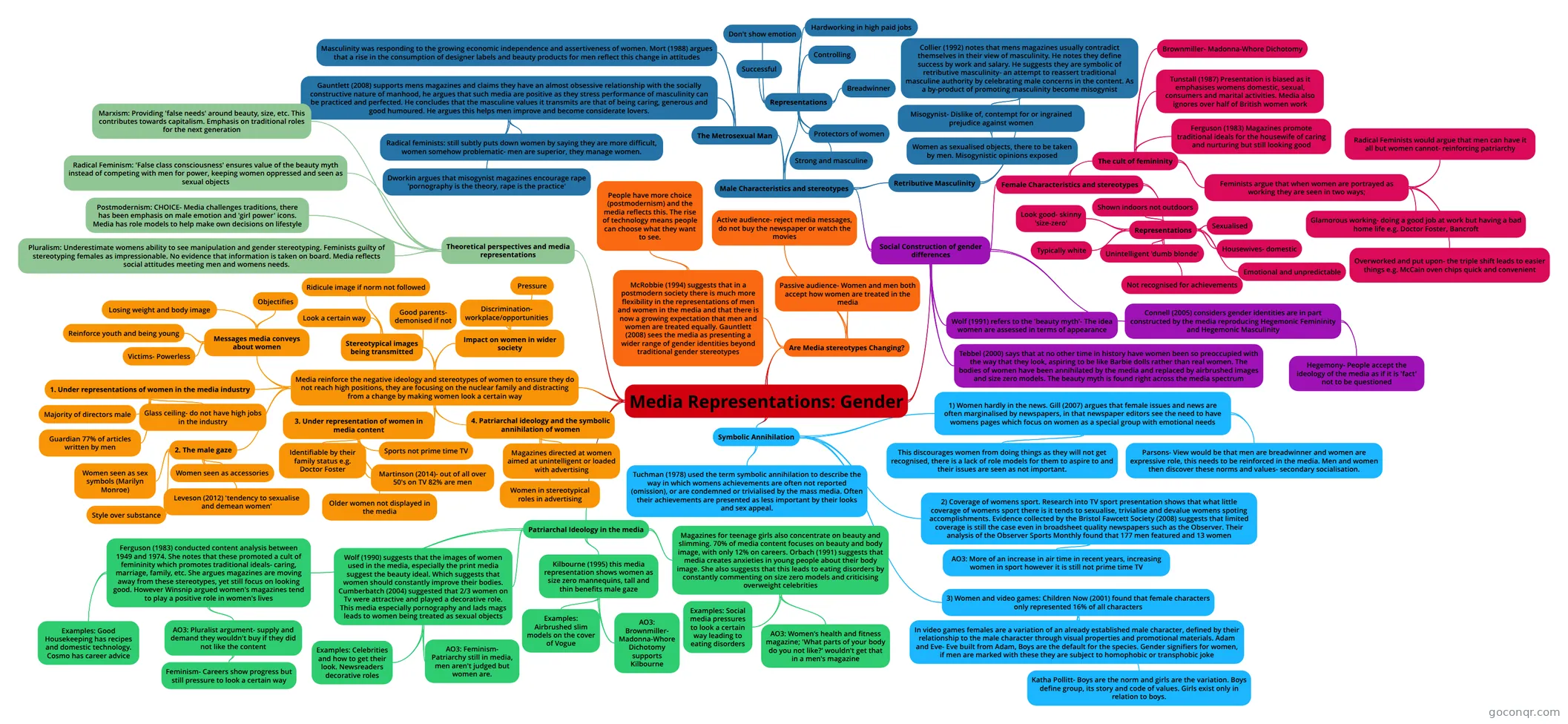
Mind map: Media representations of gender
Map content
Media Representations: Gender
Media reinforce the negative ideology and stereotypes of women to ensure they do not reach high positions, they are focusing on the nuclear family and distracting from a change by making women look a certain way
- 1. Under representations of women in the media industry
- Majority of directors male
- Glass ceiling- do not have high jobs in the industry
- Guardian 77% of articles written by men
- 2. The male gaze
- Women seen as sex symbols (Marilyn Monroe)
- Style over substance
- Women seen as accessories
- Leveson (2012) 'tendency to sexualise and demean women'
- 3. Under representation of women in media content
- Sports not prime time TV
- Older women not displayed in the media
- Identifiable by their family status e.g. Doctor Foster
- Martinson (2014)- out of all over 50's on TV 82% are men
- 4. Patriarchal ideology and the symbolic annihilation of women
- Women in stereotypical roles in advertising
- Magazines directed at women aimed at unintelligent or loaded with advertising
- Messages media conveys about women
- Victims- Powerless
- Reinforce youth and being young
- Losing weight and body image
- Objectifies
- Stereotypical images being transmitted
- Good parents- demonised if not
- Look a certain way
- Ridicule image if norm not followed
- Impact on women in wider society
- Pressure
- Discrimination- workplace/opportunities
- 1. Under representations of women in the media industry
Patriarchal Ideology in the media
- Ferguson (1983) conducted content analysis between 1949 and 1974. She notes that these promoted a cult of femininity which promotes traditional ideals- caring, marriage, family, etc. She argues magazines are moving away from these stereotypes, yet still focus on looking good. However Winsnip argued women's magazines tend to play a positive role in women's lives
- Examples: Good Housekeeping has recipes and domestic technology. Cosmo has career advice
- AO3: Pluralist argument- supply and demand they wouldn't buy if they did not like the content
- Feminism- Careers show progress but still pressure to look a certain way
- Wolf (1990) suggests that the images of women used in the media, especially the print media suggest the beauty ideal. Which suggests that women should constantly improve their bodies. Cumberbatch (2004) suggested that 2/3 women on Tv were attractive and played a decorative role. This media especially pornography and lads mags leads to women being treated as sexual objects
- Examples: Celebrities and how to get their look. Newsreaders decorative roles
- AO3: Feminism- Patriarchy still in media, men aren't judged but women are.
- Kilbourne (1995) this media representation shows women as size zero mannequins, tall and thin benefits male gaze
- Examples: Airbrushed slim models on the cover of Vogue
- AO3: Brownmiller- Madonna-Whore Dichotomy supports Kilbourne
- Magazines for teenage girls also concentrate on beauty and slimming. 70% of media content focuses on beauty and body image, with only 12% on careers. Orbach (1991) suggests that media creates anxieties in young people about their body image. She also suggests that this leads to eating disorders by constantly commenting on size zero models and criticising overweight celebrities
- Examples: Social media pressures to look a certain way leading to eating disorders
- AO3: Women's health and fitness magazine; 'What parts of your body do you not like?' wouldn't get that in a men's magazine
- Ferguson (1983) conducted content analysis between 1949 and 1974. She notes that these promoted a cult of femininity which promotes traditional ideals- caring, marriage, family, etc. She argues magazines are moving away from these stereotypes, yet still focus on looking good. However Winsnip argued women's magazines tend to play a positive role in women's lives
Symbolic Annihilation
- Tuchman (1978) used the term symbolic annihilation to describe the way in which womens achievements are often not reported (omission), or are condemned or trivialised by the mass media. Often their achievements are presented as less important by their looks and sex appeal.
- 1) Women hardly in the news. Gill (2007) argues that female issues and news are often marginalised by newspapers, in that newspaper editors see the need to have womens pages which focus on women as a special group with emotional needs
- This discourages women from doing things as they will not get recognised, there is a lack of role models for them to aspire to and their issues are seen as not important.
- Parsons- View would be that men are breadwinner and women are expressive role, this needs to be reinforced in the media. Men and women then discover these norms and values- secondary socialisation.
- 2) Coverage of womens sport. Research into TV sport presentation shows that what little coverage of womens sport there is it tends to sexualise, trivialise and devalue womens spoting accomplishments. Evidence collected by the Bristol Fawcett Society (2008) suggests that limited coverage is still the case even in broadsheet quality newspapers such as the Observer. Their analysis of the Observer Sports Monthly found that 177 men featured and 13 women
- AO3: More of an increase in air time in recent years, increasing women in sport however it is still not prime time TV
- 3) Women and video games: Children Now (2001) found that female characters only represented 16% of all characters
- Katha Pollitt- Boys are the norm and girls are the variation. Boys define group, its story and code of values. Girls exist only in relation to boys.
- In video games females are a variation of an already established male character, defined by their relationship to the male character through visual properties and promotional materials. Adam and Eve- Eve built from Adam, Boys are the default for the species. Gender signifiers for women, if men are marked with these they are subject to homophobic or transphobic joke
Social Construction of gender differences
- Connell (2005) considers gender identities are in part constructed by the media reproducing Hegemonic Femininity and Hegemonic Masculinity
- Hegemony- People accept the ideology of the media as if it is 'fact' not to be questioned
- Wolf (1991) refers to the 'beauty myth'- The idea women are assessed in terms of appearance
- Tebbel (2000) says that at no other time in history have women been so preoccupied with the way that they look, aspiring to be like Barbie dolls rather than real women. The bodies of women have been annihilated by the media and replaced by airbrushed images and size zero models. The beauty myth is found right across the media spectrum
- Female Characteristics and stereotypes
- Representations
- Look good- skinny 'size-zero'
- Typically white
- Not recognised for achievements
- Housewives- domestic
- Sexualised
- Emotional and unpredictable
- Shown indoors not outdoors
- Unintelligent 'dumb blonde'
- The cult of femininity
- Brownmiller- Madonna-Whore Dichotomy
- Ferguson (1983) Magazines promote traditional ideals for the housewife of caring and nurturing but still looking good
- Tunstall (1987) Presentation is biased as it emphasises womens domestic, sexual, consumers and marital activities. Media also ignores over half of British women work
- Feminists argue that when women are portrayed as working they are seen in two ways;
- Glamorous working- doing a good job at work but having a bad home life e.g. Doctor Foster, Bancroft
- Overworked and put upon- the triple shift leads to easier things e.g. McCain oven chips quick and convenient
- Radical Feminists would argue that men can have it all but women cannot- reinforcing patriarchy
- Representations
- Male Characteristics and stereotypes
- Representations
- Breadwinner
- Strong and masculine
- Controlling
- Successful
- Hardworking in high paid jobs
- Don't show emotion
- Protectors of women
- Retributive Masculinity
- Collier (1992) notes that mens magazines usually contradict themselves in their view of masculinity. He notes they define success by work and salary. He suggests they are symbolic of retributive masculinity- an attempt to reassert traditional masculine authority by celebrating male concerns in the content. As a by-product of promoting masculinity become misogynist
- Misogynist- Dislike of, contempt for or ingrained prejudice against women
- Women as sexualised objects, there to be taken by men. Misogynistic opinions exposed
- Misogynist- Dislike of, contempt for or ingrained prejudice against women
- Collier (1992) notes that mens magazines usually contradict themselves in their view of masculinity. He notes they define success by work and salary. He suggests they are symbolic of retributive masculinity- an attempt to reassert traditional masculine authority by celebrating male concerns in the content. As a by-product of promoting masculinity become misogynist
- The Metrosexual Man
- Masculinity was responding to the growing economic independence and assertiveness of women. Mort (1988) argues that a rise in the consumption of designer labels and beauty products for men reflect this change in attitudes
- Gauntlett (2008) supports mens magazines and claims they have an almost obsessive relationship with the socially constructive nature of manhood, he argues that such media are positive as they stress performance of masculinity can be practiced and perfected. He concludes that the masculine values it transmits are that of being caring, generous and good humoured. He argues this helps men improve and become considerate lovers.
- Radical feminists: still subtly puts down women by saying they are more difficult, women somehow problematic- men are superior, they manage women.
- Dworkin argues that misogynist magazines encourage rape 'pornography is the theory, rape is the practice'
- Representations
- Connell (2005) considers gender identities are in part constructed by the media reproducing Hegemonic Femininity and Hegemonic Masculinity
Theoretical perspectives and media representations
- Marxism: Providing 'false needs' around beauty, size, etc. This contributes towards capitalism. Emphasis on traditional roles for the next generation
- Radical Feminism: 'False class consciousness' ensures value of the beauty myth instead of competing with men for power, keeping women oppressed and seen as sexual objects
- Postmodernism: CHOICE- Media challenges traditions, there has been emphasis on male emotion and 'girl power' icons. Media has role models to help make own decisions on lifestyle
- Pluralism: Underestimate womens ability to see manipulation and gender stereotyping. Feminists guilty of stereotyping females as impressionable. No evidence that information is taken on board. Media reflects social attitudes meeting men and womens needs.
Are Media stereotypes Changing?
- Passive audience- Women and men both accept how women are treated in the media
- Active audience- reject media messages, do not buy the newspaper or watch the movies
- McRobbie (1994) suggests that in a postmodern society there is much more flexibility in the representations of men and women in the media and that there is now a growing expectation that men and women are treated equally. Gauntlett (2008) sees the media as presenting a wider range of gender identities beyond traditional gender stereotypes
- People have more choice (postmodernism) and the media reflects this. The rise of technology means people can choose what they want to see.
Information
- Description
- Mind Map on Media Representations: Gender, created by Declan Haydock on 22/01/2018.
- Created by
- Declan Haydock
- Views
- 0
- Rating