
Mind map
Phenomenological approaches to deviance
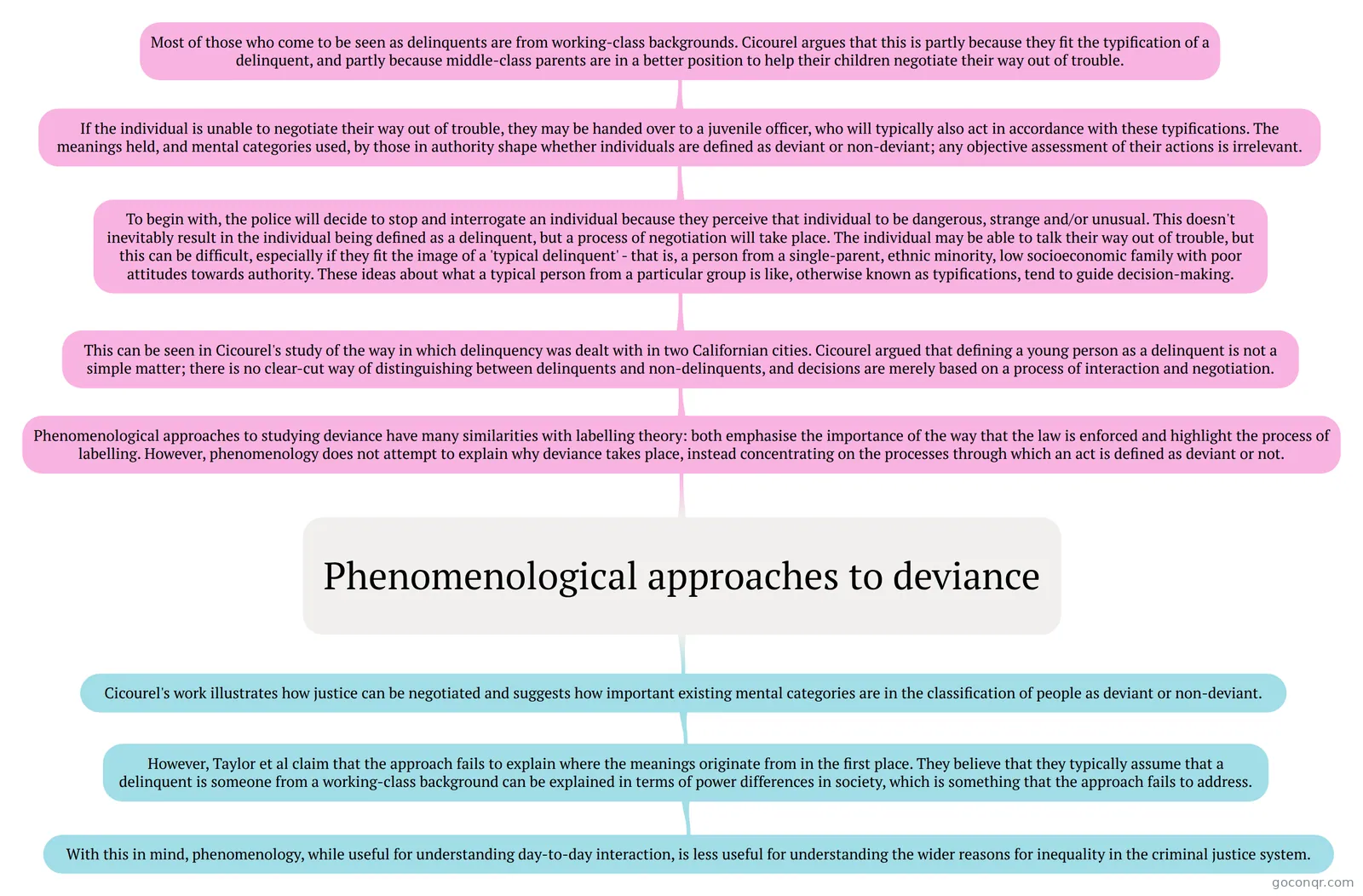
Mind map: Phenomenological approaches to deviance
Map content
Phenomenological approaches to deviance
Phenomenological approaches to studying deviance have many similarities with labelling theory: both emphasise the importance of the way that the law is enforced and highlight the process of labelling. However, phenomenology does not attempt to explain why deviance takes place, instead concentrating on the processes through which an act is defined as deviant or not.
- This can be seen in Cicourel's study of the way in which delinquency was dealt with in two Californian cities. Cicourel argued that defining a young person as a delinquent is not a simple matter; there is no clear-cut way of distinguishing between delinquents and non-delinquents, and decisions are merely based on a process of interaction and negotiation.
- To begin with, the police will decide to stop and interrogate an individual because they perceive that individual to be dangerous, strange and/or unusual. This doesn't inevitably result in the individual being defined as a delinquent, but a process of negotiation will take place. The individual may be able to talk their way out of trouble, but this can be difficult, especially if they fit the image of a 'typical delinquent' - that is, a person from a single-parent, ethnic minority, low socioeconomic family with poor attitudes towards authority. These ideas about what a typical person from a particular group is like, otherwise known as typifications, tend to guide decision-making.
- If the individual is unable to negotiate their way out of trouble, they may be handed over to a juvenile officer, who will typically also act in accordance with these typifications. The meanings held, and mental categories used, by those in authority shape whether individuals are defined as deviant or non-deviant; any objective assessment of their actions is irrelevant.
- Most of those who come to be seen as delinquents are from working-class backgrounds. Cicourel argues that this is partly because they fit the typification of a delinquent, and partly because middle-class parents are in a better position to help their children negotiate their way out of trouble.
- If the individual is unable to negotiate their way out of trouble, they may be handed over to a juvenile officer, who will typically also act in accordance with these typifications. The meanings held, and mental categories used, by those in authority shape whether individuals are defined as deviant or non-deviant; any objective assessment of their actions is irrelevant.
- To begin with, the police will decide to stop and interrogate an individual because they perceive that individual to be dangerous, strange and/or unusual. This doesn't inevitably result in the individual being defined as a delinquent, but a process of negotiation will take place. The individual may be able to talk their way out of trouble, but this can be difficult, especially if they fit the image of a 'typical delinquent' - that is, a person from a single-parent, ethnic minority, low socioeconomic family with poor attitudes towards authority. These ideas about what a typical person from a particular group is like, otherwise known as typifications, tend to guide decision-making.
- This can be seen in Cicourel's study of the way in which delinquency was dealt with in two Californian cities. Cicourel argued that defining a young person as a delinquent is not a simple matter; there is no clear-cut way of distinguishing between delinquents and non-delinquents, and decisions are merely based on a process of interaction and negotiation.
Cicourel's work illustrates how justice can be negotiated and suggests how important existing mental categories are in the classification of people as deviant or non-deviant.
- However, Taylor et al claim that the approach fails to explain where the meanings originate from in the first place. They believe that they typically assume that a delinquent is someone from a working-class background can be explained in terms of power differences in society, which is something that the approach fails to address.
- With this in mind, phenomenology, while useful for understanding day-to-day interaction, is less useful for understanding the wider reasons for inequality in the criminal justice system.
- However, Taylor et al claim that the approach fails to explain where the meanings originate from in the first place. They believe that they typically assume that a delinquent is someone from a working-class background can be explained in terms of power differences in society, which is something that the approach fails to address.
Information
- Description
- Sociology A2 - Crime and Deviance (Labelling Theory) Mind Map on Phenomenological approaches to deviance, created by Em Maskrey on 29/01/2018.
- Created by
- Em Maskrey
- Views
- 1
- Rating