
Mind map
Physics Paper 1

Map content
Physics Paper 1
Developing the Model of the Atom
Isotopes and Nuclear Radiation
- ISOTOPES are DIFFERENT FORMS of the SAME ELEMENT. They have the SAME NO. of PROTONS, but a DIFFERENT NO. of NEUTRONS (different mass number)
- Unstable isotopes tend to decay into other elements and give out radiation as they become more stable (they try to balance the number of protons and neutrons in their nucleus or get rid of any excess energy) - this is called radioactive decay.
- Radioactive substances EMIT one or more types of IONISING RADIATION from their nucleus, ALPHA, BETA and GAMMA.
- they can also emit neutrons.
- Radioactive substances EMIT one or more types of IONISING RADIATION from their nucleus, ALPHA, BETA and GAMMA.
Nuclear Equations
Half-life
- The HALF-LIFE is the TIME TAKEN for the NUMBER OF RADIOACTIVE NUCLEI in an isotope to HALVE.
- Radioactivity is a RANDOM process
- Radioactive substances give out radiation from the nuclei of their atoms. This can be measured using a Geiger-Muller Tube and Counter (which records the COUNT RATE - the NO. of RADIATION COUNTS REACHING IT PER SECOND)
- ACTIVITY is the RATE AT WHICH A SOURCE DECAYS, measured in BECQUERELS (Bq)
- Radioactive substances give out radiation from the nuclei of their atoms. This can be measured using a Geiger-Muller Tube and Counter (which records the COUNT RATE - the NO. of RADIATION COUNTS REACHING IT PER SECOND)
- The RADIOACTIVITY of a source DECREASES over TIME
- Each time a nucleus decays to become stable nucleus, the activity as a whole decreases (Older sources emit less radiation)
- For some isotopes, it takes just a few hours before nearly all unstable nuclei have decayed, whilst some take millions of years.
- The only problem is that the activity never reaches zero
- For some isotopes, it takes just a few hours before nearly all unstable nuclei have decayed, whilst some take millions of years.
- Each time a nucleus decays to become stable nucleus, the activity as a whole decreases (Older sources emit less radiation)
Irradiation and Contamination
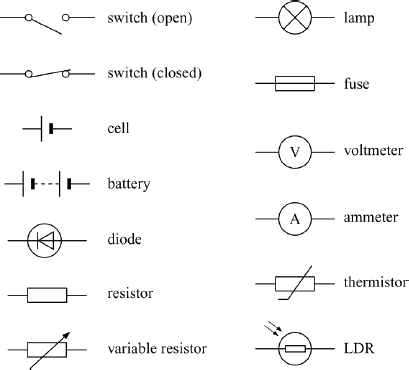
Current and Circuit symbols
- The CURRENT is the flow of electrical charge. An electrical charge will only flow round a complete (CLOSED) circuit if there is a potential difference, so there must be a source of potential difference. This unit of a current is measured in Amperes (A)
- In a SINGLE, CLOSED loop, the CURRENT has the SAME value EVERYWHERE in the circuit.
- Potential difference (or VOLTAGE) is the DRIVING FORCE that PUSHES the charge round. It is measured in VOLTS (V)
- RESISTANCE is ANYTHING THAT SLOWS the FLOW, measured in Ohms (Ω)
- The current flowing through a component depends on the potential difference across it and the resistance of the component.
- TOTAL CHARGE through a circuit depends on CURRENT and TIME.
- More charge passes around the circuit when a larger current flows.
- QUESTION: A battery charger passes a current of 2.0 A through a cell over a period of 2.5 hours. How much charge is transferred to the cell?
- ANSWER: Q = IT so 2.0 x (2.5x60x60) = 18,000 C
- The CURRENT is the flow of electrical charge. An electrical charge will only flow round a complete (CLOSED) circuit if there is a potential difference, so there must be a source of potential difference. This unit of a current is measured in Amperes (A)
Resistance and I-V Characteristics
Resistance and V=IR
- Ammeter: Measures the CURRENT, in AMPS, flowing through the test wire
- The ammeter MUST ALWAYS be placed in SERIES with whatever you're investigating
- Voltmeter: Measures the POTENTIAL DIFFERENCE across the wires (in VOLTS)
- the voltmeter MUST ALWAYS be placed PARALLEL to whatever you're investigating
- and NOT around any other bit of the circuit (e.g the battery)
- the voltmeter MUST ALWAYS be placed PARALLEL to whatever you're investigating
- Potential Difference (V) = Current (A) X Resistance (Ω)
- Ammeter: Measures the CURRENT, in AMPS, flowing through the test wire
Circuit Devices
Series Circuits
Parallel Circuits
Investigating Resistance
Electricity in the home
- The plug
Power of Electrical Appliances
More on Power
The National Grid
Images and files in the map


Information
- Description
- Energy Electricity Particle Model of Matter Atomic Structure
- Created by
- Marcelo Arenas
- Views
- 32
- Rating