
Mind map
CLASSROOM ASSESSMENT
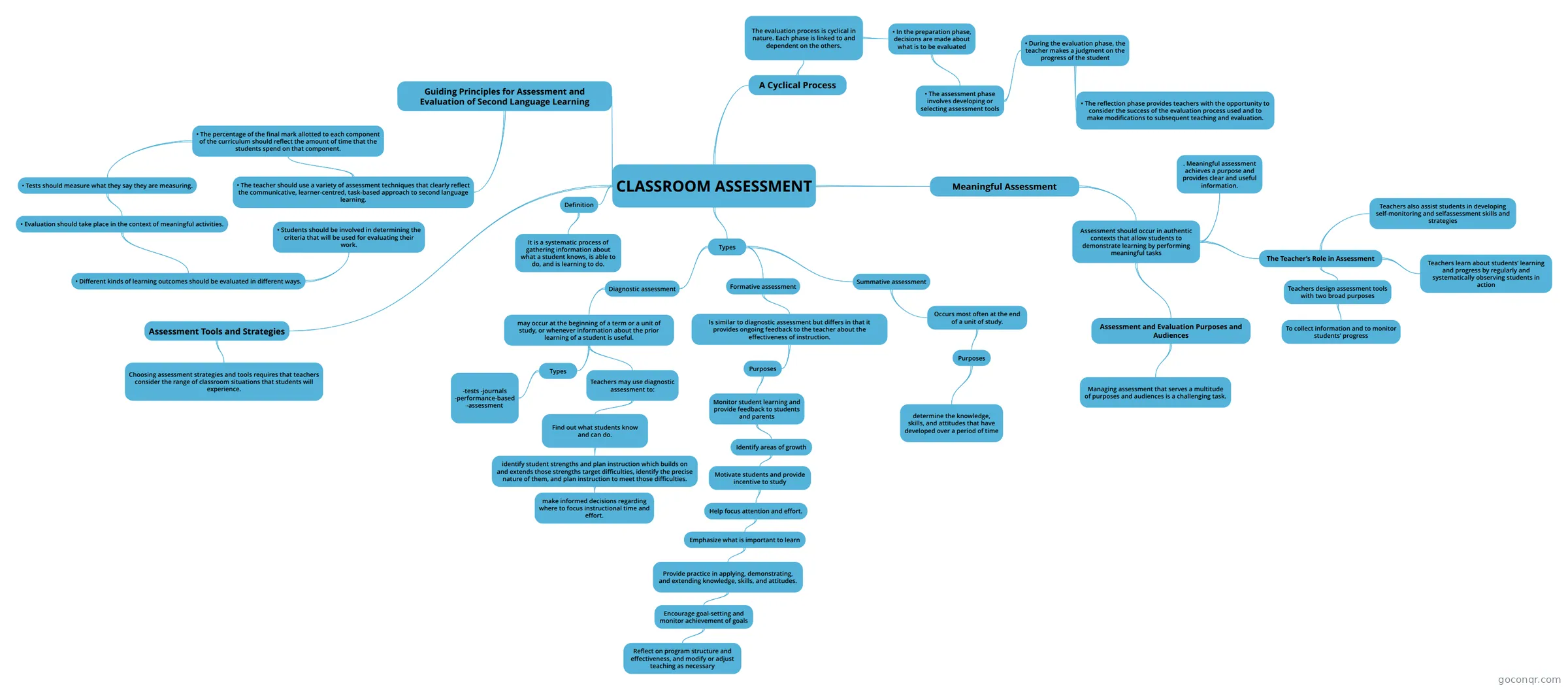
Mind map: classroom assessment
Map content
CLASSROOM ASSESSMENT
Definition
- It is a systematic process of gathering information about what a student knows, is able to do, and is learning to do.
Types
- Diagnostic assessment
- may occur at the beginning of a term or a unit of study, or whenever information about the prior learning of a student is useful.
- Types
- -tests -journals -performance-based -assessment
- Teachers may use diagnostic assessment to:
- Find out what students know and can do.
- identify student strengths and plan instruction which builds on and extends those strengths target difficulties, identify the precise nature of them, and plan instruction to meet those difficulties.
- make informed decisions regarding where to focus instructional time and effort.
- identify student strengths and plan instruction which builds on and extends those strengths target difficulties, identify the precise nature of them, and plan instruction to meet those difficulties.
- Find out what students know and can do.
- Types
- may occur at the beginning of a term or a unit of study, or whenever information about the prior learning of a student is useful.
- Formative assessment
- Is similar to diagnostic assessment but differs in that it provides ongoing feedback to the teacher about the effectiveness of instruction.
- Purposes
- Monitor student learning and provide feedback to students and parents
- Identify areas of growth
- Motivate students and provide incentive to study
- Help focus attention and effort.
- Emphasize what is important to learn
- Provide practice in applying, demonstrating, and extending knowledge, skills, and attitudes.
- Encourage goal-setting and monitor achievement of goals
- Reflect on program structure and effectiveness, and modify or adjust teaching as necessary
- Encourage goal-setting and monitor achievement of goals
- Provide practice in applying, demonstrating, and extending knowledge, skills, and attitudes.
- Emphasize what is important to learn
- Help focus attention and effort.
- Motivate students and provide incentive to study
- Identify areas of growth
- Monitor student learning and provide feedback to students and parents
- Purposes
- Is similar to diagnostic assessment but differs in that it provides ongoing feedback to the teacher about the effectiveness of instruction.
- Summative assessment
- Occurs most often at the end of a unit of study.
- Purposes
- determine the knowledge, skills, and attitudes that have developed over a period of time
- Purposes
- Occurs most often at the end of a unit of study.
- Diagnostic assessment
A Cyclical Process
- The evaluation process is cyclical in nature. Each phase is linked to and dependent on the others.
- • In the preparation phase, decisions are made about what is to be evaluated
- • The assessment phase involves developing or selecting assessment tools
- • During the evaluation phase, the teacher makes a judgment on the progress of the student
- • The reflection phase provides teachers with the opportunity to consider the success of the evaluation process used and to make modifications to subsequent teaching and evaluation.
- • During the evaluation phase, the teacher makes a judgment on the progress of the student
- • The assessment phase involves developing or selecting assessment tools
- • In the preparation phase, decisions are made about what is to be evaluated
- The evaluation process is cyclical in nature. Each phase is linked to and dependent on the others.
Meaningful Assessment
- Assessment should occur in authentic contexts that allow students to demonstrate learning by performing meaningful tasks
- . Meaningful assessment achieves a purpose and provides clear and useful information.
- The Teacher’s Role in Assessment
- Teachers design assessment tools with two broad purposes
- To collect information and to monitor students’ progress
- Teachers also assist students in developing self-monitoring and selfassessment skills and strategies
- Teachers learn about students’ learning and progress by regularly and systematically observing students in action
- Teachers design assessment tools with two broad purposes
- Assessment and Evaluation Purposes and Audiences
- Managing assessment that serves a multitude of purposes and audiences is a challenging task.
- Assessment should occur in authentic contexts that allow students to demonstrate learning by performing meaningful tasks
Guiding Principles for Assessment and Evaluation of Second Language Learning
- • The teacher should use a variety of assessment techniques that clearly reflect the communicative, learner-centred, task-based approach to second language learning.
- • The percentage of the final mark allotted to each component of the curriculum should reflect the amount of time that the students spend on that component.
- • Tests should measure what they say they are measuring.
- • Evaluation should take place in the context of meaningful activities.
- • Different kinds of learning outcomes should be evaluated in different ways.
- • Students should be involved in determining the criteria that will be used for evaluating their work.
- • Different kinds of learning outcomes should be evaluated in different ways.
- • Evaluation should take place in the context of meaningful activities.
- • Tests should measure what they say they are measuring.
- • The percentage of the final mark allotted to each component of the curriculum should reflect the amount of time that the students spend on that component.
- • The teacher should use a variety of assessment techniques that clearly reflect the communicative, learner-centred, task-based approach to second language learning.
Assessment Tools and Strategies
- Choosing assessment strategies and tools requires that teachers consider the range of classroom situations that students will experience.
Information
- Description
- Mind Map on CLASSROOM ASSESSMENT, created by Ana Verdugo on 08/05/2018.
- Created by
- Ana Verdugo
- Views
- 6
- Rating
More on Classroom Assessment Methods and Tools