
Mind map
Core 1.10 Polymers (Plastics)
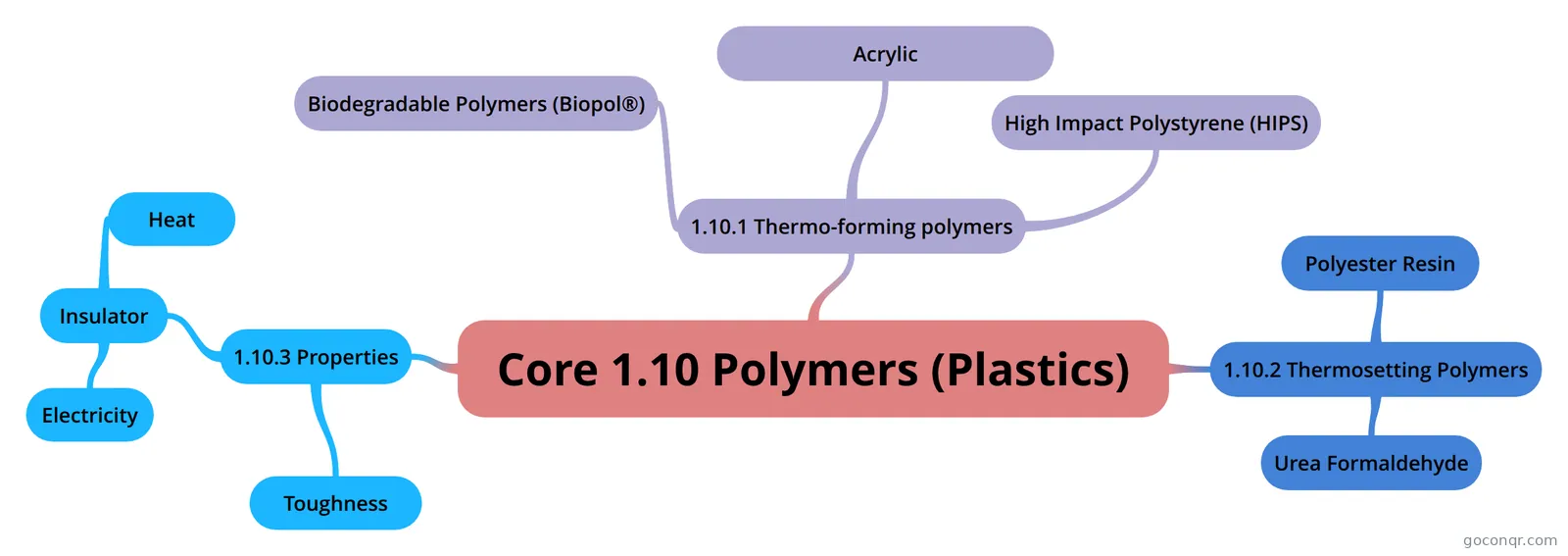
Mind map: Polymers (plastics)
Map content
Core 1.10 Polymers (Plastics)
- Polymers have a wide variety of uses in everyday life. A synthetic polymer is usually made from oil-based petrochemicals, but coal and gas can also be used. The crude oil is refined and mixed with other chemicals and can be used to produce many types of polymer. A wide variety of polymers is available, with engineers continuing to develop the range to meet the requirements of designers and manufacturers. There are two main categories of polymer that you will need to know about: thermoforming polymers and thermosetting polymers.
1.10.1 Thermo-forming polymers
- Thermoforming polymers are commonly used to make everyday products. They can offer a wide range of properties that make them suitable for an extensive array of uses. One of the biggest advantages of thermoforming polymers is that they can be recycled, which offers huge benefits to the manufacturer in reducing waste, as well as being attractive to the consumer because it helps to conserve non-renewable resources and prevents more waste going to landfill. The list of thermoforming polymers available is extensive. You will need to know more about: • acrylic • high-impact polystyrene (HIPS) • biodegradable polymers – Biopol
- Acrylic
- Acrylic (PMMA: polymethyl methacrylate) • Sheets, rods and tubes • Available in a wide range of opaque and translucent colours • Also available in a wide range of sizes • Tough, easily finished, easily cleaned, food safe and can be easily scratched • Shop signs, rear car lights, baths, fish tanks and menu holders • Widely available • Common in the school environment as it is easy to cut and finish to a high standard • Can be shaped using heat • Does not need painting • Breaks easily if dropped
- High Impact Polystyrene (HIPS)
- High-impact polystyrene (HIPS) • Sheets, rods and tubes • Available in a wide range of opaque and translucent colours • Also available in a wide range of sizes • Lightweight, high stiffness, impact resistant but can be easily scratched • Toys, television parts and refrigerator linings • Commonly used for vacuum forming, but can be formed using many techniques • Compared to other polymers it has a low melting point • Becomes brittle when exposed to UV light
- Biodegradable Polymers (Biopol®)
- Biopol® • Fibre, granules and sheets • Lightweight, good electrical insulator, degrades over time when in contact with soil, so can safely be disposed of at landfill sites • Disposable cups, razors, cutlery and other packaging products, surgical stitches and pins • Degrades in soil and can be disposed of at landfill sites • Can be injection moulded and vacuum formed • Expensive to produce • Has low resistance to impact (e.g. being dropped or having something dropped onto it)
1.10.2 Thermosetting Polymers
- Thermosetting polymers set hard once heated and cooled. Unlike thermoforming plastic, a thermosetting plastic shape, once formed, cannot be altered through reheating. These plastics cannot be recycled and are often used in applications where they will be subjected to heat, chemicals or solvents. The molecule chains in thermosetting polymers set differently once heated and cooled, with cross-linking of the chains preventing further forming and recycling. The types of thermosetting polymers you need to know about are: • polyester resin • urea formaldehyde.
- Polyester Resin
- Polyester resin • Thick liquid for casting and layup • Usually used with a catalyst to harden resin • Can be coloured through use of pigments • Rigid, brittle, (unless laminated) good electrical and heat insulation, good chemical resistance • Boat hulls and sports car bodies • Normally formed in conjunction with glass fibre • Can also be cast to form decorative objects • Can be used with glass fibres (glass reinforced plastic) to create lightweight and very strong products • Can be polished to a high finish • Can chip if dropped
- Urea Formaldehyde
- Urea formaldehyde • Powder, granules, preforms • Rigid, hard, brittle, heat resistant, excellent electrical insulation • Electrical fittings – plugs, sockets and switches • Used as an adhesive in manmade boards • Can be coloured using pigments • Can break if dropped
1.10.3 Properties
- Insulator
- Heat
- Most polymers are excellent insulators of heat. They are commonly used to increase the safety of products. For instance, expanded polystyrene cups offer the user’s hand protection from hot drinks, while they also help to keep the drink hot for longer. Polymers are also used for handles on saucepans, kettles, hairdryers and electric heaters as other parts of the products can be extremely hot and cause injury.
- Electricity
- Most polymers are excellent insulators of electricity and are commonly used in products that contain electrical components. For instance, televisions, computers and electric toothbrushes all use mains electricity for power and charging of batteries but, without adequate insulation around their exterior, could cause serious injury to the user. All electrical products that are connected to mains electricity will have cables shielded by PVC and the plug is likely to be made from urea formaldehyde.
- Heat
- Toughness
- Most polymers are tough. They can withstand rough handling, making them suitable for a wide range of products in the home, industry, agriculture and school. For instance, wheelie bins, buckets, watering cans, classroom chairs, car wheel trims and car bumpers all have to withstand impact, bumps and scrapes but continue to perform everyday tasks. Some polymers will fatigue and fail to perform following excessive wear.
- Insulator
Information
- Description
- 9999999999999999999999999999999999999999999999999999999999999999999999999999999999999999999999999999999999999999999999999999999999999999999999999999999999999999999999999999999999999999999999999999999999999999999999999999999999999999999999999999999999 Engineering Graphics and Design Mind Map on Core 1.10 Polymers (Plastics), created by Christian Costantino on 11/05/2018.
- Created by
- Christian Costantino
- Views
- 0
- History
-
- Created by T Andrews · Jul 30, 2017
- Copied by Christian Costantino · May 11, 2018
- Rating