
Mind map
Sequences and series
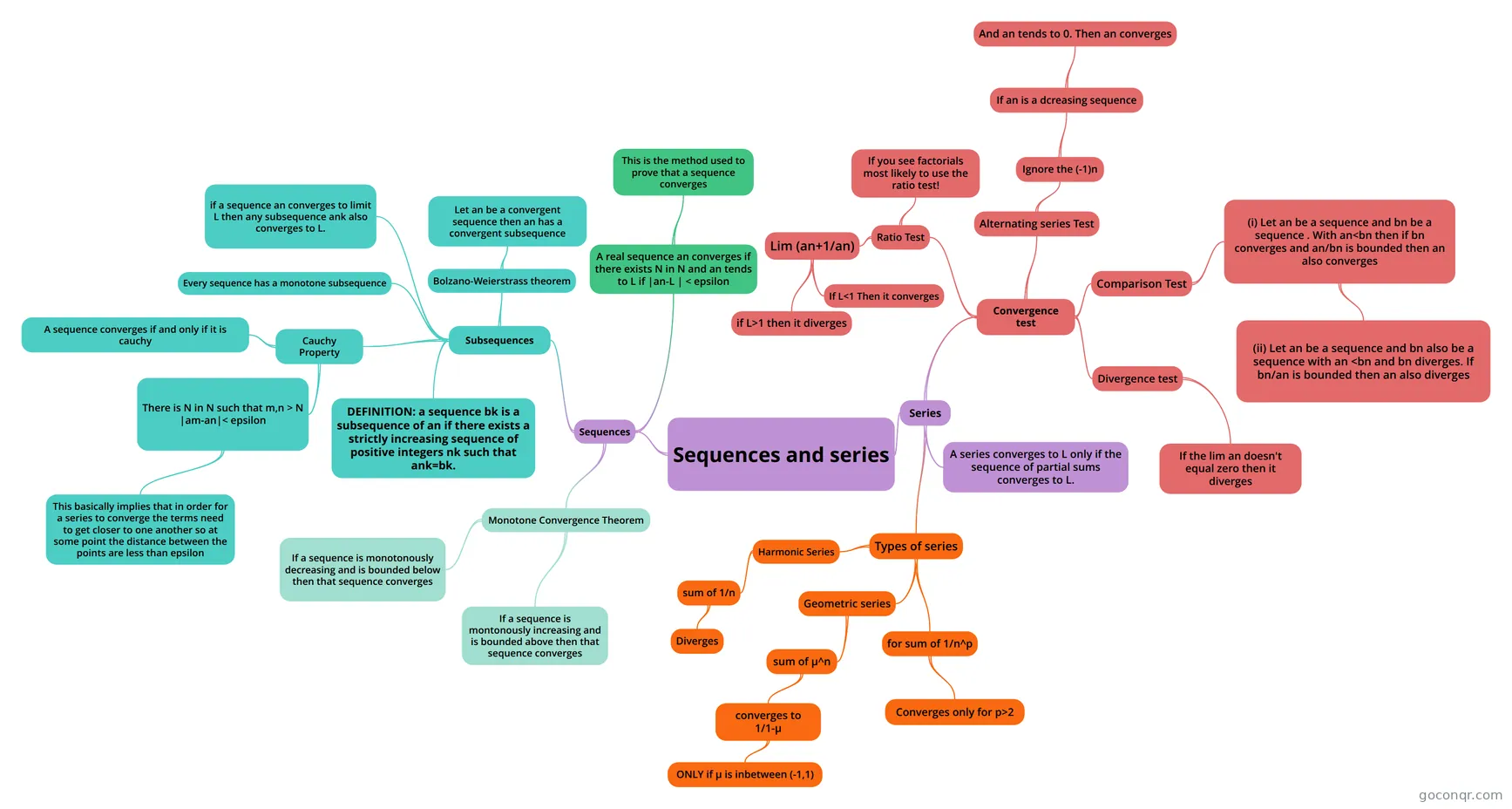
Mind map: Sequences and series
Map content
Sequences and series
Series
- Convergence test
- Ratio Test
- If you see factorials most likely to use the ratio test!
- Lim (an+1/an)
- If L<1 Then it converges
- if L>1 then it diverges
- Alternating series Test
- Ignore the (-1)n
- If an is a dcreasing sequence
- And an tends to 0. Then an converges
- If an is a dcreasing sequence
- Ignore the (-1)n
- Comparison Test
- (i) Let an be a sequence and bn be a sequence . With an<bn then if bn converges and an/bn is bounded then an also converges
- (ii) Let an be a sequence and bn also be a sequence with an <bn and bn diverges. If bn/an is bounded then an also diverges
- (i) Let an be a sequence and bn be a sequence . With an<bn then if bn converges and an/bn is bounded then an also converges
- Divergence test
- If the lim an doesn't equal zero then it diverges
- Ratio Test
- Types of series
- Harmonic Series
- sum of 1/n
- Diverges
- sum of 1/n
- Geometric series
- sum of µ^n
- converges to 1/1-µ
- ONLY if µ is inbetween (-1,1)
- converges to 1/1-µ
- sum of µ^n
- for sum of 1/n^p
- Converges only for p>2
- Harmonic Series
- A series converges to L only if the sequence of partial sums converges to L.
- Convergence test
Sequences
- Subsequences
- Bolzano-Weierstrass theorem
- Let an be a convergent sequence then an has a convergent subsequence
- Cauchy Property
- A sequence converges if and only if it is cauchy
- There is N in N such that m,n > N |am-an|< epsilon
- This basically implies that in order for a series to converge the terms need to get closer to one another so at some point the distance between the points are less than epsilon
- if a sequence an converges to limit L then any subsequence ank also converges to L.
- Every sequence has a monotone subsequence
- DEFINITION: a sequence bk is a subsequence of an if there exists a strictly increasing sequence of positive integers nk such that ank=bk.
- Bolzano-Weierstrass theorem
- Monotone Convergence Theorem
- If a sequence is montonously increasing and is bounded above then that sequence converges
- If a sequence is monotonously decreasing and is bounded below then that sequence converges
- A real sequence an converges if there exists N in N and an tends to L if |an-L | < epsilon
- This is the method used to prove that a sequence converges
- Subsequences
Information
- Description
- University Mathematics Mind Map on Sequences and series, created by Katie Speddings on 17/05/2018.
- Created by
- Katie Speddings
- Views
- 1
- Rating