
Mind map
Reprogramming
Map content
Reprogramming
Revise BMS 270
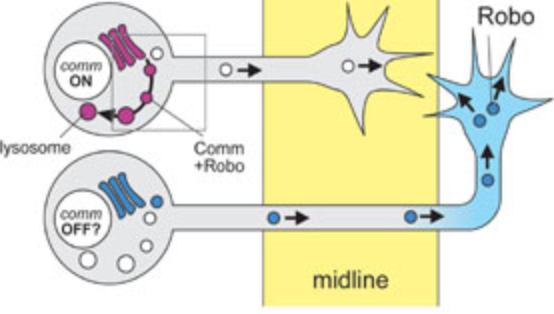
Two models
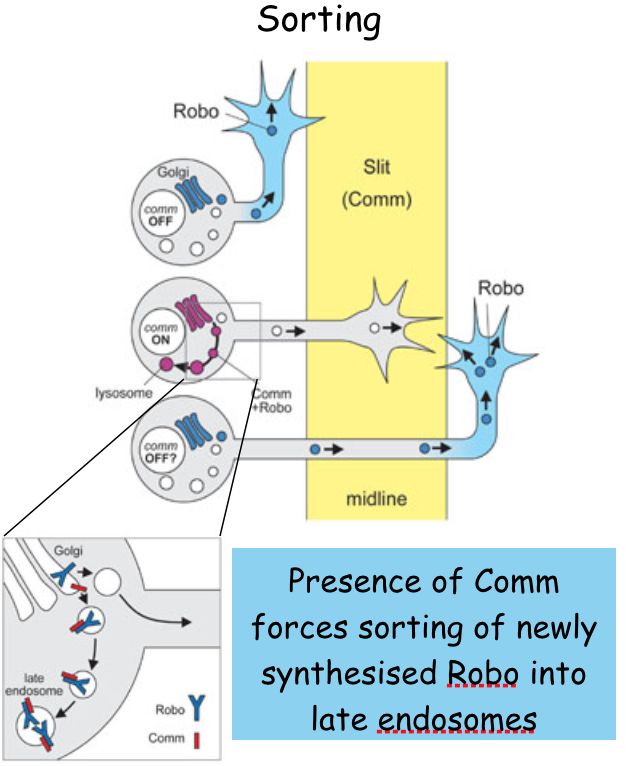
- Sorting
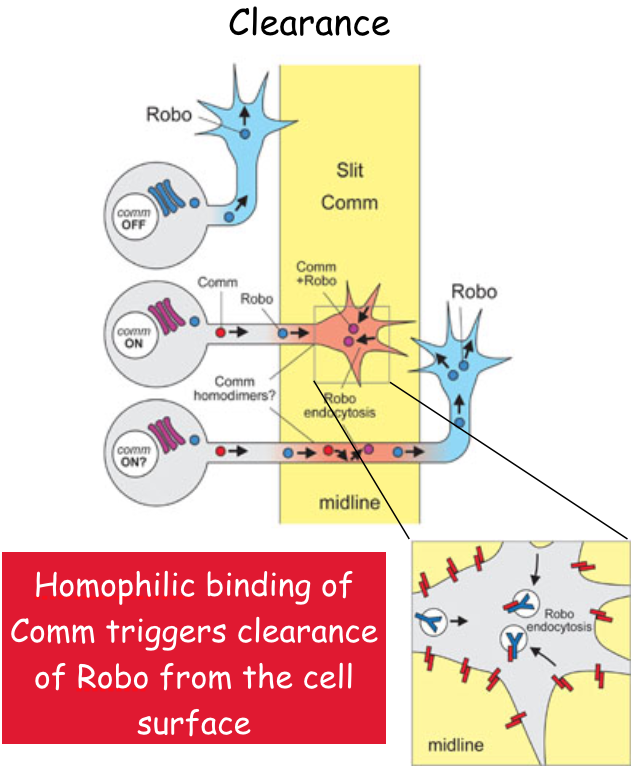
- Clearance
- Attraction of clearance model is that it suggests a mechanism for upregulation of Robo in crossed axon segments…
- Sorting model appears correct
- But we still don’t understand
- Why Comm is on the midline.
- What controls upregulation of Robo on contra-lateral side.
- Like loss of response to netrins in vertebrates, it is likely to involve contact with the midline.
- Why set this up like this?
- Because Robo protein is made before axons cross, it can rapidly appear on the cell surface once the midline is encountered.
- Why set this up like this?
- But we still don’t understand
- Both models were the proposed based on the results of cell biological experiments done in cell lines in vitro
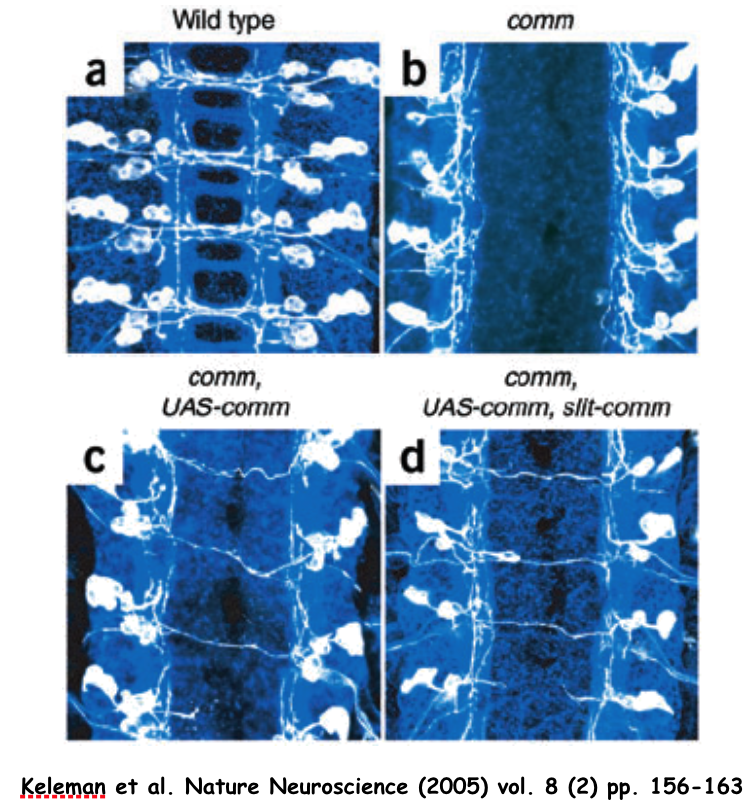
- Testing the models: (Keleman et al 2005)
- Is Comm required in midline cells for correct crossing? (clearance model suggests it should be)
- Use neuron-specific promoter to drive axon marker (white) in just a subset of crossing neurons
- Use same promoter to also drive Comm expression in Comm mutant (lof) background -> rescue (c)
- Rescue is at least as good as when Comm is also turned on in midline cells (using midline-specific promoter, Slit; d)
- i.e. don’t need Comm midline expression to rescue
- Nail 1
- Is Robo prevented from going to axons in presence of Comm?
- A simple difference between the models is that in one - the sorting model - Robo should not be shipped down the axon in the presence of Comm, whereas it should if instead it is cleared from the cell surface
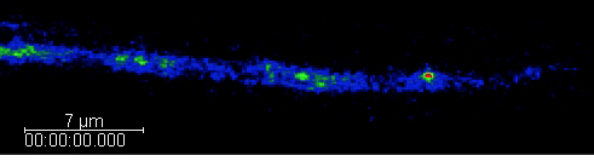
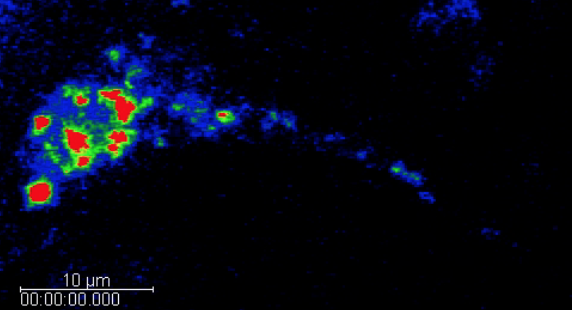
- Test by visualising Robo protein in axons in the living embryo using Robo-GFP fusion
- Robo-GFP (intensity shown green/red) in axon not expressing Comm. (Cell body to left, growth cone to right); Robo transports along axon
- NB this is specific for Robo. Other protein transport not affected
- Robo-GFP (green/red) in axon expressing Comm. NB cell body at left of picture. -> Robo doesn’t transport
- A simple difference between the models is that in one - the sorting model - Robo should not be shipped down the axon in the presence of Comm, whereas it should if instead it is cleared from the cell surface
- Is Comm required in midline cells for correct crossing? (clearance model suggests it should be)
Cell surface protein expression also changes in mammals
- The expression of a number of cell surface proteins also changes as commissural axons cross the midline in mammals.
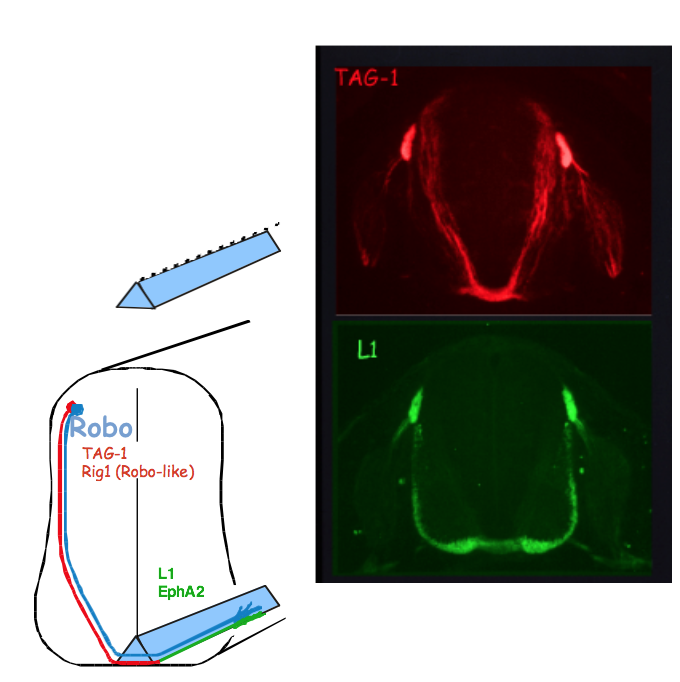
- As in flies, Robo is expressed at low levels before crossing and high after, correlating with the increase in slit sensitivity of post-crossing axons
- However, a Comm homolog has not been found in vertebrates
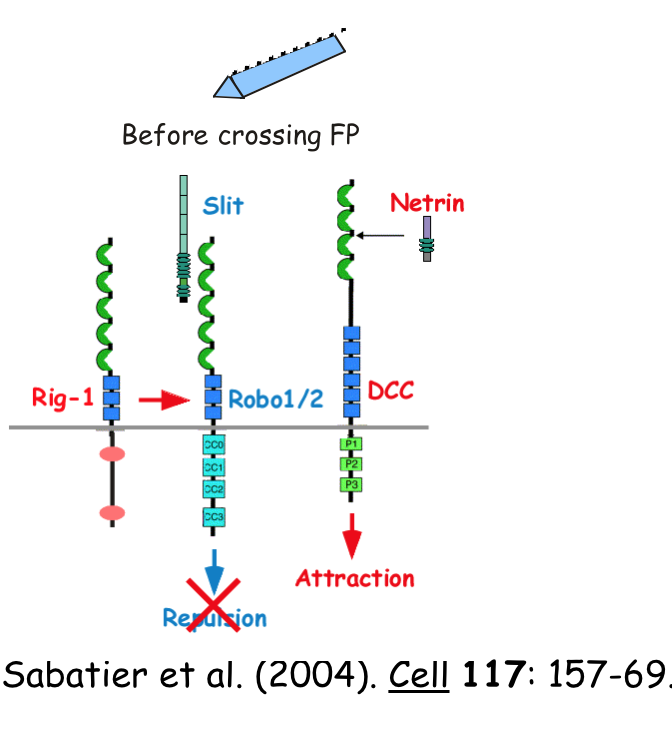
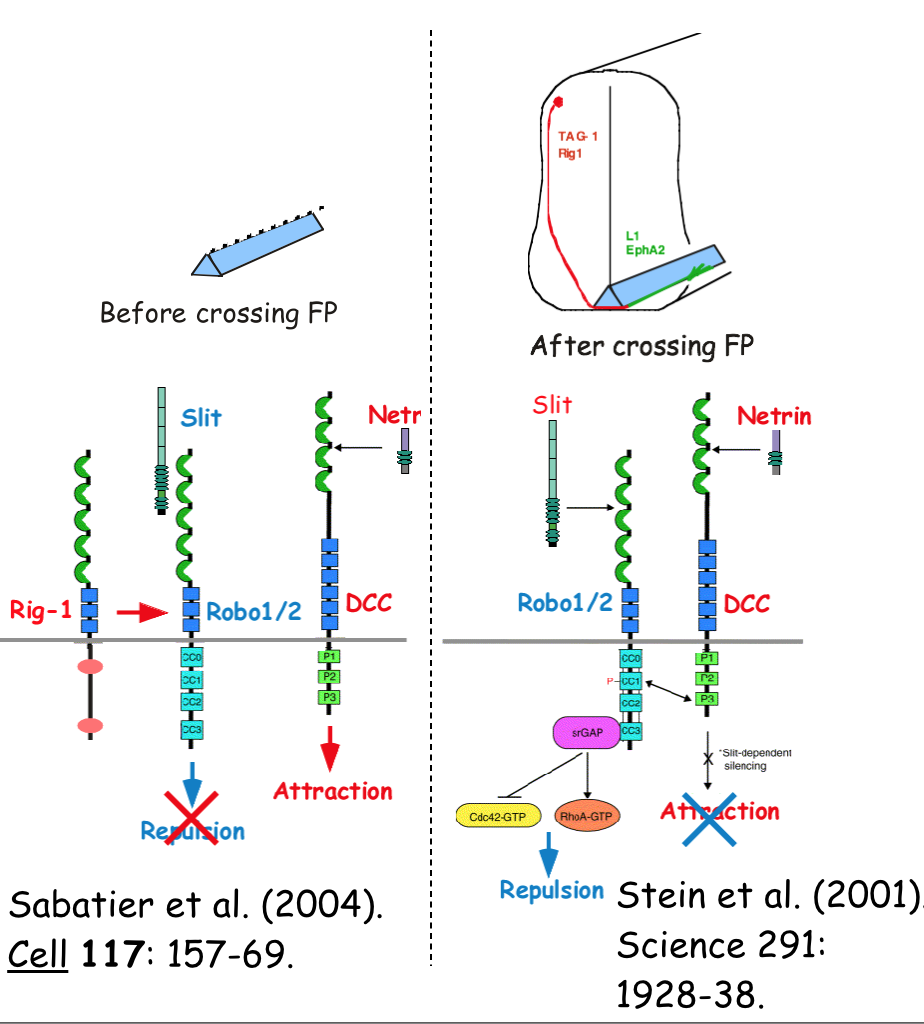
- Instead, a 2nd Robo-like receptor Rig-1 is expressed on pre-crossing axons,
- (Sabatier et al. (2004). Cell 117: 157-69)
- Instead, a 2nd Robo-like receptor Rig-1 is expressed on pre-crossing axons,
- However, a Comm homolog has not been found in vertebrates
- As in flies, Robo is expressed at low levels before crossing and high after, correlating with the increase in slit sensitivity of post-crossing axons
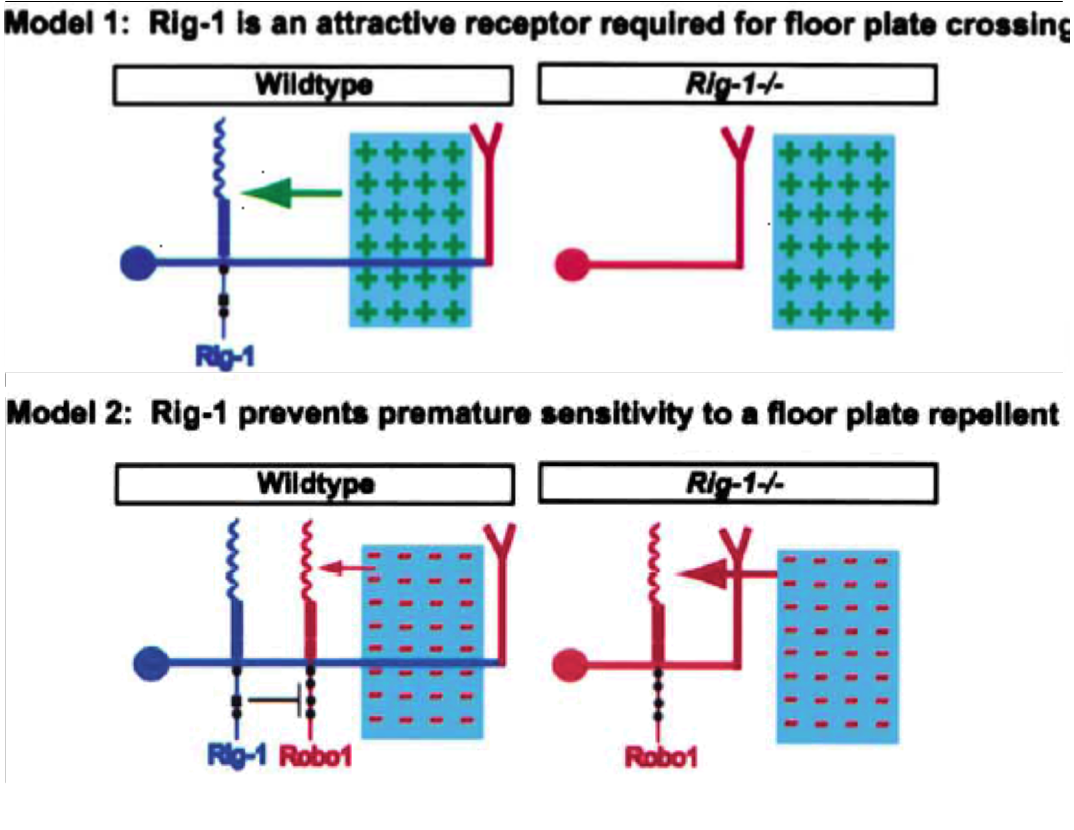
- Two possibilities:
- Loss of Robo-like protein, Rig-1, prevents C axons crossing floor plate!?
- Model 2: Rig-1 prevents premature sensitivity to a floor plate repellant
- Model 1: Rig-1 is an attractive receptor required for floor plate crossing
- Pre-crossing C axons from Rig-1 mice are prematurely sensitive to Slit
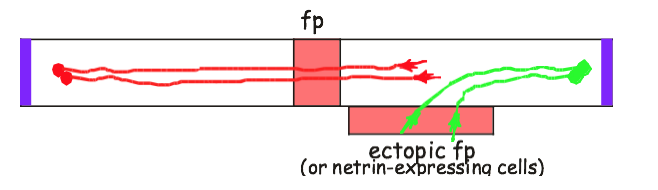
- Pre-crossing C axons lacking Rig-1 are not attracted to floorplate (Model 1?)
- But surprisingly they are if Slit function is blocked (using soluble Robo) (Model 2?)
- Wild type pre-crossing C axons ignore Slit in the presence of netrin (E), whereas those lacking Rig-1 are repelled (G)
- So the function of Rig-1 is to prevent premature Slit sensitivity
- Pre-crossing C axons lacking Rig-1 are not attracted to floorplate (Model 1?)
- The expression of a number of cell surface proteins also changes as commissural axons cross the midline in mammals.
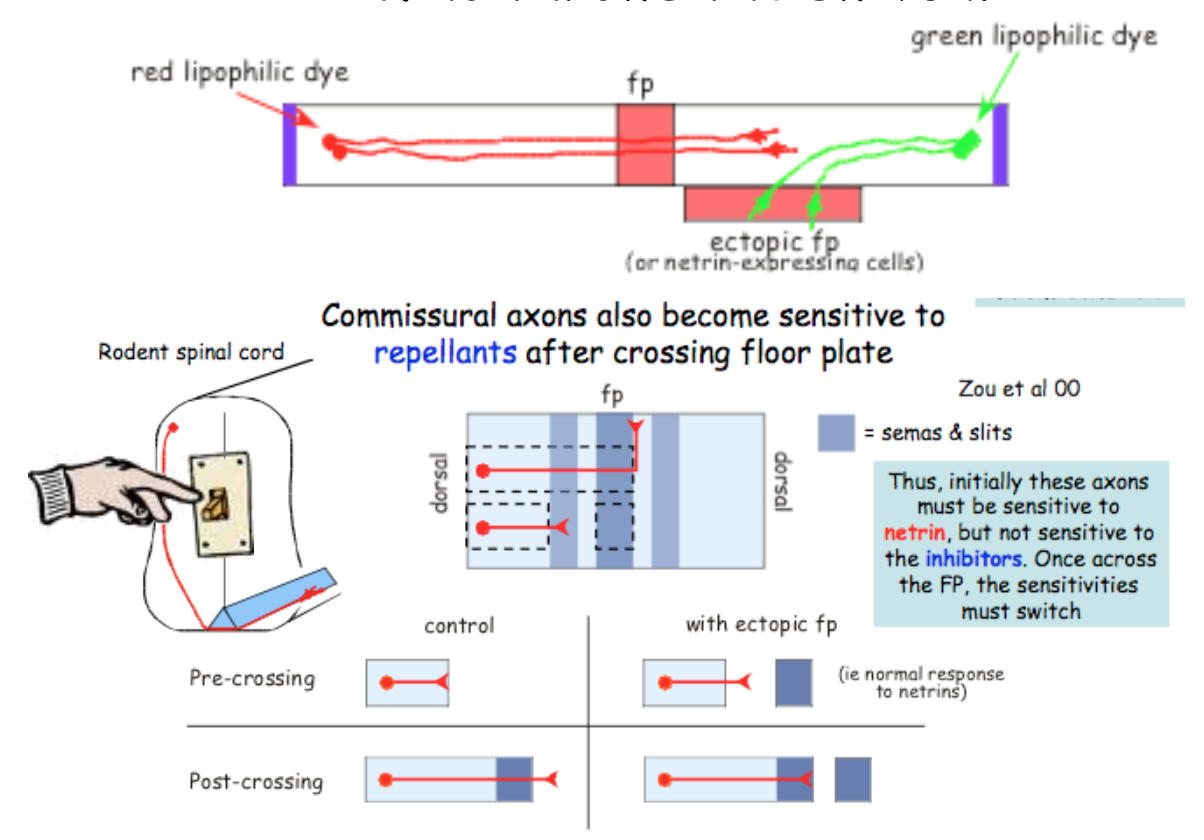
How is netrin response lost?
- Isolated neurons from embryonic Xenopus spinal cord respond to netrin in axon turning assay.
- However, effect of netrin is negated when Slit is also present.*
- This is specific to netrin since turning induced by another molecule (BDNF) that binds to a different receptor is not affected by slit.
- * these are thought to be post-crossing C axons. Note that Slit has no effect on its own.
- However, effect of netrin is negated when Slit is also present.*
- Robo/DCC interactions?
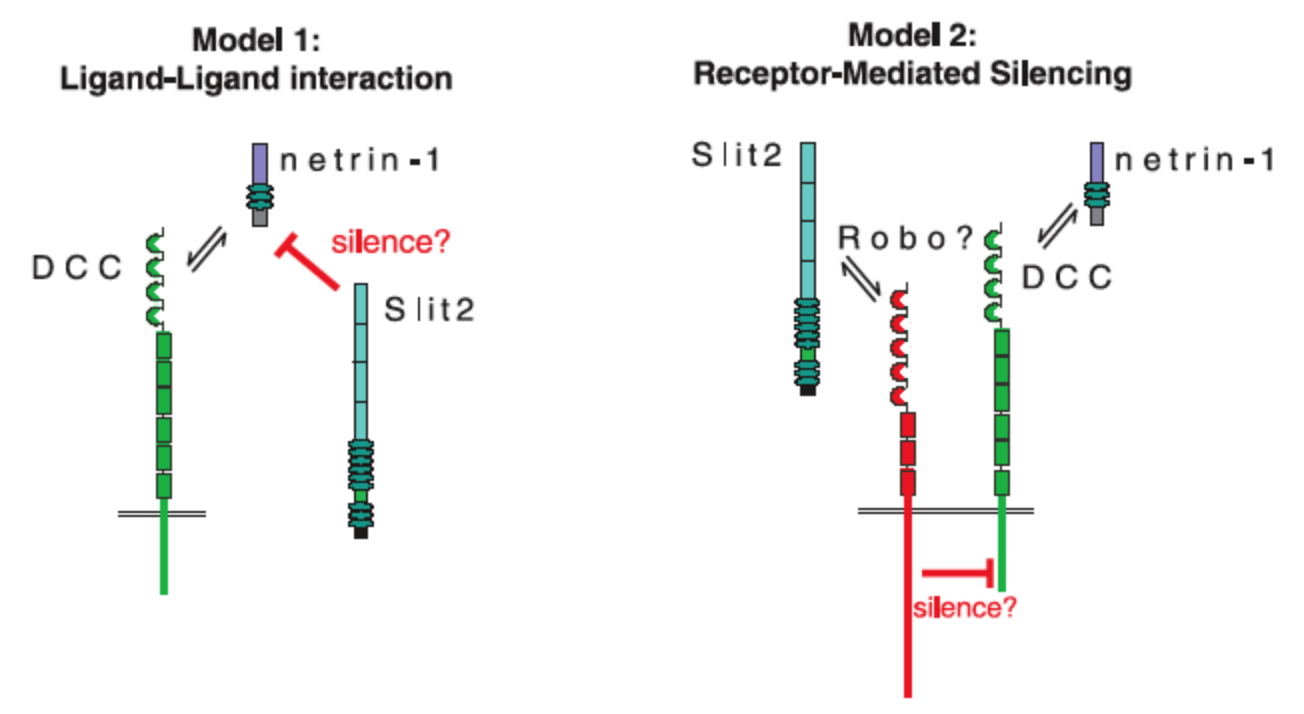
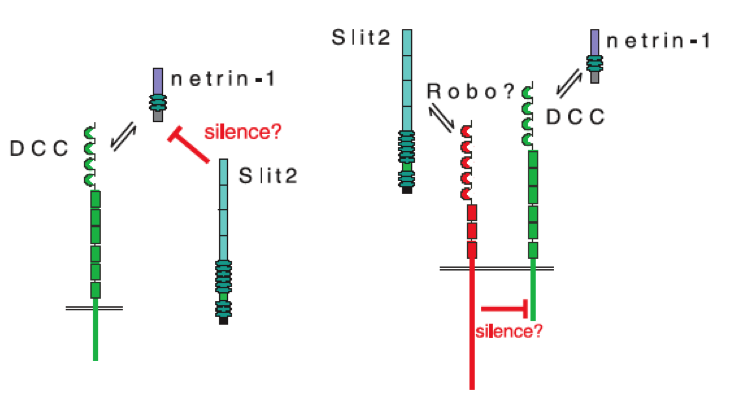
- Two models might explain:
- Ligand-ligand interaction
- Receptor-mediated silencing
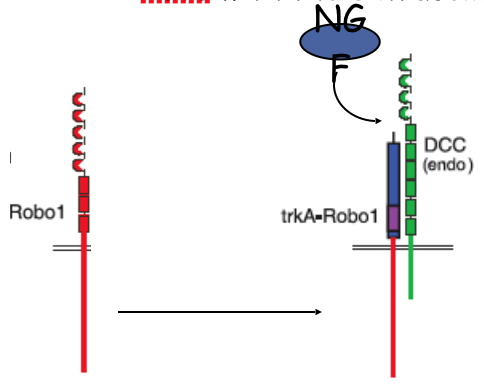
- Only Robo-intracellular domain is required to block netrin response
- Beauty of Xenopus system: can introduce new forms of the receptors by injecting RNA into one cell embryo, letting it develop and then culture neurons from its spinal cord.
- Therefore, can express hybrid versions of Robo, e.g. the intracellular domain of Robo with the extracellular domain from another receptor:
- Now find that NGF can block the netrin turning response.
- Since NGF does not do this normally, this argues against model 1 and in favour of model 2:
- These and other results indicate that the silencing of the netrin response by slit is due to an interaction between the cytoplasmic domains of DCC and Robo.
- Since NGF does not do this normally, this argues against model 1 and in favour of model 2:
- Now find that NGF can block the netrin turning response.
- Therefore, can express hybrid versions of Robo, e.g. the intracellular domain of Robo with the extracellular domain from another receptor:
- Beauty of Xenopus system: can introduce new forms of the receptors by injecting RNA into one cell embryo, letting it develop and then culture neurons from its spinal cord.
- Two models might explain:
- Isolated neurons from embryonic Xenopus spinal cord respond to netrin in axon turning assay.
Sequential silencing - crosstalk between receptors - prevents first Robo, then DCC, from operating in the wrong part of the pathway
- Crosstalk between receptors prevents Robo from operating in the wrong part of the pathway
- The role of Rig-1 is analogous to that of Comm in flies - it prevents Robo from signalling before the midline
- However, the mechanism is different. Loss of Rig-1 does not lead to the upregulation of Robo on pre-crossing axons
- What keeps Robo levels low before crossing is unclear, but clearly low levels of Robo still require blockade by Rig-1 to prevent premature Slit response
- However, the mechanism is different. Loss of Rig-1 does not lead to the upregulation of Robo on pre-crossing axons
- The role of Rig-1 is analogous to that of Comm in flies - it prevents Robo from signalling before the midline
- Thus, combining this with the previous observations about Rig-1, we see that this results in careful control of the switch from netrin to slit responsiveness that occurs as the midline is crossed.
- Before the midline, Rig-1 silences Robo
- Once across the midline, the activation of Robo1/2 by Slit interferes with signalling by DCC
- Thus, changes in Rig-1 expression underlie the changes in sensitivity to both Netrin and DCC as the midline is crossed.
- Once across the midline, the activation of Robo1/2 by Slit interferes with signalling by DCC
- Before the midline, Rig-1 silences Robo
- Testing models
- Today, all three papers presented have tested in each case at least two possible models of ‘how things might work’:
- For your revision, pick at least one of these and make sure you can explain the principles by which they test the models, ie read at least one of those papers carefully!
- Today, all three papers presented have tested in each case at least two possible models of ‘how things might work’:
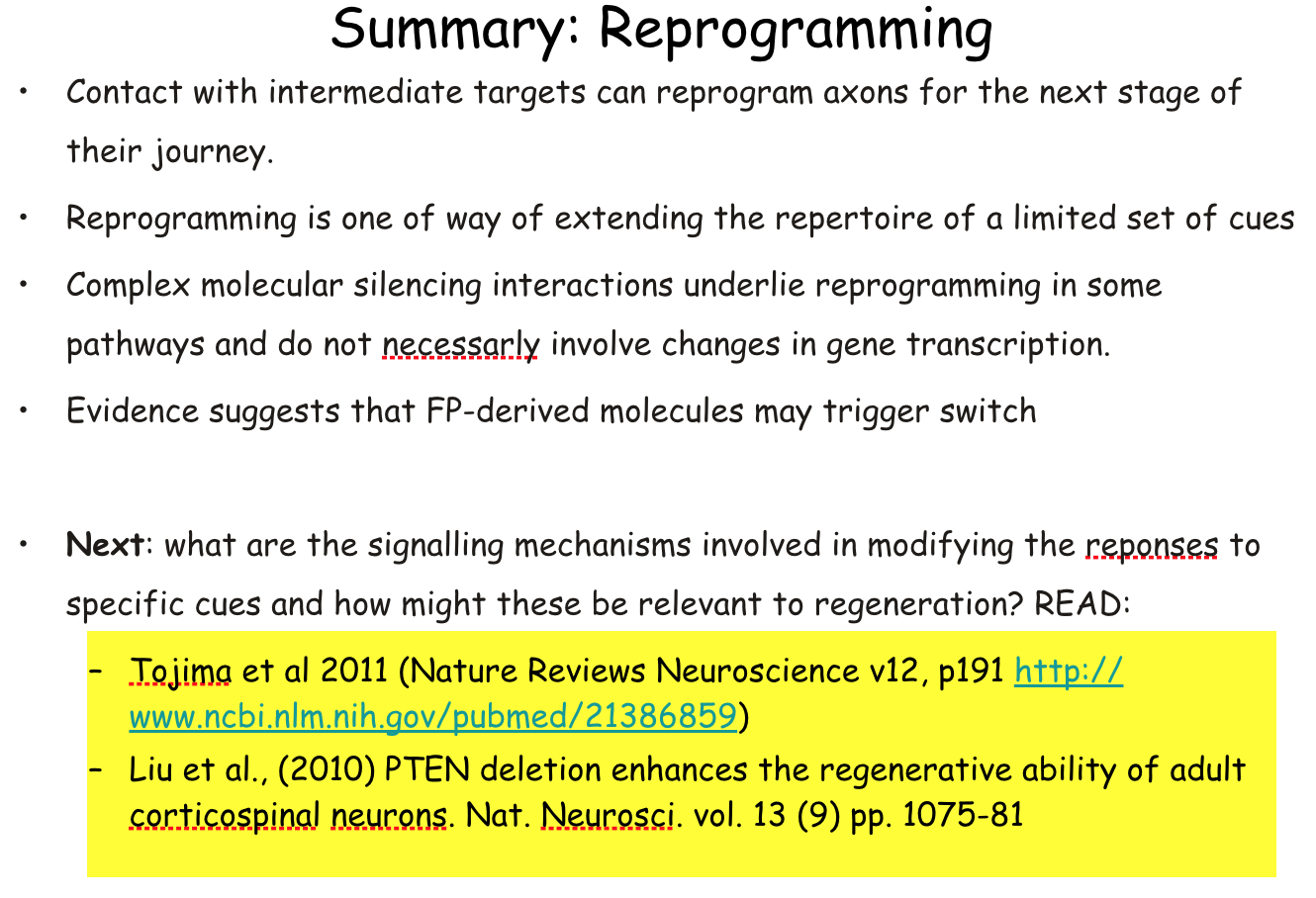
- Who throws the switch?
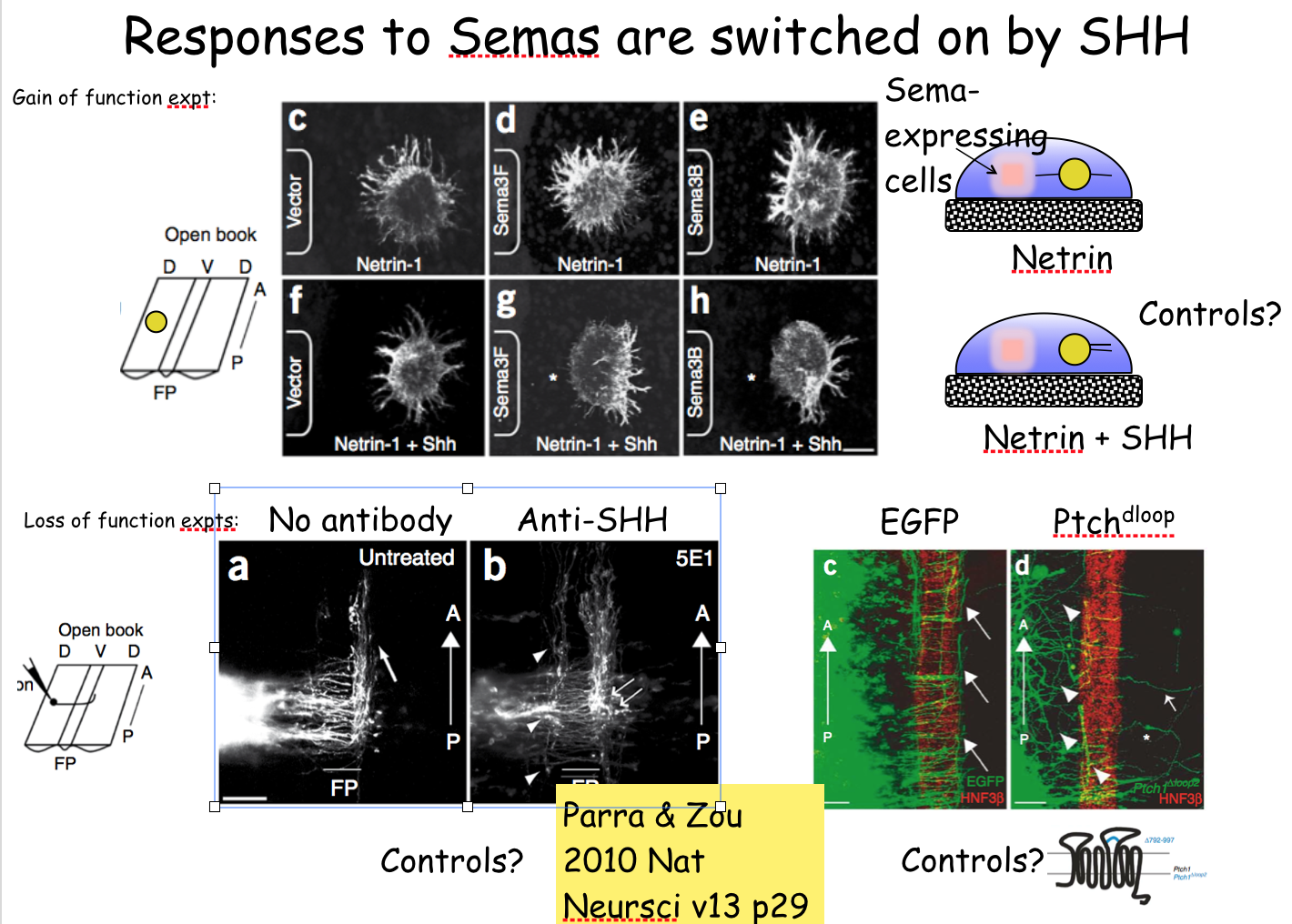
- Responses to Semas are switched on by SHH
- Last thoughts on switching
- The paper by Parra and Zou certainly suggests that SHH may be important in the triggering of at least one of the responses of C axons to midline-derived cues (Semas), but there are some important controls that are missing.
- Is a diffusible molecule the kind of trigger that you would have expected?
- The paper by Parra and Zou certainly suggests that SHH may be important in the triggering of at least one of the responses of C axons to midline-derived cues (Semas), but there are some important controls that are missing.
- Crosstalk between receptors prevents Robo from operating in the wrong part of the pathway
Images and files in the map


Information
- Description
- Undergraduate BMS 381 Developmental neurobiology (AF lectures) Mind Map on Reprogramming, created by Kristi Brogden on 31/10/2014.
- Created by
- Kristi Brogden
- Views
- 4
- Rating