
Mind map
Energy Issues
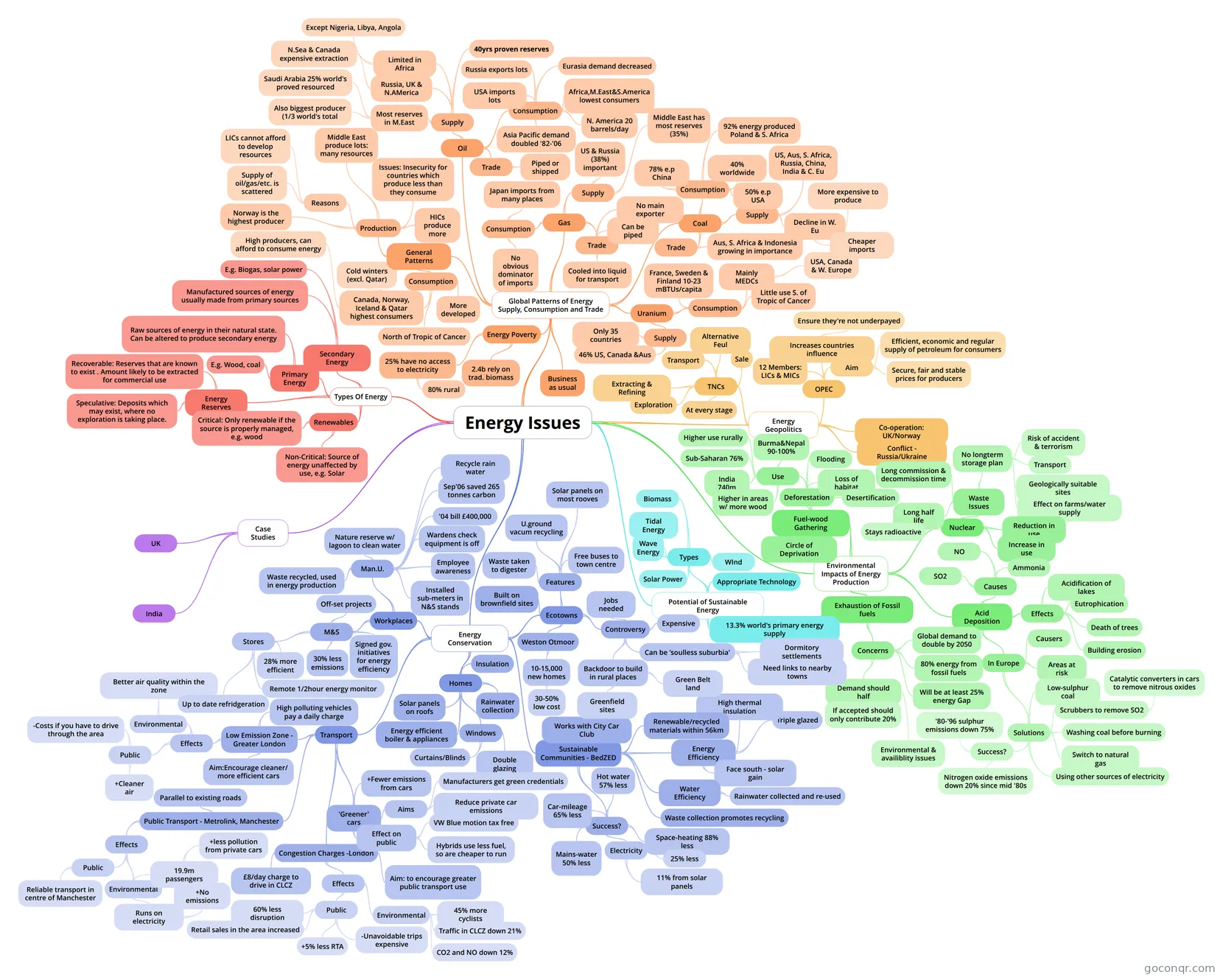
Mind map: Energy issues
Map content
Energy Issues
- Sustainable Development: Controlling energy resources so future generations still have a source of energy resources
- Energy Security: Access to reliable and affordable sources of energy
Types Of Energy
- Non-Renewables: Oil, Coal, Natural Gas and Nuclear
- Renewables: Solar, Hydroelectric, Geothermal, Wave & Tidal, Wind and Biomass
- Energy Resource: Any part of the environment that could be used for energy production
- Energy Reserve: Proportion of the resource which could be exploited under existing economic conditions w/ availible tech.
- Primary Energy
- Raw sources of energy in their natural state. Can be altered to produce secondary energy
- E.g. Wood, coal
- Energy Reserves
- Recoverable: Reserves that are known to exist . Amount likely to be extracted for commercial use
- Speculative: Deposits which may exist, where no exploration is taking place.
- Renewables
- Critical: Only renewable if the source is properly managed, e.g. wood
- Non-Critical: Source of energy unaffected by use, e.g. Solar
- Secondary Energy
- Manufactured sources of energy usually made from primary sources
- E.g. Biogas, solar power
Global Patterns of Energy Supply, Consumption and Trade
- Energy Gap: Difference between energy supply and demand
- Energy Poverty: Having less energy than is required to meet demand
- General Patterns
- Production
- Norway is the highest producer
- HICs produce more
- Middle East produce lots: many resources
- Issues: Insecurity for countries which produce less than they consume
- Reasons
- Supply of oil/gas/etc. is scattered
- LICs cannot afford to develop resources
- Consumption
- Canada, Norway, Iceland & Qatar highest consumers
- Cold winters (excl. Qatar)
- High producers, can afford to consume energy
- North of Tropic of Cancer
- More developed
- Canada, Norway, Iceland & Qatar highest consumers
- Production
- Oil
- Supply
- Most reserves in M.East
- Saudi Arabia 25% world's proved resourced
- Also biggest producer (1/3 world's total
- Russia, UK & N.AMerica
- N.Sea & Canada expensive extraction
- Limited in Africa
- Except Nigeria, Libya, Angola
- 40yrs proven reserves
- Most reserves in M.East
- Trade
- Piped or shipped
- Consumption
- Asia Pacific demand doubled '82-'06
- N. America 20 barrels/day
- Africa,M.East&S.America lowest consumers
- Eurasia demand decreased
- USA imports lots
- Russia exports lots
- Supply
- Gas
- Supply
- US & Russia (38%) important
- Middle East has most reserves (35%)
- Consumption
- No obvious dominator of imports
- Japan imports from many places
- Trade
- Cooled into liquid for transport
- Can be piped
- No main exporter
- Supply
- Coal
- Trade
- Aus, S. Africa & Indonesia growing in importance
- Consumption
- 92% energy produced Poland & S. Africa
- 78% e.p China
- 50% e.p USA
- 40% worldwide
- Supply
- US, Aus, S. Africa, Russia, China, India & C. Eu
- Decline in W. Eu
- More expensive to produce
- Cheaper imports
- Trade
- Uranium
- Supply
- Only 35 countries
- 46% US, Canada &Aus
- Consumption
- France, Sweden & Finland 10-23 mBTUs/capita
- Mainly MEDCs
- USA, Canada & W. Europe
- Little use S. of Tropic of Cancer
- Supply
- Energy Poverty
- 25% have no access to electricity
- 80% rural
- 2.4b rely on trad. biomass
- 25% have no access to electricity
- Business as usual
- How world's energy mix would look if current trends continued.
- Demand for fossil fuels and related carbon emissions would grow by 83%
Energy Conservation
- Sustainable Communities - BedZED
- Energy Efficiency
- Face south - solar gain
- Triple glazed
- High thermal insulation
- Water Efficiency
- Rainwater collected and re-used
- Renewable/recycled materials within 56km
- Waste collection promotes recycling
- Works with City Car Club
- Success?
- Compared to UK averages
- Space-heating 88% less
- Hot water 57% less
- Electricity
- 25% less
- 11% from solar panels
- Mains-water 50% less
- 67% compared to power shower households
- Car-mileage 65% less
- Energy Efficiency
- Ecotowns
- Built on brownfield sites
- Weston Otmoor
- Oxfordshire, 3 miles S. of Bicester
- 10-15,000 new homes
- 30-50% low cost
- Features
- Waste taken to digester
- Free buses to town centre
- Solar panels on most rooves
- U.ground vacum recycling
- Controversy
- Expensive
- Jobs needed
- Backdoor to build in rural places
- Greenfield sites
- Green Belt land
- Can be 'soulless suburbia'
- Dormitory settlements
- Need links to nearby towns
- Workplaces
- Man.U.
- '04 bill £400,000
- 15,000 tonnes of carbon
- Installed sub-meters in N&S stands
- Wardens check equipment is off
- Employee awareness
- Sep'06 saved 265 tonnes carbon
- 18% reduction
- Recycle rain water
- Waste recycled, used in energy production
- Nature reserve w/ lagoon to clean water
- '04 bill £400,000
- M&S
- Signed gov. initiatives for energy efficiency
- Stores
- Remote 1/2hour energy monitor
- 28% more efficient
- Up to date refridgeration
- 30% less emissions
- Off-set projects
- Achieved carbon neutrality
- Man.U.
- Transport
- Public Transport - Metrolink, Manchester
- Parallel to existing roads
- Effects
- Environmental
- 19.9m passengers
- +less pollution from private cars
- Runs on electricity
- +No emissions
- 19.9m passengers
- Public
- Reliable transport in centre of Manchester
- Environmental
- Congestion Charges -London
- Aim: to encourage greater public transport use
- Effects
- Environmental
- Traffic in CLCZ down 21%
- CO2 and NO down 12%
- 45% more cyclists
- Public
- -Unavoidable trips expensive
- +5% less RTA
- 60% less disruption
- Retail sales in the area increased
- Environmental
- £8/day charge to drive in CLCZ
- Low Emission Zone - Greater London
- High polluting vehicles pay a daily charge
- Aim:Encourage cleaner/ more efficient cars
- Effects
- Environmental
- Better air quality within the zone
- Public
- +Cleaner air
- -Costs if you have to drive through the area
- Environmental
- 'Greener' cars
- Aims
- Manufacturers get green credentials
- Reduce private car emissions
- +Fewer emissions from cars
- Effect on public
- VW Blue motion tax free
- Hybrids use less fuel, so are cheaper to run
- Aims
- Public Transport - Metrolink, Manchester
- Homes
- Insulation
- Roofs, walls, doors, floors (carpets)
- Solar panels on roofs
- Electricity and hot water
- Windows
- Curtains/Blinds
- Double glazing
- Energy efficient boiler & appliances
- Rainwater collection
- Use on garden, for washing machine & toilets
- Insulation
- Sustainable Communities - BedZED
Environmental Impacts of Energy Production
- Fuel-wood Gathering
- Use
- Sub-Saharan 76%
- Burma&Nepal 90-100%
- Higher use rurally
- India 740m
- Higher in areas w/ more wood
- Deforestation
- Loss of habitat
- Desertification
- Flooding
- Circle of Deprivation
- Use
- Nuclear
- Waste Issues
- Long half life
- Stays radioactive
- No longterm storage plan
- Transport
- Risk of accident & terrorism
- Geologically suitable sites
- Effect on farms/water supply
- Long commission & decommission time
- Long half life
- Reduction in use
- +Only have to deal with legacy waste -More CO2 from fossil fuels +Lower risk of accidents -Not enough energy when fossil fuels run out
- Increase in use
- -More nuclear waste +Lower carbon emmisions as lower fossil fuell reliance
- Waste Issues
- Acid Deposition
- When acidic compounds created in the atmosphere fall to the earth as dry particles, gas, or when they combine with moisture to create acid rain, snow or fog.
- Causes
- SO2
- Sources: Electricity Production-70%, Transport-7%, Industry-8%, Other-15%
- NO
- Transport-53%, Electricity Production-30%, Industry-5%, Other-12%
- Ammonia
- Source: Livestock farming
- SO2
- Effects
- Acidification of lakes
- Death of animals in lake - can't deal with the pH change
- Eutrophication
- Excess nitrogen, devoids lake of any plant life except algae
- Death of trees
- Acid fog strips leaves of nutrients -> in an area reliant on forestry industry would collapse
- Building erosion
- Either through iron corrosion or by dissolving molecules in stone
- Acidification of lakes
- In Europe
- Causers
- Spain, UK, Poland, Slovakia, Czech, Ukraine, Bulgaria and Hungary
- Areas at risk
- North Sea/East Coast UK, SW Poland, N Czech & Slovakia, Baltic States and Sweden
- Solutions
- Low-sulphur coal
- Scrubbers to remove SO2
- Catalytic converters in cars to remove nitrous oxides
- Washing coal before burning
- Switch to natural gas
- Using other sources of electricity
- Success?
- '80-'96 sulphur emissions down 75%
- Nitrogen oxide emissions down 20% since mid '80s
- Causers
- Exhaustion of Fossil fuels
- Years Left (proven reserves): Coal - 142 yrs, Gas - 61 yrs, Oil - 54 yrs
- Concerns
- 80% energy from fossil fuels
- Global demand to double by 2050
- Demand should half
- Environmental & availiblity issues
- If accepted should only contribute 20%
- Will be at least 25% energy Gap
- Fuel-wood Gathering
Energy Geopolitics
- Conflict - Russia/Ukraine
- Co-operation: UK/Norway
- OPEC
- Organisation of the Petroleum Exporting Countries
- Aim
- Secure, fair and stable prices for producers
- Efficient, economic and regular supply of petroleum for consumers
- Increases countries influence
- Ensure they're not underpayed
- 12 Members: LICs & MICs
- TNCs
- At every stage
- Exploration
- Negotiations about countries possible reserves
- Extracting & Refining
- Build rigs, infrastructure & refineries Local employees -> low skills
- Transport
- Maintaining pipes, using tankers
- Sale
- Different countries, possibly distributors Distributing to petrol/power stations
- Alternative Feul
- Future proofing by investing in alternative sources of energy
Potential of Sustainable Energy
- Types
- Biomass
- Solar Power
- Wave Energy
- Tidal Energy
- WInd
- 13.3% world's primary energy supply
- 10.6% combustibles 2.2% HEP 0.416% Geothermal 0.039% Solar 0.051% Wind 0.0005% Tidal
- Appropriate Technology
- Technical expertise and equipment in use suit the economic and technological levels in a country
- Types
Case Studies
Information
- Description
- A-level Geog-Energy Mind Map on Energy Issues, created by Hels-W on 02/11/2014.
- Created by
- Hels-W
- Views
- 20
- Rating