
Mind map
The Buddha's Life
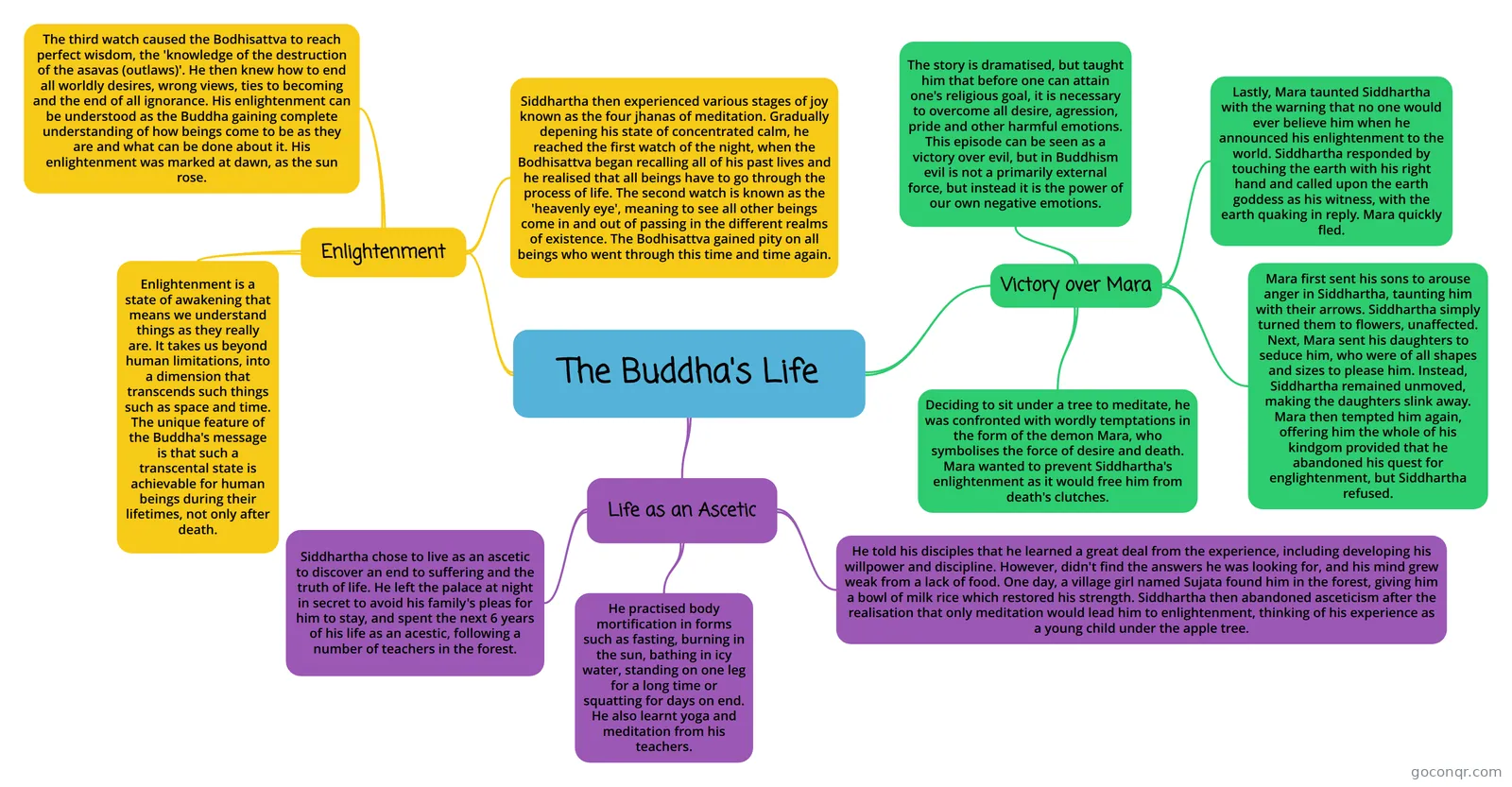
Mind map: The Buddha's life
Map content
The Buddha's Life
Life as an Ascetic
- He practised body mortification in forms such as fasting, burning in the sun, bathing in icy water, standing on one leg for a long time or squatting for days on end. He also learnt yoga and meditation from his teachers.
- Siddhartha chose to live as an ascetic to discover an end to suffering and the truth of life. He left the palace at night in secret to avoid his family's pleas for him to stay, and spent the next 6 years of his life as an acestic, following a number of teachers in the forest.
- He told his disciples that he learned a great deal from the experience, including developing his willpower and discipline. However, didn't find the answers he was looking for, and his mind grew weak from a lack of food. One day, a village girl named Sujata found him in the forest, giving him a bowl of milk rice which restored his strength. Siddhartha then abandoned asceticism after the realisation that only meditation would lead him to enlightenment, thinking of his experience as a young child under the apple tree.
Victory over Mara
- Deciding to sit under a tree to meditate, he was confronted with wordly temptations in the form of the demon Mara, who symbolises the force of desire and death. Mara wanted to prevent Siddhartha's enlightenment as it would free him from death's clutches.
- Mara first sent his sons to arouse anger in Siddhartha, taunting him with their arrows. Siddhartha simply turned them to flowers, unaffected. Next, Mara sent his daughters to seduce him, who were of all shapes and sizes to please him. Instead, Siddhartha remained unmoved, making the daughters slink away. Mara then tempted him again, offering him the whole of his kindgom provided that he abandoned his quest for englightenment, but Siddhartha refused.
- Lastly, Mara taunted Siddhartha with the warning that no one would ever believe him when he announced his enlightenment to the world. Siddhartha responded by touching the earth with his right hand and called upon the earth goddess as his witness, with the earth quaking in reply. Mara quickly fled.
- The story is dramatised, but taught him that before one can attain one's religious goal, it is necessary to overcome all desire, agression, pride and other harmful emotions. This episode can be seen as a victory over evil, but in Buddhism evil is not a primarily external force, but instead it is the power of our own negative emotions.
Enlightenment
- Siddhartha then experienced various stages of joy known as the four jhanas of meditation. Gradually depening his state of concentrated calm, he reached the first watch of the night, when the Bodhisattva began recalling all of his past lives and he realised that all beings have to go through the process of life. The second watch is known as the 'heavenly eye', meaning to see all other beings come in and out of passing in the different realms of existence. The Bodhisattva gained pity on all beings who went through this time and time again.
- The third watch caused the Bodhisattva to reach perfect wisdom, the 'knowledge of the destruction of the asavas (outlaws)'. He then knew how to end all worldly desires, wrong views, ties to becoming and the end of all ignorance. His enlightenment can be understood as the Buddha gaining complete understanding of how beings come to be as they are and what can be done about it. His enlightenment was marked at dawn, as the sun rose.
- Enlightenment is a state of awakening that means we understand things as they really are. It takes us beyond human limitations, into a dimension that transcends such things such as space and time. The unique feature of the Buddha's message is that such a transcental state is achievable for human beings during their lifetimes, not only after death.
Information
- Description
- Mind Map on The Buddha's Life, created by emmaalouisehugz on 04/11/2014.
- Created by
- emmaalouisehugz
- Views
- 12
- Rating