
Mind map
Motivation
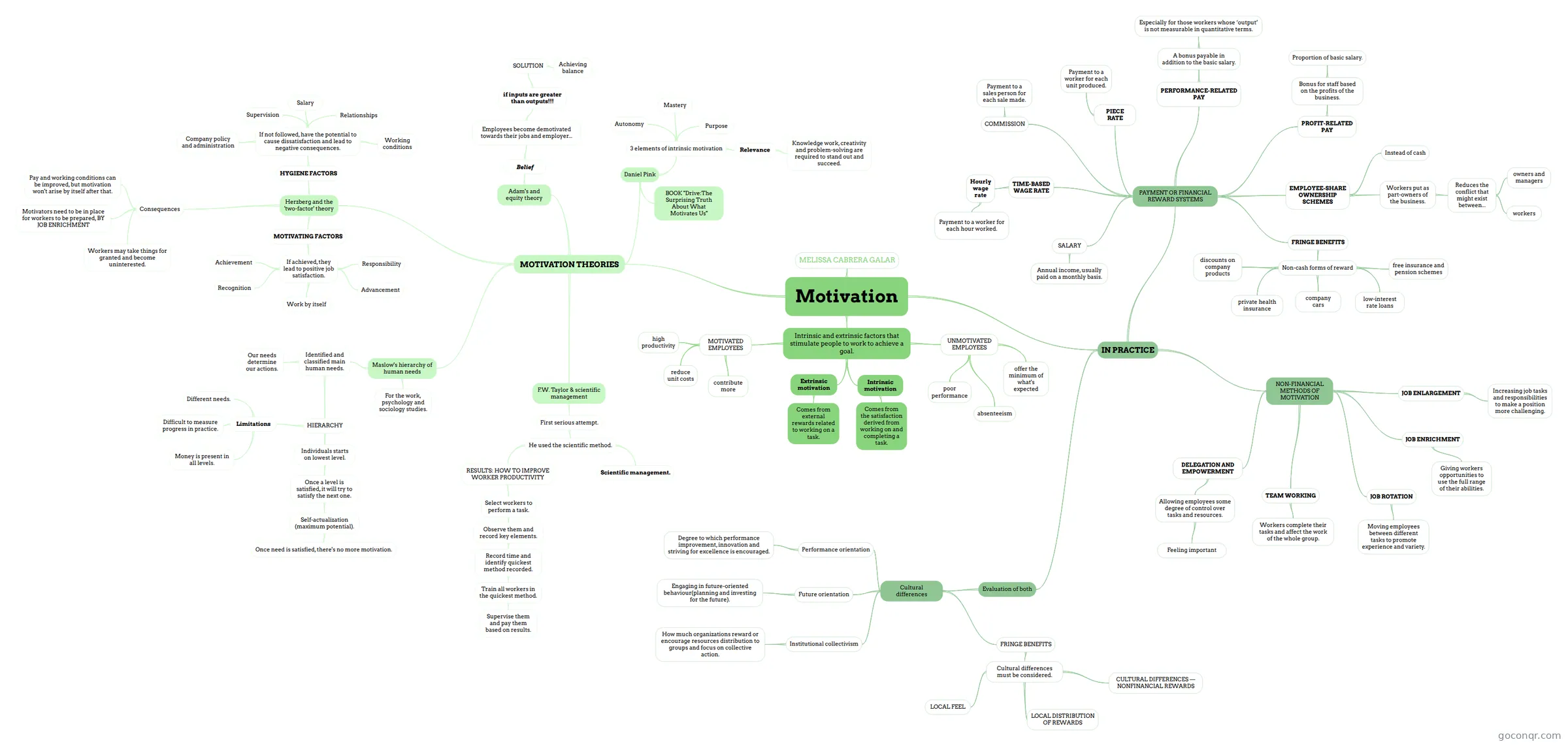
Mind map: motivation
Map content
Motivation
Intrinsic and extrinsic factors that stimulate people to work to achieve a goal.
- Extrinsic motivation
- Comes from external rewards related to working on a task.
- Intrinsic motivation
- Comes from the satisfaction derived from working on and completing a task.
- MOTIVATED EMPLOYEES
- high productivity
- reduce unit costs
- contribute more
- UNMOTIVATED EMPLOYEES
- poor performance
- offer the minimum of what's expected
- absenteeism
- Extrinsic motivation
MOTIVATION THEORIES
- F.W. Taylor & scientific management
- First serious attempt.
- He used the scientific method.
- Scientific management.
- RESULTS: HOW TO IMPROVE WORKER PRODUCTIVITY
- Select workers to perform a task.
- Observe them and record key elements.
- Record time and identify quickest method recorded.
- Train all workers in the quickest method.
- Supervise them and pay them based on results.
- Train all workers in the quickest method.
- Record time and identify quickest method recorded.
- Observe them and record key elements.
- Select workers to perform a task.
- He used the scientific method.
- First serious attempt.
- Maslow's hierarchy of human needs
- For the work, psychology and sociology studies.
- Identified and classified main human needs.
- Our needs determine our actions.
- HIERARCHY
- Individuals starts on lowest level.
- Once a level is satisfied, it will try to satisfy the next one.
- Self-actualization (maximum potential).
- Once need is satisfied, there's no more motivation.
- Self-actualization (maximum potential).
- Once a level is satisfied, it will try to satisfy the next one.
- Limitations
- Different needs.
- Difficult to measure progress in practice.
- Money is present in all levels.
- Individuals starts on lowest level.
- Herzberg and the 'two-factor' theory
- MOTIVATING FACTORS
- If achieved, they lead to positive job satisfaction.
- Achievement
- Recognition
- Work by itself
- Responsibility
- Advancement
- If achieved, they lead to positive job satisfaction.
- HYGIENE FACTORS
- If not followed, have the potential to cause dissatisfaction and lead to negative consequences.
- Company policy and administration
- Supervision
- Salary
- Relationships
- Working conditions
- If not followed, have the potential to cause dissatisfaction and lead to negative consequences.
- Consequences
- Pay and working conditions can be improved, but motivation won't arise by itself after that.
- Motivators need to be in place for workers to be prepared, BY JOB ENRICHMENT
- Workers may take things for granted and become uninterested.
- MOTIVATING FACTORS
- Adam's and equity theory
- Belief
- Employees become demotivated towards their jobs and employer...
- if inputs are greater than outputs!!!
- SOLUTION
- Achieving balance
- SOLUTION
- if inputs are greater than outputs!!!
- Employees become demotivated towards their jobs and employer...
- Belief
- Daniel Pink
- BOOK "Drive:The Surprising Truth About What Motivates Us"
- 3 elements of intrinsic motivation
- Autonomy
- Mastery
- Purpose
- Relevance
- Knowledge work, creativity and problem-solving are required to stand out and succeed.
- F.W. Taylor & scientific management
IN PRACTICE
- PAYMENT OR FINANCIAL REWARD SYSTEMS
- SALARY
- Annual income, usually paid on a monthly basis.
- TIME-BASED WAGE RATE
- Hourly wage rate
- Payment to a worker for each hour worked.
- Hourly wage rate
- PIECE RATE
- Payment to a worker for each unit produced.
- COMMISSION
- Payment to a sales person for each sale made.
- PERFORMANCE-RELATED PAY
- A bonus payable in addition to the basic salary.
- Especially for those workers whose ‘output’ is not measurable in quantitative terms.
- A bonus payable in addition to the basic salary.
- PROFIT-RELATED PAY
- Bonus for staff based on the profits of the business.
- Proportion of basic salary.
- Bonus for staff based on the profits of the business.
- EMPLOYEE-SHARE OWNERSHIP SCHEMES
- Instead of cash
- Workers put as part-owners of the business.
- Reduces the conflict that might exist between...
- owners and managers
- workers
- Reduces the conflict that might exist between...
- FRINGE BENEFITS
- Non-cash forms of reward
- company cars
- free insurance and pension schemes
- private health insurance
- discounts on company products
- low-interest rate loans
- Non-cash forms of reward
- SALARY
- NON-FINANCIAL METHODS OF MOTIVATION
- JOB ENLARGEMENT
- Increasing job tasks and responsibilities to make a position more challenging.
- JOB ENRICHMENT
- Giving workers opportunities to use the full range of their abilities.
- JOB ROTATION
- Moving employees between different tasks to promote experience and variety.
- TEAM WORKING
- Workers complete their tasks and affect the work of the whole group.
- DELEGATION AND EMPOWERMENT
- Allowing employees some degree of control over tasks and resources.
- Feeling important
- Allowing employees some degree of control over tasks and resources.
- JOB ENLARGEMENT
- Evaluation of both
- Cultural differences
- Performance orientation
- Degree to which performance improvement, innovation and striving for excellence is encouraged.
- Future orientation
- Engaging in future-oriented behaviour(planning and investing for the future).
- Institutional collectivism
- How much organizations reward or encourage resources distribution to groups and focus on collective action.
- FRINGE BENEFITS
- Cultural differences must be considered.
- LOCAL FEEL
- LOCAL DISTRIBUTION OF REWARDS
- CULTURAL DIFFERENCES –– NONFINANCIAL REWARDS
- Cultural differences must be considered.
- Performance orientation
- Cultural differences
- PAYMENT OR FINANCIAL REWARD SYSTEMS
MELISSA CABRERA GALAR
Information
- Description
- Empresa Mind Map on Motivation, created by Melissa Cabrera Galar on 06/11/2018.
- Created by
- Melissa Cabrera Galar
- Views
- 0
- Rating