
Mind map
Bonding and Structure
Map content
Bonding and Structure
Types of Bonds
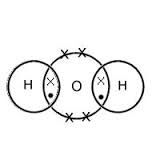
- Covalent Bonds
- It is a shared pair of electrons
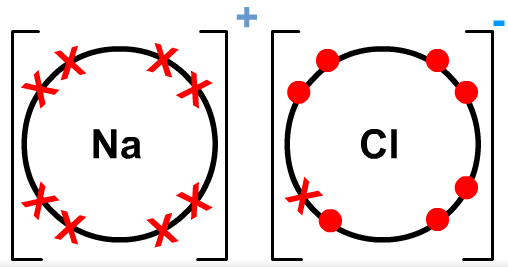
- Ionic Bonds
- It is the electrostatic attraction between oppositely charged ions
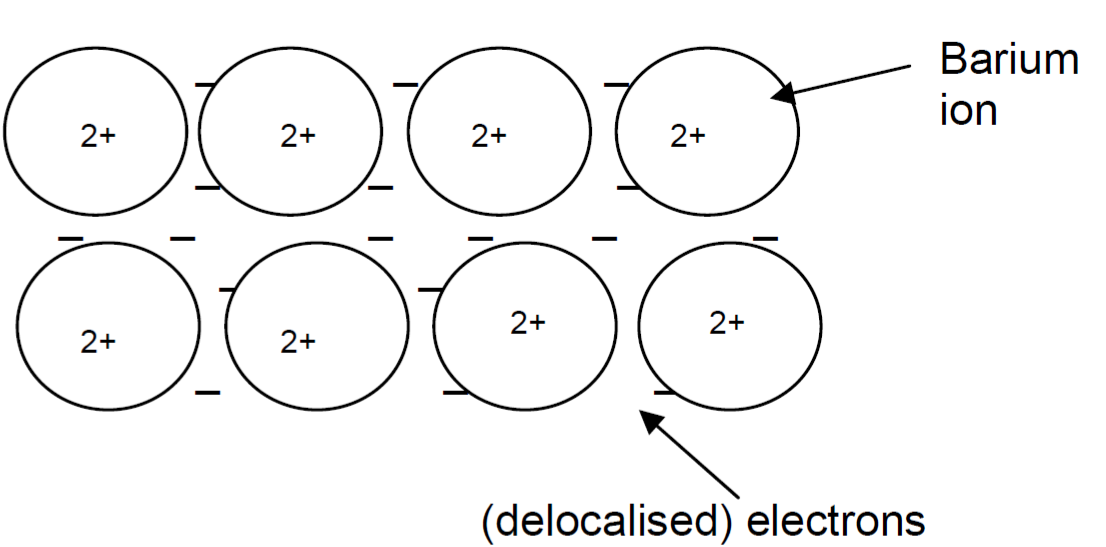
- Metallic Bonds
- It is electrostatic attraction between positive metal ions and delocalised electrons
- Covalent Bonds
Types of Structures
- Giant Metallic Lattice
- It is a 3D structure of positive ions and delocalised electrons bonded together by strong metallic bonds.
- High melting point
- Lots of energy is needed to break the strong metallic bonds between delocalised electrons and positive ions
- Conduct electricity
- The delocalised electrons are mobile i.e. free to move and carry current.
- Malleable and Ductile
- As the electrons in the metallic lattice are free to move, the structure has a degree to give, which allows layers of atoms to slide past each other.
- High melting point
- It is a 3D structure of positive ions and delocalised electrons bonded together by strong metallic bonds.
- Giant Ionic Lattice
- It is a 3D structure of oppositely charged ions bonded together by strong ionic bonds
- High Melting Point
- Lots of energy is needed to break stonng electrostatic attraction between oppositely charged ions.
- Electrical conductivity
- Does not conduct when solid
- Ions in solids have fixed position and hence are not mobile i.e. free to move
- Conduct when molten or dissolved
- The ions are mobile and free to move to carry current
- Does not conduct when solid
- Soluble in polar solvents
- Water molecules attract Na+ and Cl- ions in ionic lattice. Na+ attracts δ- charges on oxygen atoms of the water molecule and Cl- attracts δ+ charges on hydrogen atoms of the water molecules. The ionic lattice breaks down as water molecules surround the ions and dissolve it.
- High Melting Point
- It is a 3D structure of oppositely charged ions bonded together by strong ionic bonds
- Covalent Structures
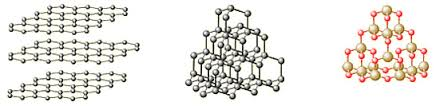
- Giant Covalent Structure
- It is a 3D structure of atoms bonded together by strong covalent bonds.
- High Melting Point
- Lots of energy is needed to break the strong covalent bonds which are broken when melting gian colvalent lattice
- Does not conduct electricity
- There are no charged particles to carry current
- Insoluble
- The covalent bonds are too strong to be broken by wither polar or non-polar solvents
- High Melting Point
- It is a 3D structure of atoms bonded together by strong covalent bonds.
- Simple molecule
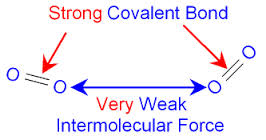
- It is a 3D structure of molecules bonded together by weak intermolecular forces.
- Low Melting Point
- Less energy is needed to break the weak intermolecular forces between molecules.
- Three types of weak intermolecular forces
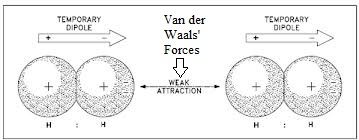
- Van der Waals' Forces
- It is the weak attractive forces between induces dipoles of neighbouring molecules
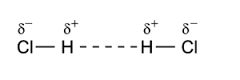
- Permanent DIpole-Dipole attraction
- It is the weak attractive forces between permanent dipoles of neighbouring molecules
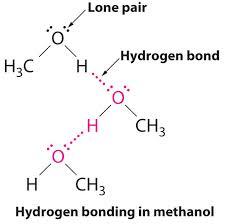
- Hydrogen bonding
- It is the strong dipole-dipole attraction between an electron-deficient hydrogen atom on one molecule and the lone pair of electrons on a highly electronegative atom on a different molecule. (O/N/F)
- Van der Waals' Forces
- Three types of weak intermolecular forces
- Less energy is needed to break the weak intermolecular forces between molecules.
- Do not conduct electricity
- No charged particles free to move and carry current
- Soluble in non-polar solvent
- Weak Van Der Waal's forces arise between the non-polar covalent molecules and non-polar solvent molecules. this weakens the structure and causes it to break down.
- Low Melting Point
- It is a 3D structure of molecules bonded together by weak intermolecular forces.
- Giant Covalent Structure
- Giant Metallic Lattice
COVALENT BOND > METALLIC BOND > INTERMOLECULAR FORCES
Images and files in the map
Information
- Description
- GCSE AS Chemistry Mind Map on Bonding and Structure, created by Kajal Patel on 26/11/2014.
- Created by
- Kajal Patel
- Views
- 185
- Rating