
Mind map
Rivers
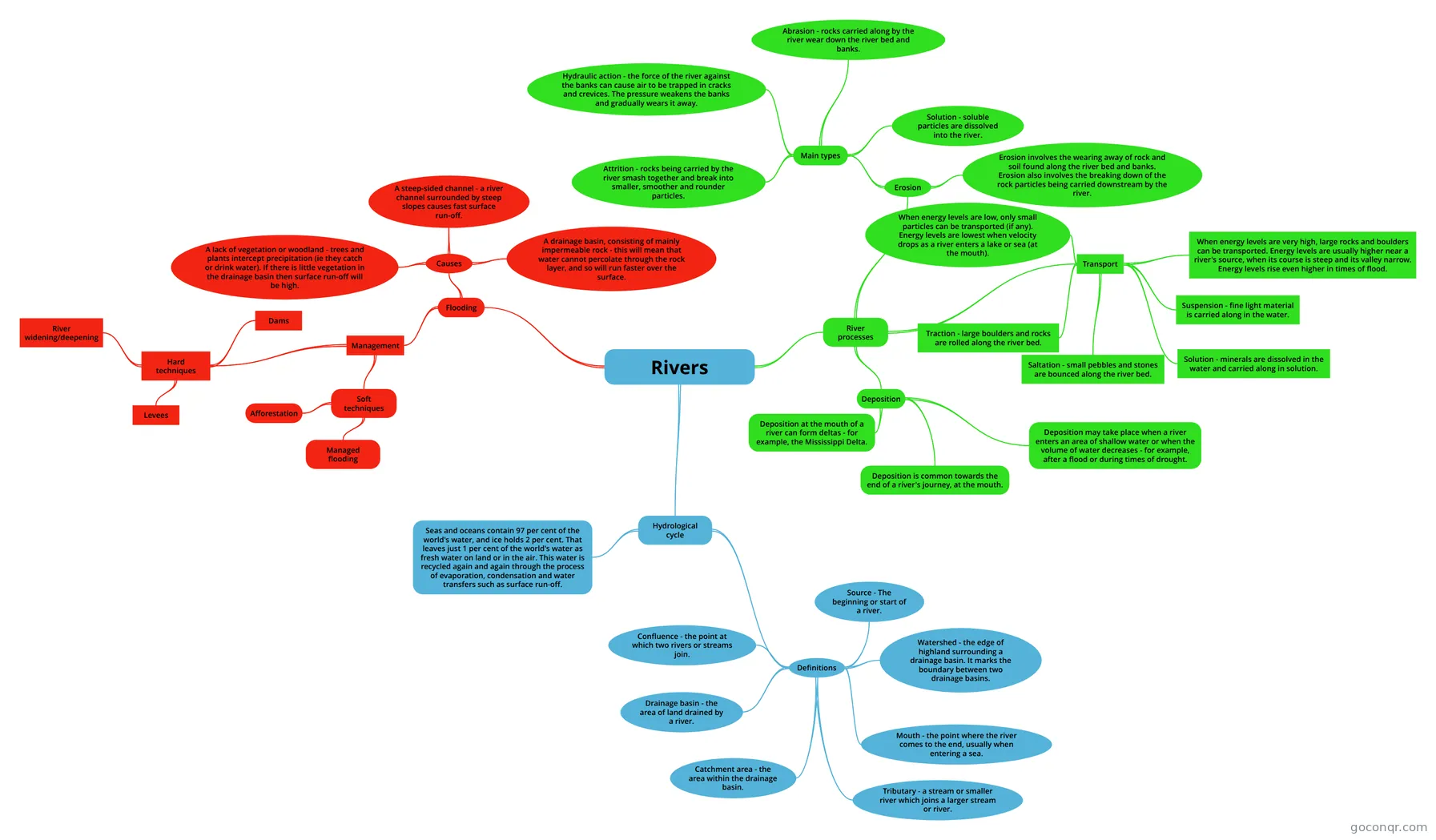
Mind map: Rivers
Map content
Rivers
Hydrological cycle
- Seas and oceans contain 97 per cent of the world's water, and ice holds 2 per cent. That leaves just 1 per cent of the world's water as fresh water on land or in the air. This water is recycled again and again through the process of evaporation, condensation and water transfers such as surface run-off.
- Definitions
- Drainage basin - the area of land drained by a river.
- Catchment area - the area within the drainage basin.
- Watershed - the edge of highland surrounding a drainage basin. It marks the boundary between two drainage basins.
- Source - The beginning or start of a river.
- Confluence - the point at which two rivers or streams join.
- Tributary - a stream or smaller river which joins a larger stream or river.
- Mouth - the point where the river comes to the end, usually when entering a sea.
River processes
- Erosion
- Erosion involves the wearing away of rock and soil found along the river bed and banks. Erosion also involves the breaking down of the rock particles being carried downstream by the river.
- Main types
- Hydraulic action - the force of the river against the banks can cause air to be trapped in cracks and crevices. The pressure weakens the banks and gradually wears it away.
- Abrasion - rocks carried along by the river wear down the river bed and banks.
- Attrition - rocks being carried by the river smash together and break into smaller, smoother and rounder particles.
- Solution - soluble particles are dissolved into the river.
- Transport
- Solution - minerals are dissolved in the water and carried along in solution.
- Suspension - fine light material is carried along in the water.
- Saltation - small pebbles and stones are bounced along the river bed.
- Traction - large boulders and rocks are rolled along the river bed.
- When energy levels are very high, large rocks and boulders can be transported. Energy levels are usually higher near a river's source, when its course is steep and its valley narrow. Energy levels rise even higher in times of flood.
- When energy levels are low, only small particles can be transported (if any). Energy levels are lowest when velocity drops as a river enters a lake or sea (at the mouth).
- Deposition
- Deposition may take place when a river enters an area of shallow water or when the volume of water decreases - for example, after a flood or during times of drought.
- Deposition is common towards the end of a river's journey, at the mouth.
- Deposition at the mouth of a river can form deltas - for example, the Mississippi Delta.
- Erosion
Flooding
- Causes
- A steep-sided channel - a river channel surrounded by steep slopes causes fast surface run-off.
- A lack of vegetation or woodland - trees and plants intercept precipitation (ie they catch or drink water). If there is little vegetation in the drainage basin then surface run-off will be high.
- A drainage basin, consisting of mainly impermeable rock - this will mean that water cannot percolate through the rock layer, and so will run faster over the surface.
- Management
- Soft techniques
- Afforestation
- Managed flooding
- Hard techniques
- Dams
- Levees
- River widening/deepening
- Soft techniques
- Causes
Information
- Description
- Mind Map on Rivers, created by Finn Hartley on 27/11/2014.
- Created by
- Finn Hartley
- Views
- 7
- Rating
More on Water Cycle and Drainage Basins