
Mind map
Week 3 Personality
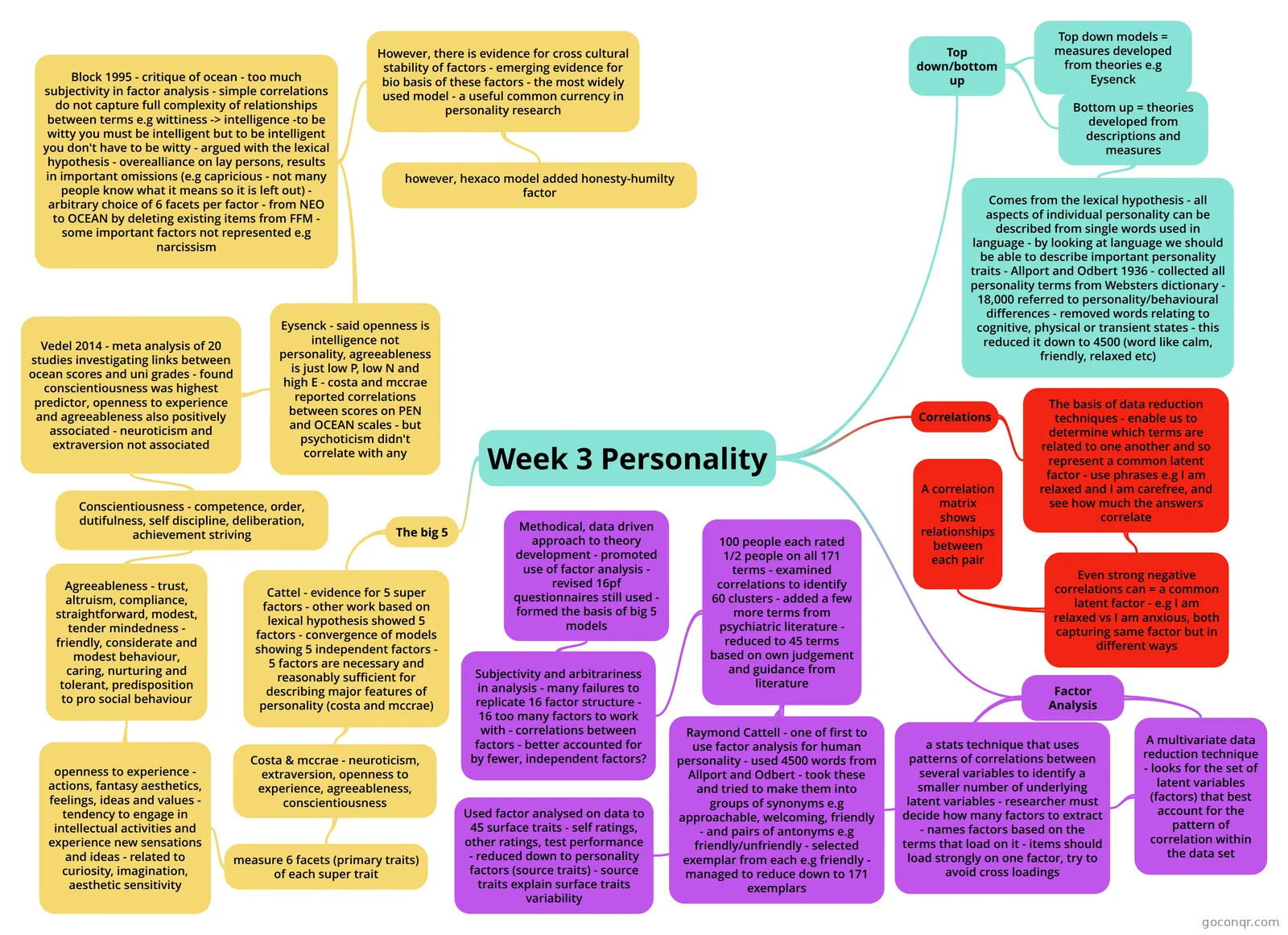
Mind map: Week 3 personality psychology
Map content
Week 3 Personality
Top down/bottom up
- Top down models = measures developed from theories e.g Eysenck
- Bottom up = theories developed from descriptions and measures
- Comes from the lexical hypothesis - all aspects of individual personality can be described from single words used in language - by looking at language we should be able to describe important personality traits - Allport and Odbert 1936 - collected all personality terms from Websters dictionary - 18,000 referred to personality/behavioural differences - removed words relating to cognitive, physical or transient states - this reduced it down to 4500 (word like calm, friendly, relaxed etc)
Correlations
- The basis of data reduction techniques - enable us to determine which terms are related to one another and so represent a common latent factor - use phrases e.g I am relaxed and I am carefree, and see how much the answers correlate
- Even strong negative correlations can = a common latent factor - e.g I am relaxed vs I am anxious, both capturing same factor but in different ways
- A correlation matrix shows relationships between each pair
- Even strong negative correlations can = a common latent factor - e.g I am relaxed vs I am anxious, both capturing same factor but in different ways
- The basis of data reduction techniques - enable us to determine which terms are related to one another and so represent a common latent factor - use phrases e.g I am relaxed and I am carefree, and see how much the answers correlate
Factor Analysis
- A multivariate data reduction technique - looks for the set of latent variables (factors) that best account for the pattern of correlation within the data set
- a stats technique that uses patterns of correlations between several variables to identify a smaller number of underlying latent variables - researcher must decide how many factors to extract - names factors based on the terms that load on it - items should load strongly on one factor, try to avoid cross loadings
- Raymond Cattell - one of first to use factor analysis for human personality - used 4500 words from Allport and Odbert - took these and tried to make them into groups of synonyms e.g approachable, welcoming, friendly - and pairs of antonyms e.g friendly/unfriendly - selected exemplar from each e.g friendly - managed to reduce down to 171 exemplars
- 100 people each rated 1/2 people on all 171 terms - examined correlations to identify 60 clusters - added a few more terms from psychiatric literature - reduced to 45 terms based on own judgement and guidance from literature
- Used factor analysed on data to 45 surface traits - self ratings, other ratings, test performance - reduced down to personality factors (source traits) - source traits explain surface traits variability
- Subjectivity and arbitrariness in analysis - many failures to replicate 16 factor structure - 16 too many factors to work with - correlations between factors - better accounted for by fewer, independent factors?
- Methodical, data driven approach to theory development - promoted use of factor analysis - revised 16pf questionnaires still used - formed the basis of big 5 models
- 100 people each rated 1/2 people on all 171 terms - examined correlations to identify 60 clusters - added a few more terms from psychiatric literature - reduced to 45 terms based on own judgement and guidance from literature
- A multivariate data reduction technique - looks for the set of latent variables (factors) that best account for the pattern of correlation within the data set
The big 5
- Cattel - evidence for 5 super factors - other work based on lexical hypothesis showed 5 factors - convergence of models showing 5 independent factors - 5 factors are necessary and reasonably sufficient for describing major features of personality (costa and mccrae)
- Costa & mccrae - neuroticism, extraversion, openness to experience, agreeableness, conscientiousness
- measure 6 facets (primary traits) of each super trait
- openness to experience - actions, fantasy aesthetics, feelings, ideas and values - tendency to engage in intellectual activities and experience new sensations and ideas - related to curiosity, imagination, aesthetic sensitivity
- Agreeableness - trust, altruism, compliance, straightforward, modest, tender mindedness - friendly, considerate and modest behaviour, caring, nurturing and tolerant, predisposition to pro social behaviour
- Conscientiousness - competence, order, dutifulness, self discipline, deliberation, achievement striving
- Vedel 2014 - meta analysis of 20 studies investigating links between ocean scores and uni grades - found conscientiousness was highest predictor, openness to experience and agreeableness also positively associated - neuroticism and extraversion not associated
- Eysenck - said openness is intelligence not personality, agreeableness is just low P, low N and high E - costa and mccrae reported correlations between scores on PEN and OCEAN scales - but psychoticism didn't correlate with any
- Block 1995 - critique of ocean - too much subjectivity in factor analysis - simple correlations do not capture full complexity of relationships between terms e.g wittiness -> intelligence -to be witty you must be intelligent but to be intelligent you don't have to be witty - argued with the lexical hypothesis - overealliance on lay persons, results in important omissions (e.g capricious - not many people know what it means so it is left out) - arbitrary choice of 6 facets per factor - from NEO to OCEAN by deleting existing items from FFM - some important factors not represented e.g narcissism
- However, there is evidence for cross cultural stability of factors - emerging evidence for bio basis of these factors - the most widely used model - a useful common currency in personality research
- however, hexaco model added honesty-humilty factor
- However, there is evidence for cross cultural stability of factors - emerging evidence for bio basis of these factors - the most widely used model - a useful common currency in personality research
- Block 1995 - critique of ocean - too much subjectivity in factor analysis - simple correlations do not capture full complexity of relationships between terms e.g wittiness -> intelligence -to be witty you must be intelligent but to be intelligent you don't have to be witty - argued with the lexical hypothesis - overealliance on lay persons, results in important omissions (e.g capricious - not many people know what it means so it is left out) - arbitrary choice of 6 facets per factor - from NEO to OCEAN by deleting existing items from FFM - some important factors not represented e.g narcissism
- Eysenck - said openness is intelligence not personality, agreeableness is just low P, low N and high E - costa and mccrae reported correlations between scores on PEN and OCEAN scales - but psychoticism didn't correlate with any
- Vedel 2014 - meta analysis of 20 studies investigating links between ocean scores and uni grades - found conscientiousness was highest predictor, openness to experience and agreeableness also positively associated - neuroticism and extraversion not associated
- Conscientiousness - competence, order, dutifulness, self discipline, deliberation, achievement striving
- Agreeableness - trust, altruism, compliance, straightforward, modest, tender mindedness - friendly, considerate and modest behaviour, caring, nurturing and tolerant, predisposition to pro social behaviour
- openness to experience - actions, fantasy aesthetics, feelings, ideas and values - tendency to engage in intellectual activities and experience new sensations and ideas - related to curiosity, imagination, aesthetic sensitivity
- measure 6 facets (primary traits) of each super trait
- Costa & mccrae - neuroticism, extraversion, openness to experience, agreeableness, conscientiousness
- Cattel - evidence for 5 super factors - other work based on lexical hypothesis showed 5 factors - convergence of models showing 5 independent factors - 5 factors are necessary and reasonably sufficient for describing major features of personality (costa and mccrae)
Information
- Description
- Individual Differences in Mental Health Mind Map on Week 3 Personality, created by Abbey Wrigley on 13/05/2019.
- Created by
- Abbey Wrigley
- Views
- 0
- Rating