
Mind map
obj-centred & obj-driven + Kimberley pt
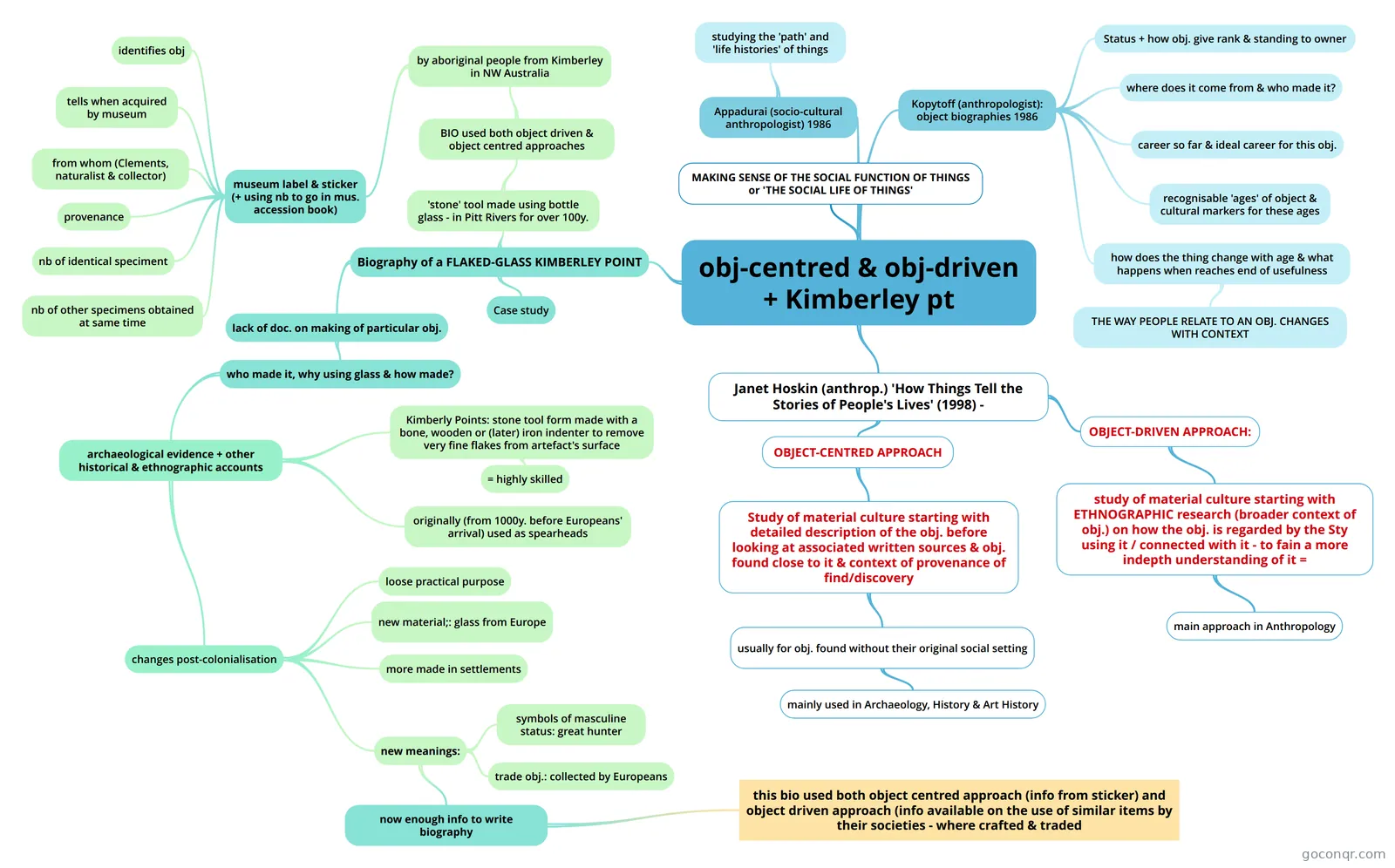
Mind map: object-centred and object-driven approaches
Map content
obj-centred & obj-driven + Kimberley pt
Appadurai (socio-cultural anthropologist) 1986
- studying the 'path' and 'life histories' of things
MAKING SENSE OF THE SOCIAL FUNCTION OF THINGS or 'THE SOCIAL LIFE OF THINGS'
Kopytoff (anthropologist): object biographies 1986
- Status + how obj. give rank & standing to owner
- where does it come from & who made it?
- career so far & ideal career for this obj.
- recognisable 'ages' of object & cultural markers for these ages
- how does the thing change with age & what happens when reaches end of usefulness
- THE WAY PEOPLE RELATE TO AN OBJ. CHANGES WITH CONTEXT
Janet Hoskin (anthrop.) 'How Things Tell the Stories of People's Lives' (1998) -
- OBJECT-DRIVEN APPROACH:
- study of material culture starting with ETHNOGRAPHIC research (broader context of obj.) on how the obj. is regarded by the Sty using it / connected with it - to fain a more indepth understanding of it =
- main approach in Anthropology
- study of material culture starting with ETHNOGRAPHIC research (broader context of obj.) on how the obj. is regarded by the Sty using it / connected with it - to fain a more indepth understanding of it =
- OBJECT-CENTRED APPROACH
- Study of material culture starting with detailed description of the obj. before looking at associated written sources & obj. found close to it & context of provenance of find/discovery
- usually for obj. found without their original social setting
- mainly used in Archaeology, History & Art History
- usually for obj. found without their original social setting
- Study of material culture starting with detailed description of the obj. before looking at associated written sources & obj. found close to it & context of provenance of find/discovery
- OBJECT-DRIVEN APPROACH:
Biography of a FLAKED-GLASS KIMBERLEY POINT
- Case study
- 'stone' tool made using bottle glass - in Pitt Rivers for over 100y.
- BIO used both object driven & object centred approaches
- by aboriginal people from Kimberley in NW Australia
- museum label & sticker (+ using nb to go in mus. accession book)
- identifies obj
- tells when acquired by museum
- from whom (Clements, naturalist & collector)
- provenance
- nb of identical speciment
- nb of other specimens obtained at same time
- museum label & sticker (+ using nb to go in mus. accession book)
- by aboriginal people from Kimberley in NW Australia
- BIO used both object driven & object centred approaches
- lack of doc. on making of particular obj.
- who made it, why using glass & how made?
- archaeological evidence + other historical & ethnographic accounts
- Kimberly Points: stone tool form made with a bone, wooden or (later) iron indenter to remove very fine flakes from artefact's surface
- = highly skilled
- originally (from 1000y. before Europeans' arrival) used as spearheads
- changes post-colonialisation
- loose practical purpose
- new material;: glass from Europe
- more made in settlements
- new meanings:
- symbols of masculine status: great hunter
- now enough info to write biography
- this bio used both object centred approach (info from sticker) and object driven approach (info available on the use of similar items by their societies - where crafted & traded
- trade obj.: collected by Europeans
- Kimberly Points: stone tool form made with a bone, wooden or (later) iron indenter to remove very fine flakes from artefact's surface
- archaeological evidence + other historical & ethnographic accounts
- who made it, why using glass & how made?
Information
- Description
- Material culture: life of objects, classifying & describing objects Mind Map on obj-centred & obj-driven + Kimberley pt, created by Chantal Walker on 30/05/2019.
- Created by
- Chantal Walker
- Views
- 1
- Rating