
Mind map
MODAL VERBS
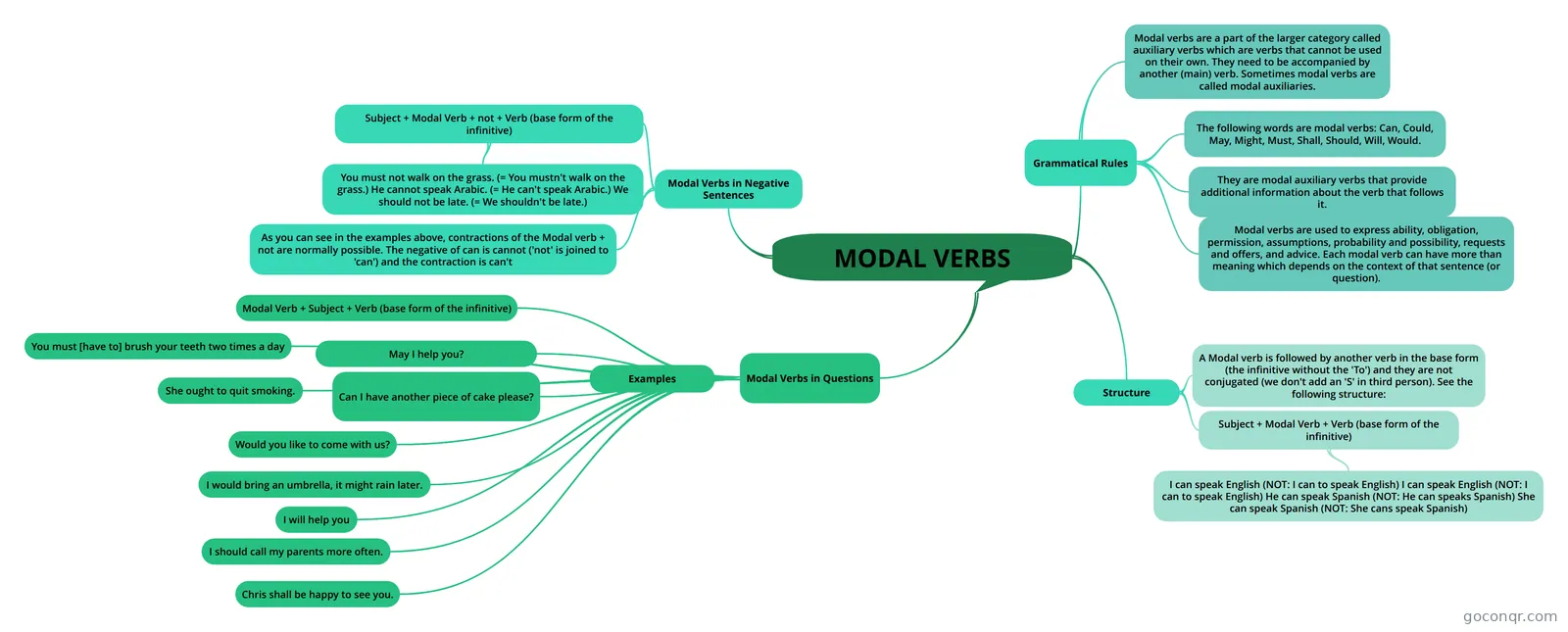
Mind map: Modal verbs
Map content
MODAL VERBS
Grammatical Rules
- Modal verbs are a part of the larger category called auxiliary verbs which are verbs that cannot be used on their own. They need to be accompanied by another (main) verb. Sometimes modal verbs are called modal auxiliaries.
- The following words are modal verbs: Can, Could, May, Might, Must, Shall, Should, Will, Would.
- They are modal auxiliary verbs that provide additional information about the verb that follows it.
- Modal verbs are used to express ability, obligation, permission, assumptions, probability and possibility, requests and offers, and advice. Each modal verb can have more than meaning which depends on the context of that sentence (or question).
Structure
- A Modal verb is followed by another verb in the base form (the infinitive without the 'To') and they are not conjugated (we don't add an 'S' in third person). See the following structure:
- Subject + Modal Verb + Verb (base form of the infinitive)
- I can speak English (NOT: I can to speak English) I can speak English (NOT: I can to speak English) He can speak Spanish (NOT: He can speaks Spanish) She can speak Spanish (NOT: She cans speak Spanish)
Modal Verbs in Negative Sentences
- Subject + Modal Verb + not + Verb (base form of the infinitive)
- You must not walk on the grass. (= You mustn't walk on the grass.) He cannot speak Arabic. (= He can't speak Arabic.) We should not be late. (= We shouldn't be late.)
- As you can see in the examples above, contractions of the Modal verb + not are normally possible. The negative of can is cannot ('not' is joined to 'can') and the contraction is can't
- Subject + Modal Verb + not + Verb (base form of the infinitive)
Modal Verbs in Questions
- Modal Verb + Subject + Verb (base form of the infinitive)
- May I help you?
- Can I have another piece of cake please?
- Would you like to come with us?
- I would bring an umbrella, it might rain later.
- I will help you
- Chris shall be happy to see you.
- I should call my parents more often.
- She ought to quit smoking.
- You must [have to] brush your teeth two times a day
- Examples
Information
- Description
- Psicología Mind Map on MODAL VERBS, created by Zulay Jineth Hernandez Rodriguez on 30/09/2019.
- Created by
- Zulay Jineth Hernandez Rodriguez
- Views
- 0
- Rating