
Mind map
Aqueous Solutions
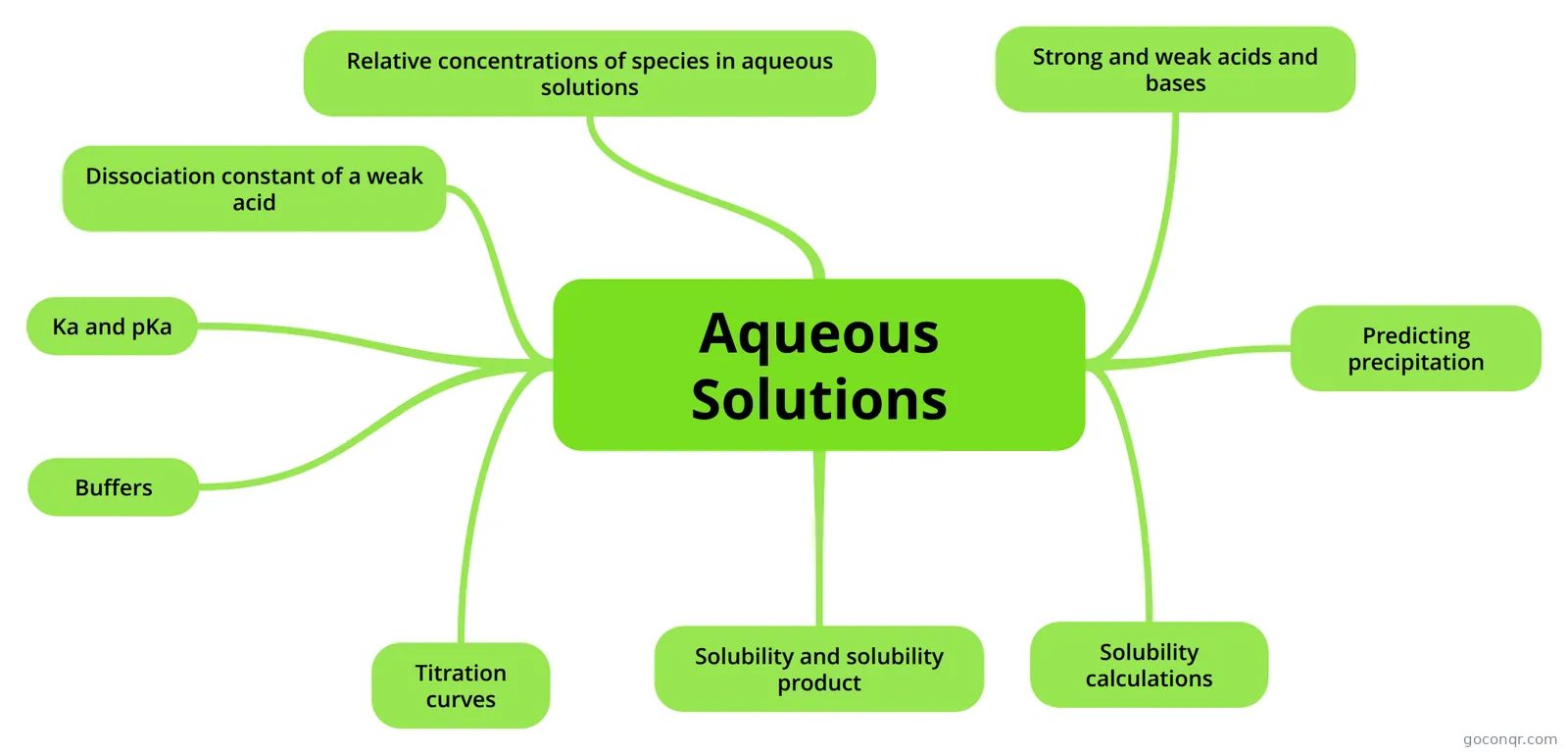
Mind map: aqueous solutions chemistry
Map content
Aqueous Solutions
Solubility and solubility product
- A solvent is a substance that dissolves other substances called solutes. A solute is a substance which is dissolved in a solvent. The end result of this process of dissolving a solute in a solvent is called a solution. A saturated solution is a saturated solution of a solute, x, is one which is in equilibrium with undissolved x. Solubility product is when increasing quantities of a sparingly soluble ionic solid are added to water, a saturated solution is eventually formed.
Solubility calculations
- For the equations see page 193 in orange chemistry book
Predicting precipitation
- If the ionic product of a compound exceeds its solubility product then a precipitate will form. For more info see page 198 in orange chemistry book.
Strong and weak acids and bases
- An acid is a proton donor, and a base is a proton acceptor. When a substance can become both proton donor or an acceptor it is called amphiprotic. Strong acids and bases are completely ionised in aqueous solutions. Weak acids and bases are only slightly ionised in aqueous solutions.
Relative concentrations of species in aqueous solutions
- See page 214 in orange chemistry book
Dissociation constant of a weak acid
- See page 219 in orange chemistry book
Ka and pKa
- See page 221 in orange chemistry book
Buffers
- Buffers are solutions in which an equilibrium reaction maintains the pH at a nearly constant level, by counteracting the effects of any added acid or base. A buffer is usually a mixture of a weak acid and its conjugate base.
Titration curves
- A titration curve is simply a graph which 'tracks' the change in pH as a titration progresses.
Information
- Description
- NCEA Level 3 Chemistry Mind Map on Aqueous Solutions, created by japaneseguy48 on 13/09/2013.
- Created by
- japaneseguy48
- Views
- 87
- Tags
- Rating