
Mind map
Australian Parliamentary System
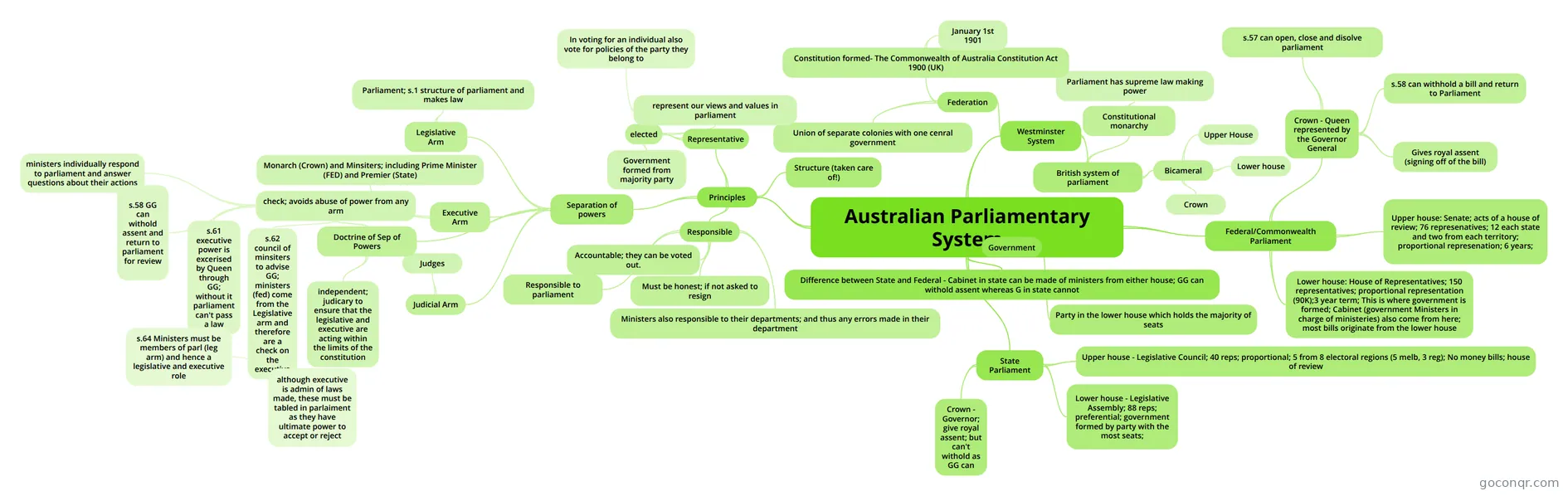
Mind map: Australian parliamentary system
Map content
Australian Parliamentary System
Westminster System
- British system of parliament
- Bicameral
- Upper House
- Lower house
- Crown
- Constitutional monarchy
- Parliament has supreme law making power
- Bicameral
- Federation
- Constitution formed- The Commonwealth of Australia Constitution Act 1900 (UK)
- January 1st 1901
- Union of separate colonies with one cenral government
- Constitution formed- The Commonwealth of Australia Constitution Act 1900 (UK)
- British system of parliament
Federal/Commonwealth Parliament
- Crown - Queen represented by the Governor General
- Gives royal assent (signing off of the bill)
- s.58 can withhold a bill and return to Parliament
- s.57 can open, close and disolve parliament
- Upper house: Senate; acts of a house of review; 76 represenatives; 12 each state and two from each territory; proportional represenation; 6 years;
- Lower house: House of Representatives; 150 representatives; proportional representation (90K);3 year term; This is where government is formed; Cabinet (government Ministers in charge of ministeries) also come from here; most bills originate from the lower house
- Crown - Queen represented by the Governor General
Government
- Party in the lower house which holds the majority of seats
State Parliament
- Upper house - Legislative Council; 40 reps; proportional; 5 from 8 electoral regions (5 melb, 3 reg); No money bills; house of review
- Lower house - Legislative Assembly; 88 reps; preferential; government formed by party with the most seats;
- Crown - Governor; give royal assent; but can't withold as GG can
Difference between State and Federal - Cabinet in state can be made of ministers from either house; GG can withold assent whereas G in state cannot
Principles
- Representative
- elected
- represent our views and values in parliament
- In voting for an individual also vote for policies of the party they belong to
- Government formed from majority party
- represent our views and values in parliament
- elected
- Responsible
- Accountable; they can be voted out.
- Must be honest; if not asked to resign
- Ministers also responsible to their departments; and thus any errors made in their department
- Responsible to parliament
- Separation of powers
- Legislative Arm
- Parliament; s.1 structure of parliament and makes law
- Executive Arm
- Monarch (Crown) and Minsiters; including Prime Minister (FED) and Premier (State)
- Judicial Arm
- Judges
- Doctrine of Sep of Powers
- check; avoids abuse of power from any arm
- s.61 executive power is excerised by Queen through GG; without it parliament can't pass a law
- s.62 council of minsiters to advise GG; ministers (fed) come from the Legislative arm and therefore are a check on the executive
- s.64 Ministers must be members of parl (leg arm) and hence a legislative and executive role
- although executive is admin of laws made, these must be tabled in parlaiment as they have ultimate power to accept or reject
- ministers individually respond to parliament and answer questions about their actions
- s.58 GG can withold assent and return to parliament for review
- independent; judicary to ensure that the legislative and executive are acting within the limits of the constitution
- check; avoids abuse of power from any arm
- Legislative Arm
- Structure (taken care of!)
- Representative
Information
- Description
- VCE Legal Studies Mind Map on Australian Parliamentary System, created by Mizzi on 23/09/2013.
- Created by
- Mizzi
- Views
- 776
- Tags
- Rating