
Mind map
P4- EXPLAINING MOTION
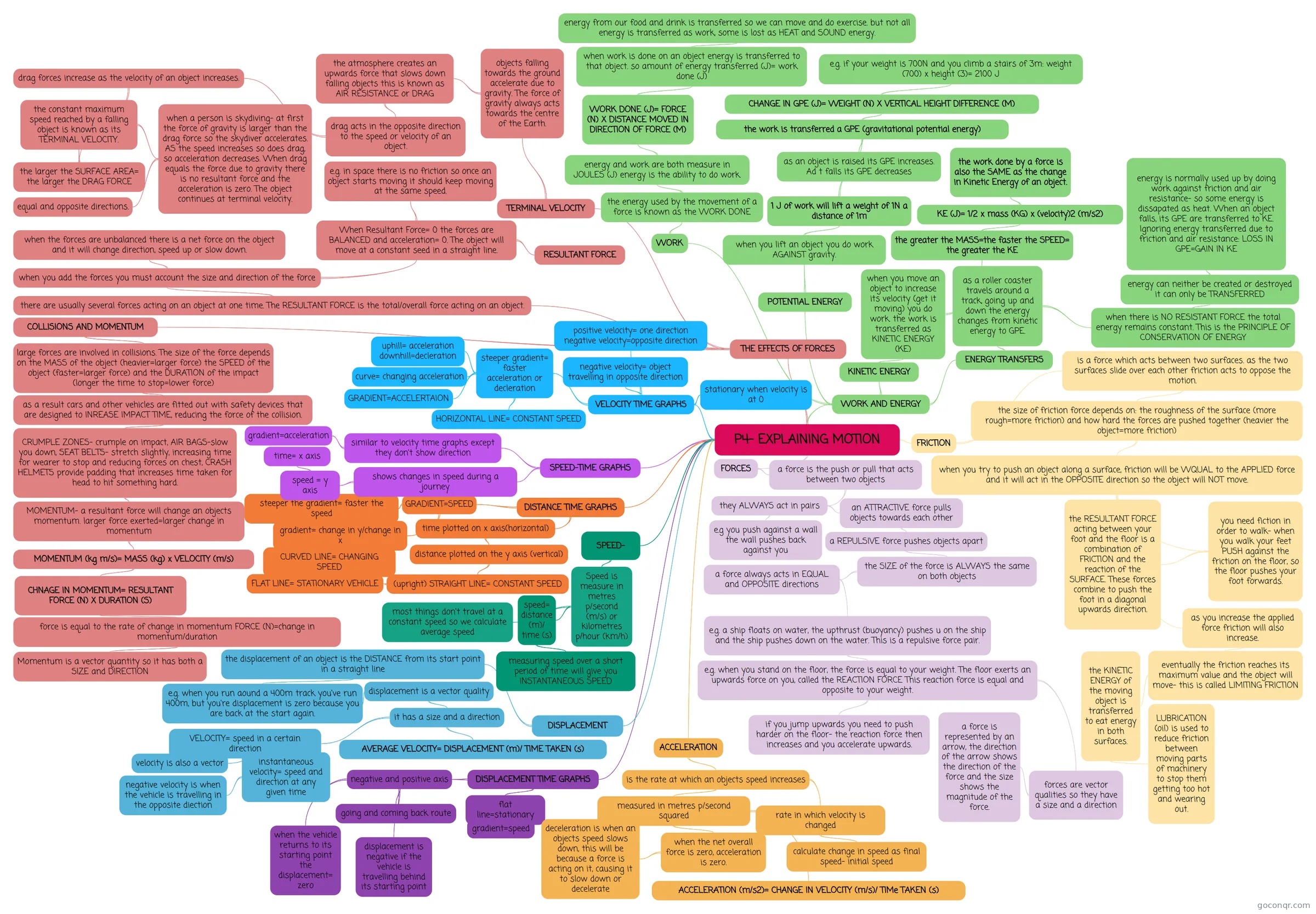
Mind map: explaining motion
Map content
P4- EXPLAINING MOTION
SPEED-
- Speed is measure in metres p/second (m/s) or kilometres p/hour (km/h)
- speed= distance (m)/ time (s)
- measuring speed over a short period of time will give you INSTANTANEOUS SPEED
- most things don't travel at a constant speed so we calculate average speed
- speed= distance (m)/ time (s)
- Speed is measure in metres p/second (m/s) or kilometres p/hour (km/h)
DISPLACEMENT
- the displacement of an object is the DISTANCE from its start point in a straight line
- e.g. when you run aound a 400m track you've run 400m, but you're displacement is zero because you are back at the start again.
- displacement is a vector quality
- it has a size and a direction
- VELOCITY= speed in a certain direction
- velocity is also a vector
- instantaneous velocity= speed and direction at any given time
- negative velocity is when the vehicle is travelling in the opposite diection
- AVERAGE VELOCITY= DISPLACEMENT (m)/ TIME TAKEN (s)
- VELOCITY= speed in a certain direction
- it has a size and a direction
- displacement is a vector quality
- e.g. when you run aound a 400m track you've run 400m, but you're displacement is zero because you are back at the start again.
- the displacement of an object is the DISTANCE from its start point in a straight line
DISTANCE TIME GRAPHS
- time plotted on x axis(horizontal)
- distance plotted on the y axis (vertical)
- (upright) STRAIGHT LINE= CONSTANT SPEED
- FLAT LINE= STATIONARY VEHICLE
- CURVED LINE= CHANGING SPEED
- FLAT LINE= STATIONARY VEHICLE
- (upright) STRAIGHT LINE= CONSTANT SPEED
- distance plotted on the y axis (vertical)
- GRADIENT=SPEED
- steeper the gradient= faster the speed
- gradient= change in y/change in x
- time plotted on x axis(horizontal)
DISPLACEMENT TIME GRAPHS
- negative and positive axis
- going and coming back route
- when the vehicle returns to its starting point the displacement= zero
- displacement is negative if the vehicle is travelling behind its starting point
- flat line=stationary
- gradient=speed
- negative and positive axis
ACCELERATION
- is the rate at which an objects speed increases
- measured in metres p/second squared
- ACCELERATION (m/s2)= CHANGE IN VELOCITY (m/s)/ TIMe TAKEN (s)
- when the net overall force is zero, acceleration is zero.
- deceleration is when an objects speed slows down, this will be because a force is acting on it, causing it to slow down or decelerate
- rate in which velocity is changed
- calculate change in speed as final speed- initial speed
- measured in metres p/second squared
- is the rate at which an objects speed increases
SPEED-TIME GRAPHS
- shows changes in speed during a journey
- speed = y axis
- time= x axis
- speed = y axis
- similar to velocity time graphs except they don't show direction
- gradient=acceleration
- shows changes in speed during a journey
VELOCITY TIME GRAPHS
- steeper gradient= faster acceleration or decleration
- HORIZONTAL LINE= CONSTANT SPEED
- GRADIENT=ACCELERTAION
- uphill= acceleration downhill=decleration
- curve= changing acceleration
- negative velocity= object travelling in opposite direction
- stationary when velocity is at 0
- positive velocity= one direction negative velocity=opposite direction
- steeper gradient= faster acceleration or decleration
FORCES
- a force is the push or pull that acts between two objects
- they ALWAYS act in pairs
- e.g you push against a wall the wall pushes back against you
- an ATTRACTIVE force pulls objects towards each other
- a REPULSIVE force pushes objects apart
- the SIZE of the force is ALWAYS the same on both objects
- a force always acts in EQUAL and OPPOSITE directions
- e.g. a ship floats on water, the upthrust (buoyancy) pushes u on the ship and the ship pushes down on the water. This is a repulsive force pair.
- e.g. when you stand on the floor, the force is equal to your weight. The floor exerts an upwards force on you, called the REACTION FORCE This reaction force is equal and opposite to your weight.
- if you jump upwards you need to push harder on the floor- the reaction force then increases and you accelerate upwards.
- forces are vector qualities so they have a size and a direction
- a force is represented by an arrow, the direction of the arrow shows the direction of the force and the size shows the magnitude of the force.
- e.g. when you stand on the floor, the force is equal to your weight. The floor exerts an upwards force on you, called the REACTION FORCE This reaction force is equal and opposite to your weight.
- e.g. a ship floats on water, the upthrust (buoyancy) pushes u on the ship and the ship pushes down on the water. This is a repulsive force pair.
- a force always acts in EQUAL and OPPOSITE directions
- the SIZE of the force is ALWAYS the same on both objects
- a REPULSIVE force pushes objects apart
- they ALWAYS act in pairs
- a force is the push or pull that acts between two objects
FRICTION
- is a force which acts between two surfaces. as the two surfaces slide over each other friction acts to oppose the motion.
- the size of friction force depends on: the roughness of the surface (more rough=more friction) and how hard the forces are pushed together (heavier the object=more friction)
- when you try to push an object along a surface, friction will be WQUAL to the APPLIED force and it will act in the OPPOSITE direction so the object will NOT move.
- as you increase the applied force friction will also increase.
- eventually the friction reaches its maximum value and the object will move- this is called LIMITING FRICTION
- the KINETIC ENERGY of the moving object is transferred to eat energy in both surfaces.
- LUBRICATION (oil) is used to reduce friction between moving parts of machinery to stop them getting too hot and wearing out.
- the KINETIC ENERGY of the moving object is transferred to eat energy in both surfaces.
- eventually the friction reaches its maximum value and the object will move- this is called LIMITING FRICTION
- you need fiction in order to walk- when you walk your feet PUSH against the friction on the floor, so the floor pushes your foot forwards.
- the RESULTANT FORCE acting between your foot and the floor is a combination of FRICTION and the reaction of the SURFACE. These forces combine to push the foot in a diagonal upwards direction.
- as you increase the applied force friction will also increase.
- when you try to push an object along a surface, friction will be WQUAL to the APPLIED force and it will act in the OPPOSITE direction so the object will NOT move.
- the size of friction force depends on: the roughness of the surface (more rough=more friction) and how hard the forces are pushed together (heavier the object=more friction)
- is a force which acts between two surfaces. as the two surfaces slide over each other friction acts to oppose the motion.
THE EFFECTS OF FORCES
- there are usually several forces acting on an object at one time. The RESULTANT FORCE is the total/overall force acting on an object.
- when you add the forces you must account the size and direction of the force
- When Resultant Force= 0 the forces are BALANCED and acceleration= 0. The object will move at a constant seed in a straight line.
- e.g. in space there is no friction so once an object starts moving it should keep moving at the same speed.
- RESULTANT FORCE
- when the forces are unbalanced there is a net force on the object and it will change direction, speed up or slow down.
- When Resultant Force= 0 the forces are BALANCED and acceleration= 0. The object will move at a constant seed in a straight line.
- when you add the forces you must account the size and direction of the force
- TERMINAL VELOCITY
- objects falling towards the ground accelerate due to gravity. The force of gravity always acts towards the centre of the Earth.
- the atmosphere creates an upwards force that slows down falling objects this is known as AIR RESISTANCE or DRAG
- drag acts in the opposite direction to the speed or velocity of an object.
- drag forces increase as the velocity of an object increases.
- the larger the SURFACE AREA= the larger the DRAG FORCE
- the constant maximum speed reached by a falling object is known as its TERMINAL VELOCITY.
- when a person is skydiving- at first the force of gravity is larger than the drag force so the skydiver accelerates. AS the speed increases so does drag, so acceleration decreases. When drag equals the force due to gravity there is no resultant force and the acceleration is zero. The object continues at terminal velocity.
- equal and opposite directions.
- when a person is skydiving- at first the force of gravity is larger than the drag force so the skydiver accelerates. AS the speed increases so does drag, so acceleration decreases. When drag equals the force due to gravity there is no resultant force and the acceleration is zero. The object continues at terminal velocity.
- the constant maximum speed reached by a falling object is known as its TERMINAL VELOCITY.
- the larger the SURFACE AREA= the larger the DRAG FORCE
- drag forces increase as the velocity of an object increases.
- drag acts in the opposite direction to the speed or velocity of an object.
- the atmosphere creates an upwards force that slows down falling objects this is known as AIR RESISTANCE or DRAG
- objects falling towards the ground accelerate due to gravity. The force of gravity always acts towards the centre of the Earth.
- COLLISIONS AND MOMENTUM
- large forces are involved in collisions. The size of the force depends on the MASS of the object (heavier=larger force) the SPEED of the object (faster=larger force) and the DURATION of the impact (longer the time to stop=lower force)
- as a result cars and other vehicles are fitted out with safety devices that are designed to INREASE IMPACT TIME, reducing the force of the collision.
- CRUMPLE ZONES- crumple on impact, AIR BAGS-slow you down, SEAT BELTS- stretch slightly, increasing time for wearer to stop and reducing forces on chest, CRASH HELMETS provide padding that increases time taken for head to hit something hard.
- MOMENTUM- a resultant force will change an objects momentum. larger force exerted=larger change in momentum
- MOMENTUM (kg m/s)= MASS (kg) x VELOCITY (m/s)
- CHNAGE IN MOMENTUM= RESULTANT FORCE (N) X DURATION (S)
- force is equal to the rate of change in momentum FORCE (N)=change in momentum/duration
- Momentum is a vector quantity so it has both a SIZE and DIRECTION
- force is equal to the rate of change in momentum FORCE (N)=change in momentum/duration
- CHNAGE IN MOMENTUM= RESULTANT FORCE (N) X DURATION (S)
- MOMENTUM (kg m/s)= MASS (kg) x VELOCITY (m/s)
- MOMENTUM- a resultant force will change an objects momentum. larger force exerted=larger change in momentum
- CRUMPLE ZONES- crumple on impact, AIR BAGS-slow you down, SEAT BELTS- stretch slightly, increasing time for wearer to stop and reducing forces on chest, CRASH HELMETS provide padding that increases time taken for head to hit something hard.
- as a result cars and other vehicles are fitted out with safety devices that are designed to INREASE IMPACT TIME, reducing the force of the collision.
- large forces are involved in collisions. The size of the force depends on the MASS of the object (heavier=larger force) the SPEED of the object (faster=larger force) and the DURATION of the impact (longer the time to stop=lower force)
- there are usually several forces acting on an object at one time. The RESULTANT FORCE is the total/overall force acting on an object.
WORK AND ENERGY
- WORK
- the energy used by the movement of a force is known as the WORK DONE
- energy and work are both measure in JOULES (J) energy is the ability to do work.
- WORK DONE (J)= FORCE (N) X DISTANCE MOVED IN DIRECTION OF FORCE (M)
- when work is done on an object energy is transferred to that object. so amount of energy transferred (J)= work done (J)
- energy from our food and drink is transferred so we can move and do exercise. but not all energy is transferred as work, some is lost as HEAT and SOUND energy.
- when work is done on an object energy is transferred to that object. so amount of energy transferred (J)= work done (J)
- WORK DONE (J)= FORCE (N) X DISTANCE MOVED IN DIRECTION OF FORCE (M)
- energy and work are both measure in JOULES (J) energy is the ability to do work.
- the energy used by the movement of a force is known as the WORK DONE
- POTENTIAL ENERGY
- when you lift an object you do work AGAINST gravity.
- 1 J of work will lift a weight of 1N a distance of 1m
- the work is transferred a GPE (gravitational potential energy)
- as an object is raised its GPE increases. Ad t falls its GPE decreases
- CHANGE IN GPE (J)= WEIGHT (N) X VERTICAL HEIGHT DIFFERENCE (M)
- e.g. if your weight is 700N and you climb a stairs of 3m: weight (700) x height (3)= 2100 J
- the work is transferred a GPE (gravitational potential energy)
- 1 J of work will lift a weight of 1N a distance of 1m
- when you lift an object you do work AGAINST gravity.
- KINETIC ENERGY
- when you move an object to increase its velocity (get it moving) you do work. the work is transferred as KINETIC ENERGY (KE)
- the greater the MASS=the faster the SPEED= the greater the KE
- KE (J)= 1/2 x mass (KG) x (velocity)2 (m/s2)
- the work done by a force is also the SAME as the change in Kinetic Energy of an object.
- KE (J)= 1/2 x mass (KG) x (velocity)2 (m/s2)
- the greater the MASS=the faster the SPEED= the greater the KE
- when you move an object to increase its velocity (get it moving) you do work. the work is transferred as KINETIC ENERGY (KE)
- ENERGY TRANSFERS
- as a roller coaster travels around a track, going up and down the energy changes from kinetic energy to GPE.
- when there is NO RESISTANT FORCE the total energy remains constant. This is the PRINCIPLE OF CONSERVATION OF ENERGY
- energy can neither be created or destroyed it can only be TRANSFERRED
- energy is normally used up by doing work against friction and air resistance- so some energy is dissapated as heat. When an object falls, its GPE are transferred to KE. Ignoring energy transferred due to friction and air resistance: LOSS IN GPE=GAIN IN KE
- energy can neither be created or destroyed it can only be TRANSFERRED
- when there is NO RESISTANT FORCE the total energy remains constant. This is the PRINCIPLE OF CONSERVATION OF ENERGY
- as a roller coaster travels around a track, going up and down the energy changes from kinetic energy to GPE.
- WORK
Information
- Description
- Mind Map on P4- EXPLAINING MOTION, created by livvyeileen on 22/03/2015.
- Created by
- livvyeileen
- Views
- 17
- Rating