
Mind map
epistemological communities seminar
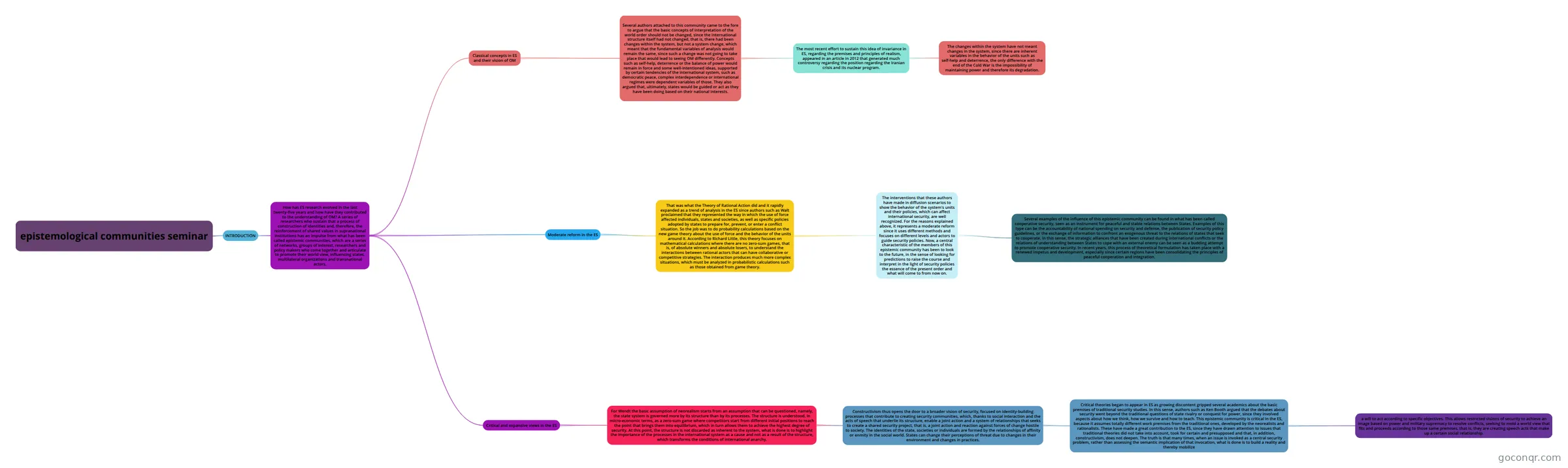
Mind map: epistemological communities seminar
Map content
epistemological communities seminar
INTRODUCTION
- How has ES research evolved in the last twenty-five years and how have they contributed to the understanding of OM? A series of researchers who sustain that a process of construction of identities and, therefore, the reinforcement of shared values in supranational institutions has an impulse from what has been called epistemic communities, which are a series of networks, groups of interest, researchers and policy makers who come together and articulate to promote their world view, influencing states, multilateral organizations and transnational actors.
- Classical concepts in ES and their vision of OM
- Several authors attached to this community came to the fore to argue that the basic concepts of interpretation of the world order should not be changed, since the international structure itself had not changed, that is, there had been changes within the system, but not a system change, which meant that the fundamental variables of analysis would remain the same, since such a change was not going to take place that would lead to seeing OM differently. Concepts such as self-help, deterrence or the balance of power would remain in force and some well-intentioned ideas, supported by certain tendencies of the international system, such as democratic peace, complex interdependence or international regimes were dependent variables of those. They also argued that, ultimately, states would be guided or act as they have been doing based on their national interests.
- The most recent effort to sustain this idea of invariance in ES, regarding the premises and principles of realism, appeared in an article in 2012 that generated much controversy regarding the position regarding the Iranian crisis and its nuclear program.
- The changes within the system have not meant changes in the system, since there are inherent variables in the behavior of the units such as self-help and deterrence, the only difference with the end of the Cold War is the impossibility of maintaining power and therefore its degradation.
- The most recent effort to sustain this idea of invariance in ES, regarding the premises and principles of realism, appeared in an article in 2012 that generated much controversy regarding the position regarding the Iranian crisis and its nuclear program.
- Several authors attached to this community came to the fore to argue that the basic concepts of interpretation of the world order should not be changed, since the international structure itself had not changed, that is, there had been changes within the system, but not a system change, which meant that the fundamental variables of analysis would remain the same, since such a change was not going to take place that would lead to seeing OM differently. Concepts such as self-help, deterrence or the balance of power would remain in force and some well-intentioned ideas, supported by certain tendencies of the international system, such as democratic peace, complex interdependence or international regimes were dependent variables of those. They also argued that, ultimately, states would be guided or act as they have been doing based on their national interests.
- Moderate reform in the ES
- That was what the Theory of Rational Action did and it rapidly expanded as a trend of analysis in the ES since authors such as Walt proclaimed that they represented the way in which the use of force affected individuals, states and societies, as well as specific policies adopted by states to prepare for, prevent, or enter a conflict situation. So the job was to do probability calculations based on the new game theory about the use of force and the behavior of the units around it. According to Richard Little, this theory focuses on mathematical calculations where there are no zero-sum games, that is, of absolute winners and absolute losers, to understand the interactions between rational actors that can have collaborative or competitive strategies. The interaction produces much more complex situations, which must be analyzed in probabilistic calculations such as those obtained from game theory.
- The interventions that these authors have made in diffusion scenarios to show the behavior of the system's units and their policies, which can affect international security, are well recognized. For the reasons explained above, it represents a moderate reform since it uses different methods and focuses on different levels and actors to guide security policies. Now, a central characteristic of the members of this epistemic community has been to look to the future, in the sense of looking for predictions to raise the course and interpret in the light of security policies the essence of the present order and what will come to from now on.
- Several examples of the influence of this epistemic community can be found in what has been called cooperative security, seen as an instrument for peaceful and stable relations between States. Examples of this type can be the accountability of national spending on security and defense, the publication of security policy guidelines, or the exchange of information to confront an exogenous threat to the relations of states that seek to cooperate. In this sense, the strategic alliances that have been created during international conflicts or the relations of understanding between States to cope with an external enemy can be seen as a budding attempt to promote cooperative security. In recent years, this process of theoretical formulation has taken place with a renewed impetus and development, especially since certain regions have been consolidating the principles of peaceful cooperation and integration.
- The interventions that these authors have made in diffusion scenarios to show the behavior of the system's units and their policies, which can affect international security, are well recognized. For the reasons explained above, it represents a moderate reform since it uses different methods and focuses on different levels and actors to guide security policies. Now, a central characteristic of the members of this epistemic community has been to look to the future, in the sense of looking for predictions to raise the course and interpret in the light of security policies the essence of the present order and what will come to from now on.
- That was what the Theory of Rational Action did and it rapidly expanded as a trend of analysis in the ES since authors such as Walt proclaimed that they represented the way in which the use of force affected individuals, states and societies, as well as specific policies adopted by states to prepare for, prevent, or enter a conflict situation. So the job was to do probability calculations based on the new game theory about the use of force and the behavior of the units around it. According to Richard Little, this theory focuses on mathematical calculations where there are no zero-sum games, that is, of absolute winners and absolute losers, to understand the interactions between rational actors that can have collaborative or competitive strategies. The interaction produces much more complex situations, which must be analyzed in probabilistic calculations such as those obtained from game theory.
- Critical and expansive views in the ES
- For Wendt the basic assumption of neorealism starts from an assumption that can be questioned, namely, the state system is governed more by its structure than by its processes. The structure is understood, in micro-economic terms, as a zero-sum game where competitors start from different initial positions to reach the point that brings them into equilibrium, which in turn allows them to achieve the highest degree of security. At this point, the structure is not discarded as inherent to the system, what is done is to highlight the importance of the processes in the international system as a cause and not as a result of the structure, which transforms the conditions of international anarchy.
- Constructivism thus opens the door to a broader vision of security, focused on identity-building processes that contribute to creating security communities, which, thanks to social interaction and the acts of speech that underlie its structure, enable a joint action and a system of relationships that seeks to create a shared security project, that is, a joint action and reaction against forces of change hostile to society. The identities of the state, societies or individuals are formed by the relationships of affinity or enmity in the social world. States can change their perceptions of threat due to changes in their environment and changes in practices.
- Critical theories began to appear in ES as growing discontent gripped several academics about the basic premises of traditional security studies. In this sense, authors such as Ken Booth argued that the debates about security went beyond the traditional questions of state rivalry or conquest for power, since they involved aspects about how we think, how we survive and how to teach. This epistemic community is critical in the ES, because it assumes totally different work premises from the traditional ones, developed by the neorealists and rationalists. These have made a great contribution to the ES, since they have drawn attention to issues that traditional theories did not take into account, took for certain and presupposed and that, in addition, constructivism, does not deepen. The truth is that many times, when an issue is invoked as a central security problem, rather than assessing the semantic implication of that invocation, what is done is to build a reality and thereby mobilize
- a will to act according to specific objectives. This allows restricted visions of security to achieve an image based on power and military supremacy to resolve conflicts, seeking to mold a world view that fits and proceeds according to those same premises, that is, they are creating speech acts that make up a certain social relationship.
- Critical theories began to appear in ES as growing discontent gripped several academics about the basic premises of traditional security studies. In this sense, authors such as Ken Booth argued that the debates about security went beyond the traditional questions of state rivalry or conquest for power, since they involved aspects about how we think, how we survive and how to teach. This epistemic community is critical in the ES, because it assumes totally different work premises from the traditional ones, developed by the neorealists and rationalists. These have made a great contribution to the ES, since they have drawn attention to issues that traditional theories did not take into account, took for certain and presupposed and that, in addition, constructivism, does not deepen. The truth is that many times, when an issue is invoked as a central security problem, rather than assessing the semantic implication of that invocation, what is done is to build a reality and thereby mobilize
- Constructivism thus opens the door to a broader vision of security, focused on identity-building processes that contribute to creating security communities, which, thanks to social interaction and the acts of speech that underlie its structure, enable a joint action and a system of relationships that seeks to create a shared security project, that is, a joint action and reaction against forces of change hostile to society. The identities of the state, societies or individuals are formed by the relationships of affinity or enmity in the social world. States can change their perceptions of threat due to changes in their environment and changes in practices.
- For Wendt the basic assumption of neorealism starts from an assumption that can be questioned, namely, the state system is governed more by its structure than by its processes. The structure is understood, in micro-economic terms, as a zero-sum game where competitors start from different initial positions to reach the point that brings them into equilibrium, which in turn allows them to achieve the highest degree of security. At this point, the structure is not discarded as inherent to the system, what is done is to highlight the importance of the processes in the international system as a cause and not as a result of the structure, which transforms the conditions of international anarchy.
- Classical concepts in ES and their vision of OM
- How has ES research evolved in the last twenty-five years and how have they contributed to the understanding of OM? A series of researchers who sustain that a process of construction of identities and, therefore, the reinforcement of shared values in supranational institutions has an impulse from what has been called epistemic communities, which are a series of networks, groups of interest, researchers and policy makers who come together and articulate to promote their world view, influencing states, multilateral organizations and transnational actors.
Information
- Description
- Mind Map on epistemological communities seminar, created by Juan Pablo Gómez Marquez on 25/06/2020.
- Created by
- Juan Pablo Gómez Marquez
- Views
- 0
- Rating
More on International Institutions and Regime Theory