
Mind map
Genetic Diversity
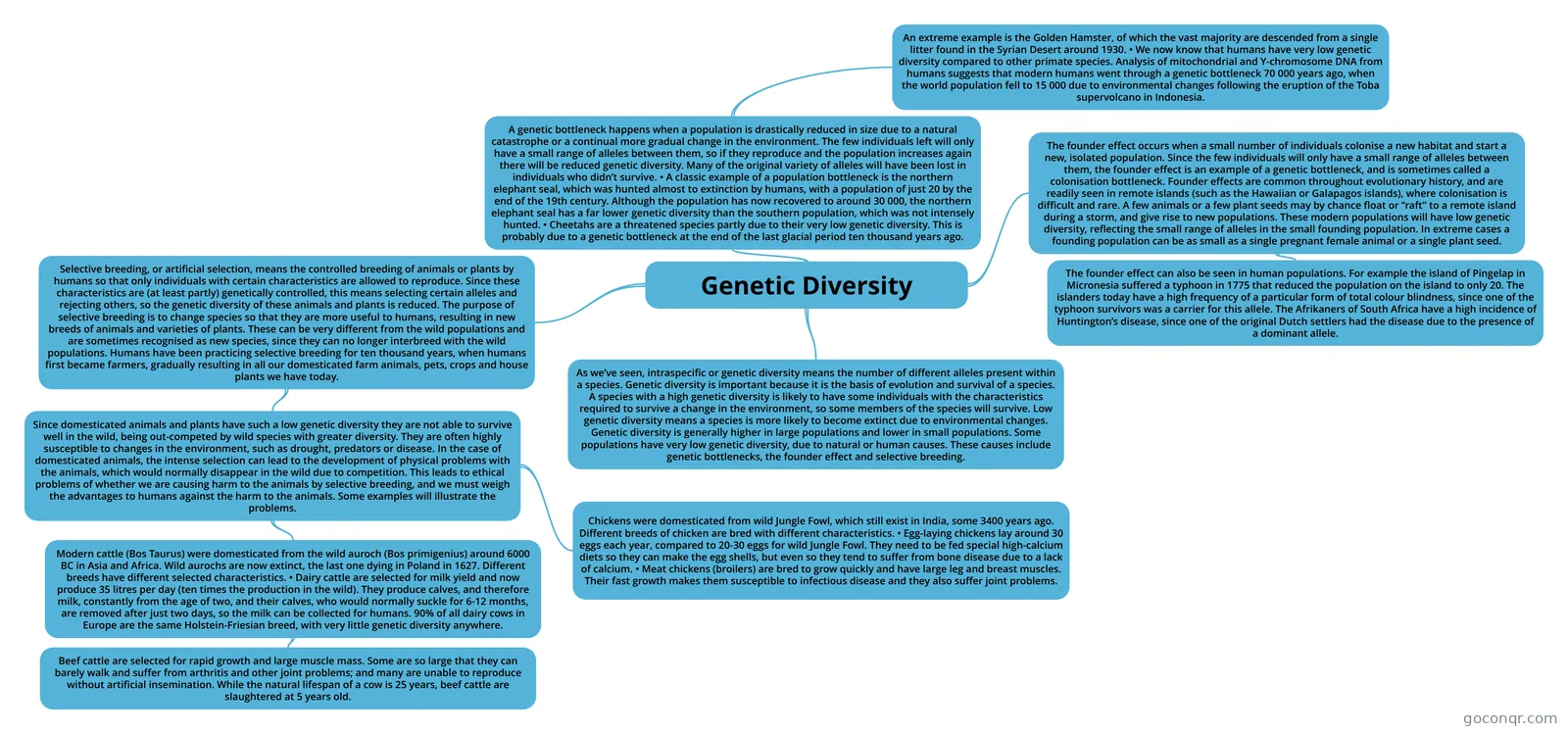
Mind map: Genetic diversity
Map content
Genetic Diversity
As we’ve seen, intraspecific or genetic diversity means the number of different alleles present within a species. Genetic diversity is important because it is the basis of evolution and survival of a species. A species with a high genetic diversity is likely to have some individuals with the characteristics required to survive a change in the environment, so some members of the species will survive. Low genetic diversity means a species is more likely to become extinct due to environmental changes. Genetic diversity is generally higher in large populations and lower in small populations. Some populations have very low genetic diversity, due to natural or human causes. These causes include genetic bottlenecks, the founder effect and selective breeding.
A genetic bottleneck happens when a population is drastically reduced in size due to a natural catastrophe or a continual more gradual change in the environment. The few individuals left will only have a small range of alleles between them, so if they reproduce and the population increases again there will be reduced genetic diversity. Many of the original variety of alleles will have been lost in individuals who didn’t survive. • A classic example of a population bottleneck is the northern elephant seal, which was hunted almost to extinction by humans, with a population of just 20 by the end of the 19th century. Although the population has now recovered to around 30 000, the northern elephant seal has a far lower genetic diversity than the southern population, which was not intensely hunted. • Cheetahs are a threatened species partly due to their very low genetic diversity. This is probably due to a genetic bottleneck at the end of the last glacial period ten thousand years ago.
- An extreme example is the Golden Hamster, of which the vast majority are descended from a single litter found in the Syrian Desert around 1930. • We now know that humans have very low genetic diversity compared to other primate species. Analysis of mitochondrial and Y-chromosome DNA from humans suggests that modern humans went through a genetic bottleneck 70 000 years ago, when the world population fell to 15 000 due to environmental changes following the eruption of the Toba supervolcano in Indonesia.
The founder effect occurs when a small number of individuals colonise a new habitat and start a new, isolated population. Since the few individuals will only have a small range of alleles between them, the founder effect is an example of a genetic bottleneck, and is sometimes called a colonisation bottleneck. Founder effects are common throughout evolutionary history, and are readily seen in remote islands (such as the Hawaiian or Galapagos islands), where colonisation is difficult and rare. A few animals or a few plant seeds may by chance float or “raft” to a remote island during a storm, and give rise to new populations. These modern populations will have low genetic diversity, reflecting the small range of alleles in the small founding population. In extreme cases a founding population can be as small as a single pregnant female animal or a single plant seed.
- The founder effect can also be seen in human populations. For example the island of Pingelap in Micronesia suffered a typhoon in 1775 that reduced the population on the island to only 20. The islanders today have a high frequency of a particular form of total colour blindness, since one of the typhoon survivors was a carrier for this allele. The Afrikaners of South Africa have a high incidence of Huntington’s disease, since one of the original Dutch settlers had the disease due to the presence of a dominant allele.
Selective breeding, or artificial selection, means the controlled breeding of animals or plants by humans so that only individuals with certain characteristics are allowed to reproduce. Since these characteristics are (at least partly) genetically controlled, this means selecting certain alleles and rejecting others, so the genetic diversity of these animals and plants is reduced. The purpose of selective breeding is to change species so that they are more useful to humans, resulting in new breeds of animals and varieties of plants. These can be very different from the wild populations and are sometimes recognised as new species, since they can no longer interbreed with the wild populations. Humans have been practicing selective breeding for ten thousand years, when humans first became farmers, gradually resulting in all our domesticated farm animals, pets, crops and house plants we have today.
- Since domesticated animals and plants have such a low genetic diversity they are not able to survive well in the wild, being out-competed by wild species with greater diversity. They are often highly susceptible to changes in the environment, such as drought, predators or disease. In the case of domesticated animals, the intense selection can lead to the development of physical problems with the animals, which would normally disappear in the wild due to competition. This leads to ethical problems of whether we are causing harm to the animals by selective breeding, and we must weigh the advantages to humans against the harm to the animals. Some examples will illustrate the problems.
- Modern cattle (Bos Taurus) were domesticated from the wild auroch (Bos primigenius) around 6000 BC in Asia and Africa. Wild aurochs are now extinct, the last one dying in Poland in 1627. Different breeds have different selected characteristics. • Dairy cattle are selected for milk yield and now produce 35 litres per day (ten times the production in the wild). They produce calves, and therefore milk, constantly from the age of two, and their calves, who would normally suckle for 6-12 months, are removed after just two days, so the milk can be collected for humans. 90% of all dairy cows in Europe are the same Holstein-Friesian breed, with very little genetic diversity anywhere.
- Beef cattle are selected for rapid growth and large muscle mass. Some are so large that they can barely walk and suffer from arthritis and other joint problems; and many are unable to reproduce without artificial insemination. While the natural lifespan of a cow is 25 years, beef cattle are slaughtered at 5 years old.
- Chickens were domesticated from wild Jungle Fowl, which still exist in India, some 3400 years ago. Different breeds of chicken are bred with different characteristics. • Egg-laying chickens lay around 30 eggs each year, compared to 20-30 eggs for wild Jungle Fowl. They need to be fed special high-calcium diets so they can make the egg shells, but even so they tend to suffer from bone disease due to a lack of calcium. • Meat chickens (broilers) are bred to grow quickly and have large leg and breast muscles. Their fast growth makes them susceptible to infectious disease and they also suffer joint problems.
- Modern cattle (Bos Taurus) were domesticated from the wild auroch (Bos primigenius) around 6000 BC in Asia and Africa. Wild aurochs are now extinct, the last one dying in Poland in 1627. Different breeds have different selected characteristics. • Dairy cattle are selected for milk yield and now produce 35 litres per day (ten times the production in the wild). They produce calves, and therefore milk, constantly from the age of two, and their calves, who would normally suckle for 6-12 months, are removed after just two days, so the milk can be collected for humans. 90% of all dairy cows in Europe are the same Holstein-Friesian breed, with very little genetic diversity anywhere.
- Since domesticated animals and plants have such a low genetic diversity they are not able to survive well in the wild, being out-competed by wild species with greater diversity. They are often highly susceptible to changes in the environment, such as drought, predators or disease. In the case of domesticated animals, the intense selection can lead to the development of physical problems with the animals, which would normally disappear in the wild due to competition. This leads to ethical problems of whether we are causing harm to the animals by selective breeding, and we must weigh the advantages to humans against the harm to the animals. Some examples will illustrate the problems.
Information
- Description
- Mind Map on Genetic Diversity, created by basharatbadr on 28/03/2015.
- Created by
- basharatbadr
- Views
- 0
- Rating