
Mind map
1.1 system architecture
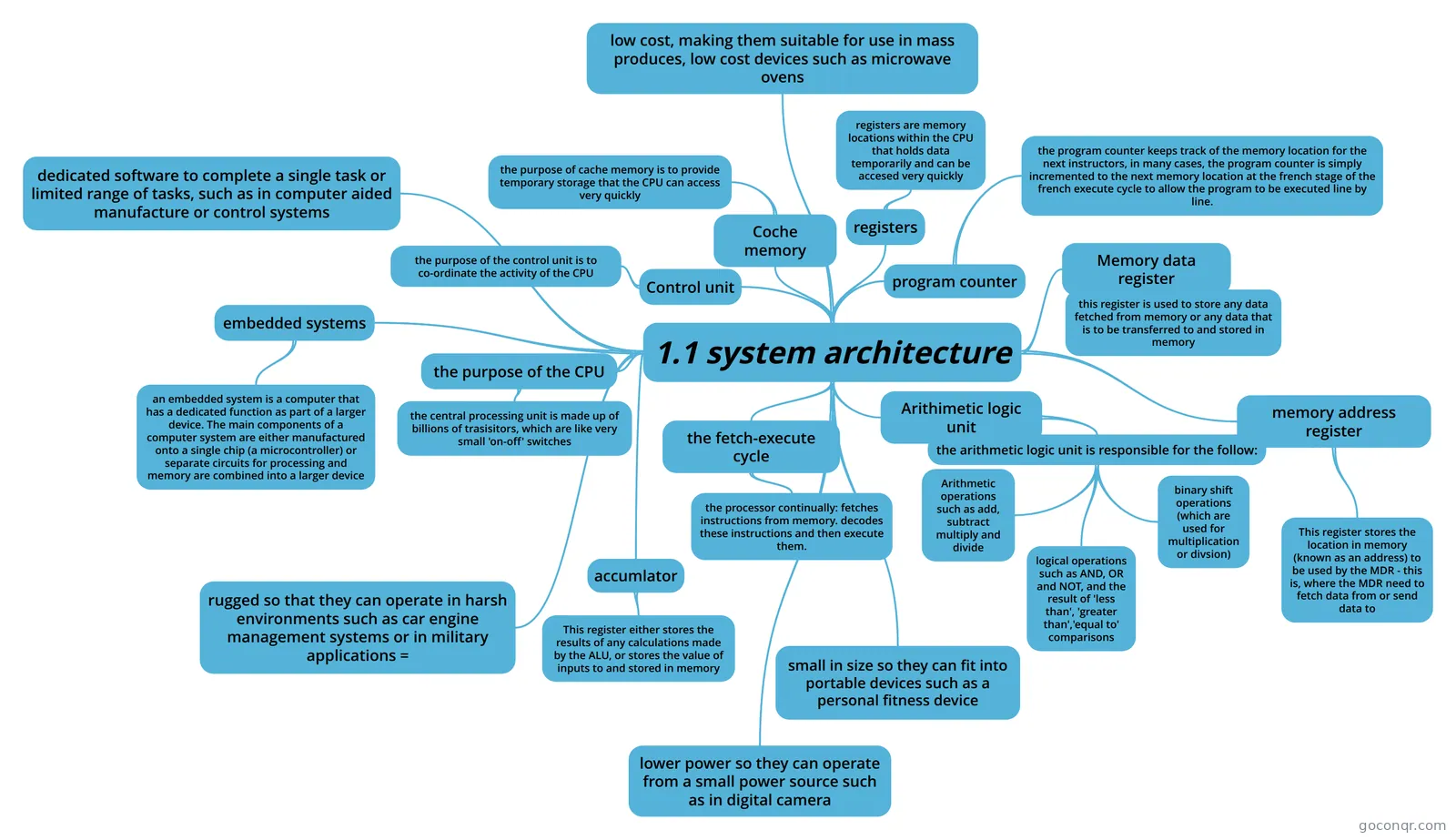
Mind map: system architecture
Map content
1.1 system architecture
the purpose of the CPU
- the central processing unit is made up of billions of trasisitors, which are like very small 'on-off' switches
the fetch-execute cycle
- the processor continually: fetches instructions from memory. decodes these instructions and then execute them.
Arithimetic logic unit
- the arithmetic logic unit is responsible for the follow:
- Arithmetic operations such as add, subtract multiply and divide
- logical operations such as AND, OR and NOT, and the result of 'less than', 'greater than','equal to' comparisons
- binary shift operations (which are used for multiplication or divsion)
- the arithmetic logic unit is responsible for the follow:
Control unit
- the purpose of the control unit is to co-ordinate the activity of the CPU
Coche memory
- the purpose of cache memory is to provide temporary storage that the CPU can access very quickly
program counter
- the program counter keeps track of the memory location for the next instructors, in many cases, the program counter is simply incremented to the next memory location at the french stage of the french execute cycle to allow the program to be executed line by line.
registers
- registers are memory locations within the CPU that holds data temporarily and can be accesed very quickly
Memory data register
- this register is used to store any data fetched from memory or any data that is to be transferred to and stored in memory
memory address register
- This register stores the location in memory (known as an address) to be used by the MDR - this is, where the MDR need to fetch data from or send data to
accumlator
- This register either stores the results of any calculations made by the ALU, or stores the value of inputs to and stored in memory
embedded systems
- an embedded system is a computer that has a dedicated function as part of a larger device. The main components of a computer system are either manufactured onto a single chip (a microcontroller) or separate circuits for processing and memory are combined into a larger device
lower power so they can operate from a small power source such as in digital camera
small in size so they can fit into portable devices such as a personal fitness device
rugged so that they can operate in harsh environments such as car engine management systems or in military applications =
low cost, making them suitable for use in mass produces, low cost devices such as microwave ovens
dedicated software to complete a single task or limited range of tasks, such as in computer aided manufacture or control systems
Information
- Description
- Mind Map on 1.1 system architecture, created by kian barretto on 05/10/2020.
- Created by
- kian barretto
- Views
- 0
- Rating