
Mind map
CLIL
Map content
CLIL
Language policy
- In 1995 The European Council stated that linguistic policy should be based on Plurilingualism
- All EU citizen should be able to speak 2 languages
- In 1995 The European Council stated that linguistic policy should be based on Plurilingualism
History
- Content-based Learning
- Parents in Ancient Rome educated their children in Greek, seeing it as more prestigious
- British children (usually girls) complete their education through the medium of French
- 1950's French was consider to be superior living language for academic study
- 1970's and 1980's
- Immerssion Learning Began as a result of English-speaking parentsliving in Quebec who considered that proficiency in French was vital in a French-speaking environment
- The acronym CLIL was defined in 1994 and launched in 1996 by UNICOM
- Subjects are taught through a foreign language with dual-focused aims, namely the learning of content, and simultaneous learning of a foreign language.
- Post modern era, emerged the term ELF. English as a Lingua Franca
- English became a core skill
- TEACHING ENGLISH AS A FOREIGN LANGUAGE became an industry
- The central question is : What is the content of language teaching?
- Grammar translationist: content was language itself
- Humanists: content should be personalized
- Standard EFL textbooks began
- Each chapter would possesed a linguistic objective
- Encourage student to talk about his feelings
- Each chapter would possesed a linguistic objective
- Standard EFL textbooks began
- How do we decide on content?
- The basic twin principles for course desing are:
- Selection
- The utility of a body of content
- Grading
- Content's learnability
- Selection
- The basic twin principles for course desing are:
- The central question is : What is the content of language teaching?
- TEACHING ENGLISH AS A FOREIGN LANGUAGE became an industry
- English became a core skill
- Content-based Learning
Curriculum Constrains
- Context in secondary education, the objective is to teach the subject content
- Conceptual Objective
- Context in secondary education, the objective is to teach the subject content
Definition
- Content and Language Integrated Learning (CLIL)
- Dual-focused educational context in which an additional language,is used as a medium in the teaching and learning of non-language content
- attention may be predominantly on either subject-specific content or language, both are always accommodated.
- Dual-focused educational context in which an additional language,is used as a medium in the teaching and learning of non-language content
- Content and Language Integrated Learning (CLIL)
Content
- how a curriculum can be divided up
- Depends on the time, culture and the politics of any given nation, nation-state or autonomous region
- A more modern interpretation of content is to see it as all-encompassing, so that a particular skill becomes an integral part of the total content. It is ‘Procedural Content’
- 3 sections or blocks
- Concepts
- Procedures/ skills
- Attitudes
- Depends on the time, culture and the politics of any given nation, nation-state or autonomous region
- Real Content
- continuity
- Conceptual Content
- sequencing
- how a curriculum can be divided up
Task- product or process?
- Prabhu
- Procedural Syllabus
- List of relevant skills or cognitive operations
- Procedural Syllabus
- Nunan
- Task-based syllabus
- It is product oriented
- Emphasizing the learning outcomes
- It is product oriented
- Task-based syllabus
- Prabhu
Bloom's Taxonomy
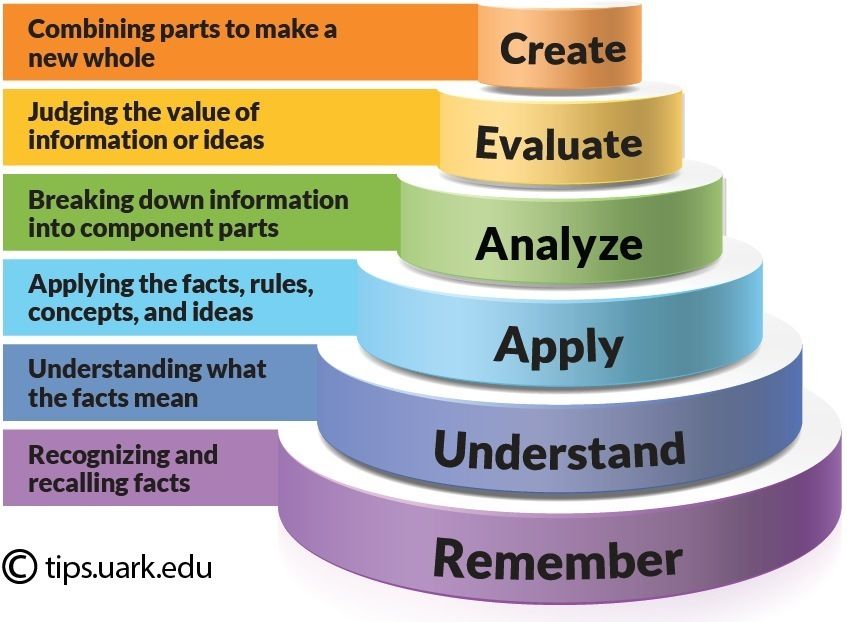
- Benjamin Bloom came up with his famous ‘taxonomy’, of educational objectives published in 1956.
- divided educational objectives into 3 domains
- affective
- psychomotor
- cognitive
- Thinking skills
- higher order
- Low order
- Thinking skills
Wilkin's distinction between
- Synthetic
- the traditional grammatical syllabus
- It's units are different elements of language, taught separately
- the traditional grammatical syllabus
- Analytic
- It's based on the task as a unit; the learner is exposed to target language hollistically in large chunks
- Synthetic
Communicative Language Teaching
- 3 trends
- Communicativeness
- Activities that promote real communication
- tasks
- Activities that create the need for meaningful language use
- Meaningfulness
- if the language is used in an activity is meaningful to the learner, the learning process will be more effective
- Communicativeness
- 3 trends
Bibliography: For the information/quotes taken from the anthology given. Class Anthology (2020). IEXPRO University.
Images and files in the map





Information
- Description
- Mind Map on CLIL, created by Yuridia Galán on 29/11/2020.
- Created by
- Yuridia Galán
- Views
- 0
- Rating