
Mind map
Tectonic Hazard Management
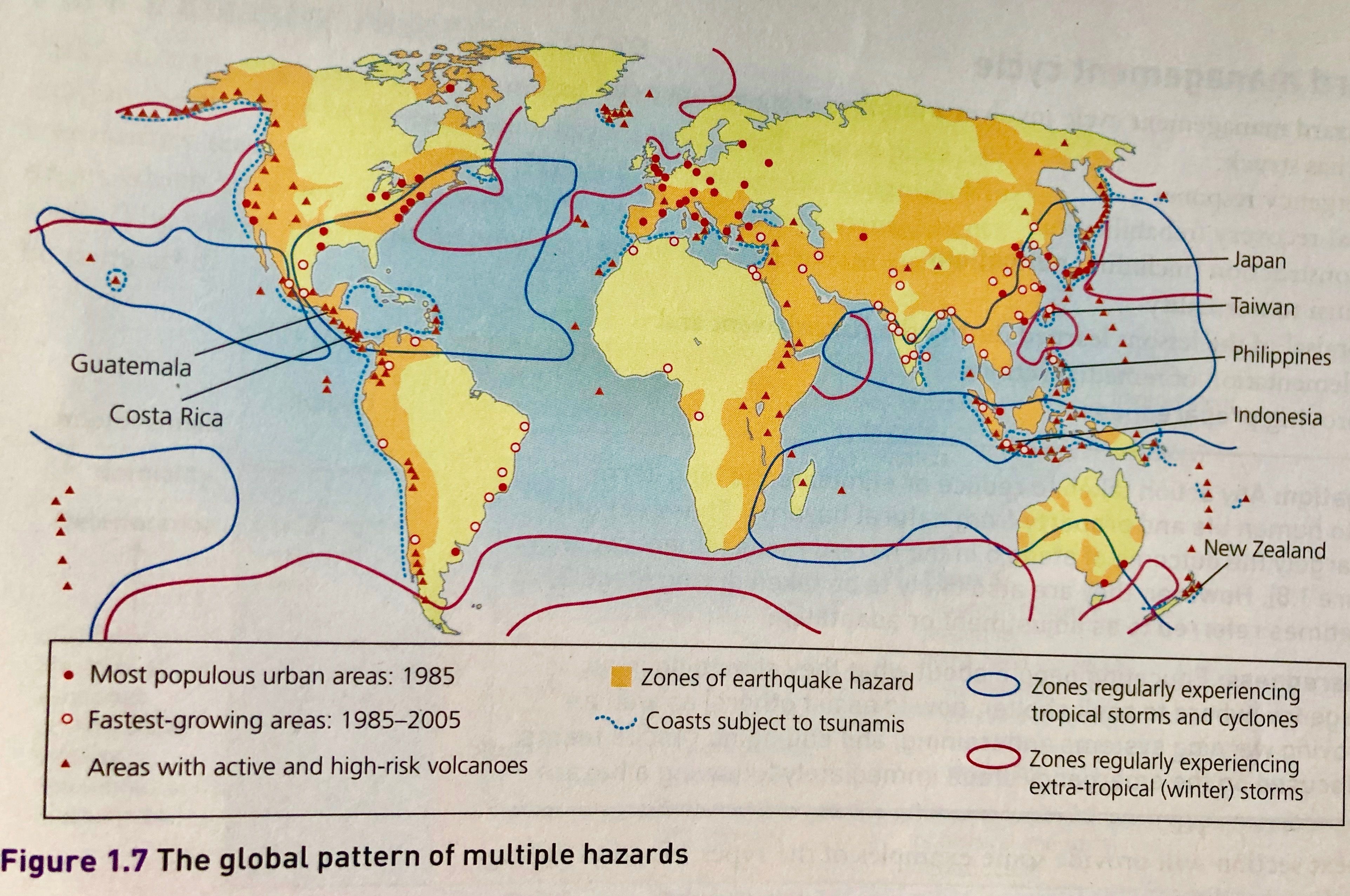
Map content
Tectonic Hazard Management
Trends and Patterns
- Few tectonic hazards turn into disasters. Since 1980, the annual number of geophysical events involving loss (life, property) have remained stable but meteorological and hydrological events have increase (2015) and occur more regularly.
- Geophysical events - earthquake, tsunami, volcanic activity
- Meteorological events - tropical storm, convective storm, local storm
- Hydrological events - flood, mass movement
- Climatological events - extreme temperatures, drought, wildfire
- Data of hazards has to be treat with caution:
- no universally agreed definition of a 'disaster'
- smaller events in remote locations often aren't recorded
- disaster deaths and damage are sometimes under-recorded for political reasons
- mega-disasters can distort trends in disaster losses (e.g. 2004 Asian tsunami, 2010 Iceland disaster, 2011 Japanese tsunami)
- Countries can be exposed to multiple hazards. 5 = Ecuador, Philippines. 4 = Taiwan, Japan. 3= Vanuatu.
- Hazard Hotspots - locations that are extremely disaster prone for a number of reasons. Usually for the fact that they experience more than one type of natural hazard
- Few tectonic hazards turn into disasters. Since 1980, the annual number of geophysical events involving loss (life, property) have remained stable but meteorological and hydrological events have increase (2015) and occur more regularly.
Prediction and Management
- Prediction is always the strarting point to trying to prevent the amount of damage caused by disasters
- The Hazard Management Cycle (involves multiple stages that happen once the hazard has struck)
- 1.Emergency response
- 2. Initial recovery (rehabilitation)
- 3. Reconstruction (including mitigation)
- 4. Return to normality
- 5. Appraisal of the lessons learned during the event and implementation of remedial actions
- 6. Improving preparedness
- Mitigation - any action taken to reduce or eliminate the long-term risk to human life and property from natural hazards
- Preparedness - educating people about what they should do in an emergency (e.g. where to shell shelter and how to assist), improving warning systems and training, equipping rescue teams. More focused on the emergency stage immediately after the hazard