
Mind map
4. Sentence Processing
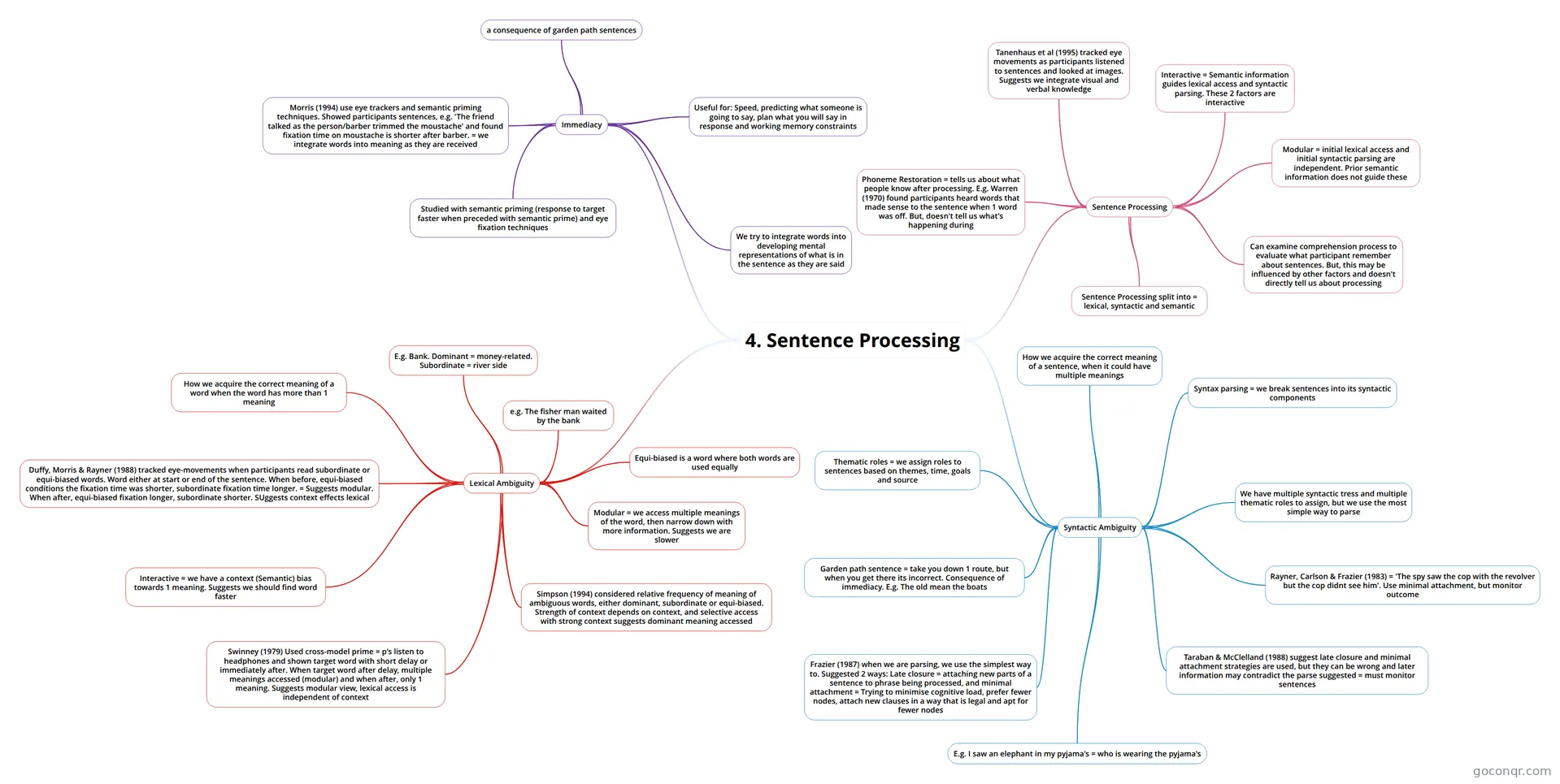
Mind map: Sentence processing
Map content
4. Sentence Processing
Sentence Processing
- Sentence Processing split into = lexical, syntactic and semantic
- Modular = initial lexical access and initial syntactic parsing are independent. Prior semantic information does not guide these
- Interactive = Semantic information guides lexical access and syntactic parsing. These 2 factors are interactive
- Can examine comprehension process to evaluate what participant remember about sentences. But, this may be influenced by other factors and doesn't directly tell us about processing
- Phoneme Restoration = tells us about what people know after processing. E.g. Warren (1970) found participants heard words that made sense to the sentence when 1 word was off. But, doesn't tell us what's happening during
- Tanenhaus et al (1995) tracked eye movements as participants listened to sentences and looked at images. Suggests we integrate visual and verbal knowledge
Immediacy
- We try to integrate words into developing mental representations of what is in the sentence as they are said
- Useful for: Speed, predicting what someone is going to say, plan what you will say in response and working memory constraints
- Studied with semantic priming (response to target faster when preceded with semantic prime) and eye fixation techniques
- a consequence of garden path sentences
- Morris (1994) use eye trackers and semantic priming techniques. Showed participants sentences, e.g. 'The friend talked as the person/barber trimmed the moustache' and found fixation time on moustache is shorter after barber. = we integrate words into meaning as they are received
Lexical Ambiguity
- How we acquire the correct meaning of a word when the word has more than 1 meaning
- e.g. The fisher man waited by the bank
- E.g. Bank. Dominant = money-related. Subordinate = river side
- Equi-biased is a word where both words are used equally
- Interactive = we have a context (Semantic) bias towards 1 meaning. Suggests we should find word faster
- Modular = we access multiple meanings of the word, then narrow down with more information. Suggests we are slower
- Duffy, Morris & Rayner (1988) tracked eye-movements when participants read subordinate or equi-biased words. Word either at start or end of the sentence. When before, equi-biased conditions the fixation time was shorter, subordinate fixation time longer. = Suggests modular. When after, equi-biased fixation longer, subordinate shorter. SUggests context effects lexical
- Swinney (1979) Used cross-model prime = p's listen to headphones and shown target word with short delay or immediately after. When target word after delay, multiple meanings accessed (modular) and when after, only 1 meaning. Suggests modular view, lexical access is independent of context
- Simpson (1994) considered relative frequency of meaning of ambiguous words, either dominant, subordinate or equi-biased. Strength of context depends on context, and selective access with strong context suggests dominant meaning accessed
Syntactic Ambiguity
- How we acquire the correct meaning of a sentence, when it could have multiple meanings
- Syntax parsing = we break sentences into its syntactic components
- Thematic roles = we assign roles to sentences based on themes, time, goals and source
- E.g. I saw an elephant in my pyjama's = who is wearing the pyjama's
- We have multiple syntactic tress and multiple thematic roles to assign, but we use the most simple way to parse
- Rayner, Carlson & Frazier (1983) = 'The spy saw the cop with the revolver but the cop didnt see him'. Use minimal attachment, but monitor outcome
- Garden path sentence = take you down 1 route, but when you get there its incorrect. Consequence of immediacy. E.g. The old mean the boats
- Frazier (1987) when we are parsing, we use the simplest way to. Suggested 2 ways: Late closure = attaching new parts of a sentence to phrase being processed, and minimal attachment = Trying to minimise cognitive load, prefer fewer nodes, attach new clauses in a way that is legal and apt for fewer nodes
- Taraban & McClelland (1988) suggest late closure and minimal attachment strategies are used, but they can be wrong and later information may contradict the parse suggested = must monitor sentences
Information
- Description
- Year 1 Language and Memory Mind Map on 4. Sentence Processing, created by Lucy Owen on 08/05/2021.
- Created by
- Lucy Owen
- Views
- 2
- Rating
More on Speech Perception and Language Comprehension