
Mind map
Modal Verbs
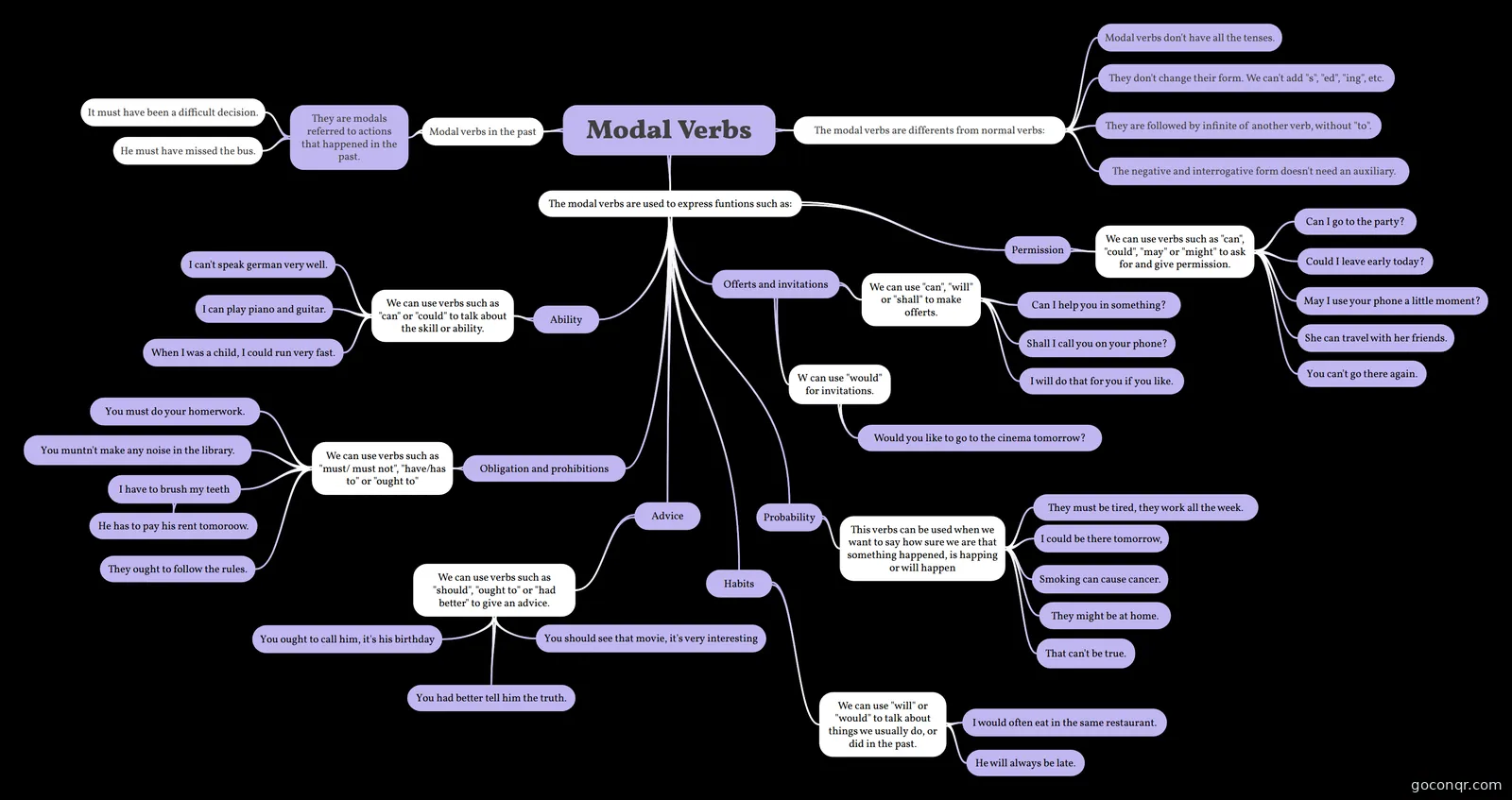
Mind map: Modal verbs
Map content
Modal Verbs
The modal verbs are used to express funtions such as:
- Ability
- We can use verbs such as "can" or "could" to talk about the skill or ability.
- I can't speak german very well.
- I can play piano and guitar.
- When I was a child, I could run very fast.
- We can use verbs such as "can" or "could" to talk about the skill or ability.
- Permission
- We can use verbs such as "can", "could", "may" or "might" to ask for and give permission.
- Can I go to the party?
- Could I leave early today?
- May I use your phone a little moment?
- She can travel with her friends.
- You can't go there again.
- We can use verbs such as "can", "could", "may" or "might" to ask for and give permission.
- Probability
- This verbs can be used when we want to say how sure we are that something happened, is happing or will happen
- They must be tired, they work all the week.
- I could be there tomorrow,
- Smoking can cause cancer.
- They might be at home.
- That can't be true.
- This verbs can be used when we want to say how sure we are that something happened, is happing or will happen
- Obligation and prohibitions
- We can use verbs such as "must/ must not", "have/has to" or "ought to"
- I have to brush my teeth
- He has to pay his rent tomoroow.
- You must do your homerwork.
- They ought to follow the rules.
- You muntn't make any noise in the library.
- I have to brush my teeth
- We can use verbs such as "must/ must not", "have/has to" or "ought to"
- Advice
- We can use verbs such as "should", "ought to" or "had better" to give an advice.
- You ought to call him, it's his birthday
- You should see that movie, it's very interesting
- You had better tell him the truth.
- We can use verbs such as "should", "ought to" or "had better" to give an advice.
- Habits
- We can use "will" or "would" to talk about things we usually do, or did in the past.
- He will always be late.
- I would often eat in the same restaurant.
- We can use "will" or "would" to talk about things we usually do, or did in the past.
- Offerts and invitations
- We can use "can", "will" or "shall" to make offerts.
- Can I help you in something?
- Shall I call you on your phone?
- I will do that for you if you like.
- W can use "would" for invitations.
- Would you like to go to the cinema tomorrow?
- We can use "can", "will" or "shall" to make offerts.
- Ability
The modal verbs are differents from normal verbs:
- They don't change their form. We can't add "s", "ed", "ing", etc.
- They are followed by infinite of another verb, without "to".
- The negative and interrogative form doesn't need an auxiliary.
- Modal verbs don't have all the tenses.
Modal verbs in the past
- They are modals referred to actions that happened in the past.
- It must have been a difficult decision.
- He must have missed the bus.
- They are modals referred to actions that happened in the past.
Information
- Description
- Mind Map on Modal Verbs, created by Catalina Martinez Martinez on 20/05/2021.
- Created by
- Catalina Martinez Martinez
- Views
- 10
- Rating